

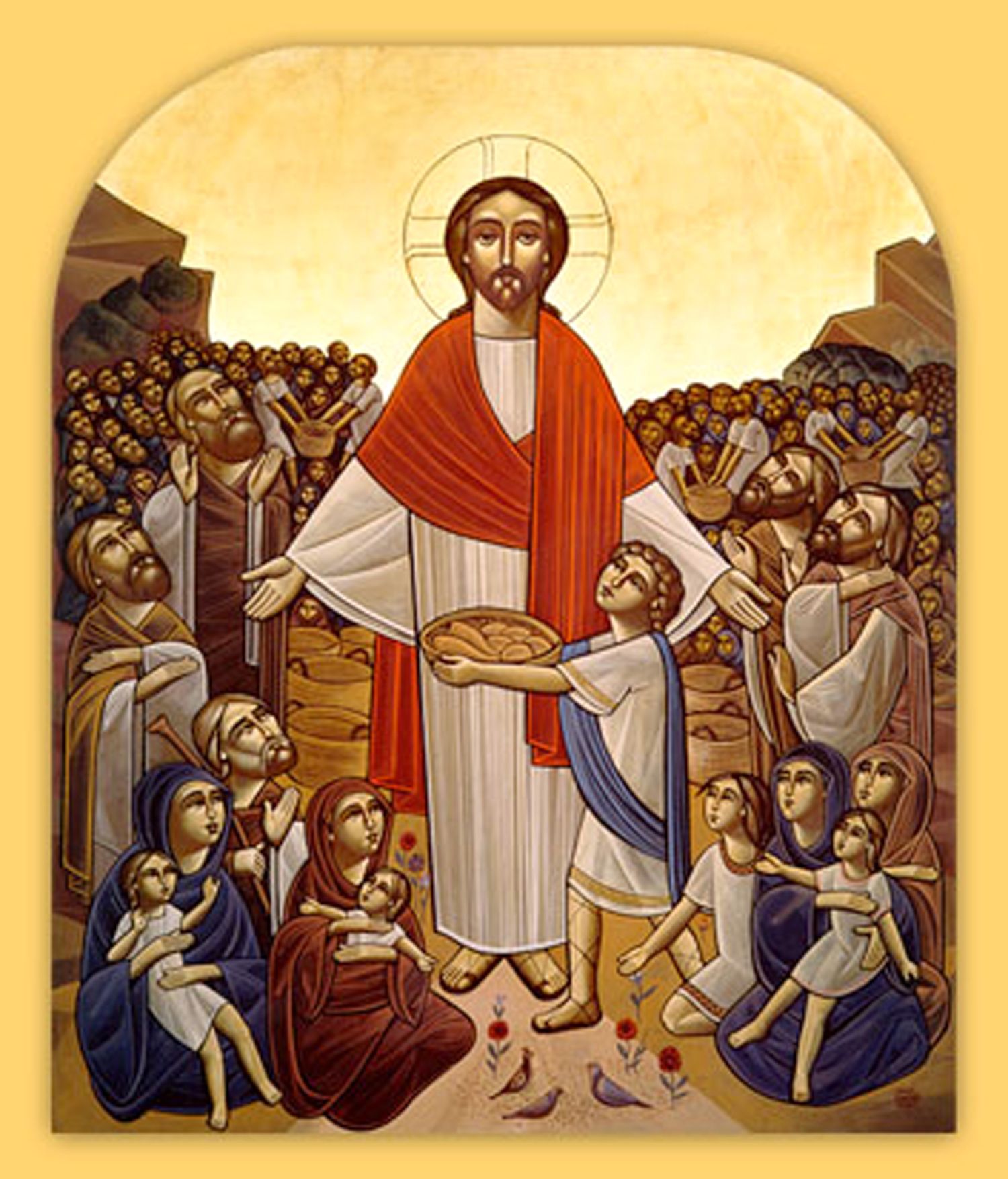
Image Credit: Image Credit: Christ Feeding the Multitude, icon, 20th century, https://commons.wikimedia.org/wiki/File:Christ_feeding_the_multitude.jpg
Proper 13 (18), Year A
2 August 2026
Genesis 32:22-31 and Psalm 17:1-7, 15
Romans 9:1-5
Matthew 14:13-21
The story of the feeding of the 5000 is told in all four Gospels. It is a wonderful story that has meaning beyond the occurrence on that particular day. It reaches back to the wandering of God’s people in the wilderness and God’s provision of manna and quails, it connects to Jesus’ own hunger at the beginning of his ministry when the devil tempts Jesus to turn stones into bread to which Jesus replies that before we are sustained by bread, we are sustained by the word of God, and finally, the story alludes to the last supper, to Jesus as the bread of life, and to the heavenly banquet.
And so the story puts before us the horizon of God’s goodness and of God’s providing.
This is an important story for us because too often we are the disciples in the story. We send people away and feel charitable about it. We send them away because we think we have nothing to give, and we feel good about it because our sending them away is to show that we care about their well-being. The disciples said to Jesus, This is a deserted place, and the hour is now late; send the crowds away so that they may go into the villages and buy food for themselves.
But nowhere does Jesus say that God helps those who help themselves. That is our excuse.
Yet it is easy to think and feel that way when the world seems overwhelming and when the church seems diminished. Even if we do not pine for the good old days, many of us still remember them. We remember when the church was full, when the Sunday School was bursting at the seams, when we built this church, when we paid off the mortgage, and so we wonder what we can do.
However, the story of the feeding of the 5000 is told to people like us, people who feel overwhelmed and who wonder what they can do.
And that’s where we usually begin. We begin with the question of what we can do in light of what must be done. But that puts all responsibility and all pressure on us, as if we could save the world. We know that we cannot save the world, we know that saving is God’s work, but still it is how we look at things.
But this is not how the story goes.
The disciples were a fledgling group, John the Baptist had been murdered and Herod thinks that Jesus is John risen from the dead. In this the story shows the fear of Herod. It also shows Herod’s enmity to John and Jesus. That is the setting of the story.
But the story begins with the compassion of Jesus, which means that the story begins with Jesus.
It is important that the story begins with Jesus, because this shifts the centre of the story away from us and toward Jesus. If we, if humanity, were the centre of the story, as the world is often tempted to think, then all the pressure is on us, and some of us cave under pressure and others avoid pressure, as in … send the crowds away so that they may go into the villages and buy food for themselves. Making us the centre of the story helps no one.
But the story begins with Jesus, and Jesus offers compassion. Compassion is a composite word, consisting of com and passion, meaning to suffer with. That is not pity of one who deems himself above others but it is divine solidarity with our human plight of life after the fall. The One who took on our nature and our lot suffers with us.
Jesus is indeed Emmanuel, God is with us, and being with us is what God most desires, and so Jesus is with the people who seek him. He does not send them away.
When in this story I consider the people seeking Jesus, they had walked a long way along the shore to get to Jesus, I notice that the crowd seeking Jesus is a mirror image of Jesus – alone on the lake – seeking the Father. They seek the face of God as Jesus seeks the face of God, except that perhaps they did not know that Jesus is God, nor – as John tells us in his gospel – that Jesus is the bread of life.
Now it is true that in the story, Jesus answers the disciples, They need not go away; you give them something to eat. But Jesus does not say this for the disciples to fix the problem, or to make them the centre of the story, rather, he invites their participation into what God is doing in and through him. The disciples don’t multiply the loaves or the fishes, the disciples merely bring their gifts to Jesus who blesses them, and then they take these gifts that have been blessed to the people. That Jesus does all the heavy lifting does not leave the disciples as bystanders or extras, their presence and participation is needed.
None of that has changed in the last 50 years, nor in the last 2000 years, regardless of the size and wealth or poverty of the church. Whether the church was small, poor, and persecuted, or large and affluent, the Church was never the centre of the story, Jesus was and is, and because Jesus is the centre of the story we need not throw up our hands thinking that there is nothing for us to do, because the big job is God’s anyway, always has and always will be, and God gives from God’s abundance. If only we had eyes to see!
This is an important shift in perspective because it saves us from being overwhelmed and it frees us to bring our gifts to God for God to bless them and then for us to distribute them.
And if this seems familiar, it is because when we are hungry and come to the table, we may bring the gifts forward (as we used to), or bake the bread, or distribute the bread and the wine but it is God who blesses the gifts and it is God who gifts Godself, who comes to us in bread and wine.
A few years ago Bishop Greg quoted a newly ordained pastor who had said they were tired of hearing about the days when the church was full and instead they wanted the Church to contemplate the life of the Church today. But it’s not about today versus yesterday. It is about God as the centre of our lives, God who does all the heavy lifting, God who provides, and who wants all to be saved (1 Timothy 2:4), for that is God’s gracious will.
Amen.