

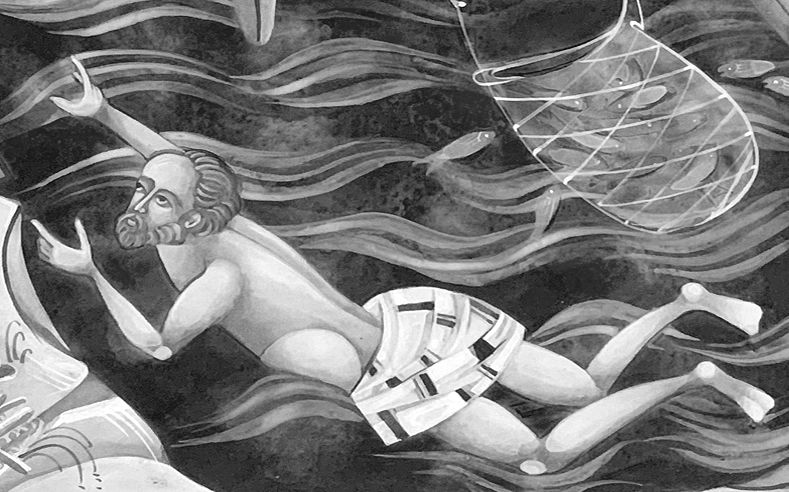
Image Credit: Peter Walking on Water(2008 ) by Mary Jane Miller, taken from her collection Life in Christ 2021, Knowledge of God made visible in Jesus the Man.
The artist has granted permission for the non-commercial use of this image with attribution. From Art in the Christian Tradition, a project of the Vanderbilt University Divinity Library, Nashville, TN. https://act.library.vanderbilt.edu/artworks/59763 [retrieved August 2, 2026]. Original source: Mary Jane Miller, https://www.millericons.com/.
Way of Doing and Way of Faith Romans 10 Verses 5 – 15, sermon by Ron Vonk
Proper 14 (19), Year A
9 August 2026
Genesis 37:1-4, 12-28
Psalm 105: 1-6, 16-22, 45b
Romans 10:5-15
Matthew 14:22-33
Sometimes people ask confusing questions. When people ask me confusing questions that I need to answer, I either ask them to repeat the question or maybe I ask them to ask the question differently to help me understand the question. Even after that, I am sometimes still confused.
In our reading from Romans 10 this morning the apostle Paul tells us not to ask 2 questions that confused me. First, Paul tells us not to ask, “Who will ascend into heaven?” Second, Paul tells us not to ask, “Who will descend into the abyss?” I was not tempted to ask either of Paul’s questions.
Paul adds to our confusion when Paul then asks, “What does it say?” We in turn want to ask Paul, “What does it say where, Paul?” Then Paul quotes words presumably from the Old Testament. “The word is near you, in your mouth and in your heart.” We are not sure how these words relate to our 2 puzzling questions.
The challenge for us who live 2,000 years after Paul wrote his letter to the Romans is that we are not familiar with the form of Paul’s argument and we are not familiar with the Old Testament verses that Paul quotes throughout our short reading from Romans. My hope this morning is for us to become more familiar with the shape of Paul’s argument and that we become more familiar with the words Paul quotes from the Old Testament.
I am thankful for our weekly lectionary readings from the Old Testament, from the Psalms, from the epistles and finally from the gospels. Our lectionary readings help us become better acquainted with the world of the early church and the world of the Old Testament. This morning’s readings also help us to better understand why Paul tells us not to ask his 2 puzzling questions.
So brace yourselves, we will do an overview of our scripture readings this morning and we will visit those parts of the Old Testament that Paul quotes in our reading from Romans 10. Our goal is to understand why Paul tells us not to ask his two puzzling questions.
Our Genesis reading is part of a larger story from the life of Jacob and his 12 sons. The 12 sons know right from wrong. Their parents taught them right from wrong. But their knowledge of right and wrong does not help them overcome their hatred of their younger brother Joseph. Joseph is their father’s favorite. The other sons hate Joseph because of this favoritism. When these sons have an opportunity to kill Joseph they act on their hatred. But since Joseph is their brother they instead sell Joseph to slave traders. The slave traders bind Joseph’s feet, put a collar of iron around his neck and force Joseph to trudge behind them to be sold as a slave in Egypt. We are shocked by the level of violence in this family.
This morning we also chanted parts of Psalm 105. Psalm 105 tells the story of Joseph differently. The brothers meant Joseph harm but at the same time God sent Joseph ahead of his brothers to deliver the brothers and their families from a severe famine. God’s grace prevails. God, because of His grace, provides for this family’s deliverance. God provides what this family needs in spite of the evil perpetrated by the brothers against Joseph. It is no wonder the Psalm ends with words of worship. “Hallelujah!” “Praise the Lord” is a fitting response to God’s actions.
Our gospel reading centers on the apostle Peter. Peter has spent time with Jesus. Peter was a fisherman. But when Peter met Jesus, Jesus told Peter that Jesus would make Peter fish for people. In our gospel reading we watch Peter and the other disciples at night, struggling in a small fishing boat battered by waves in the middle of a lake during an unexpected storm.
Early in the morning Jesus comes walking toward the disciples. The disciples think they see a ghost – an evil spirit. The disciples cry out in fear. Jesus addresses their fear with these words: “Take heart, it is I (here Jesus speaks the name of God), do not be afraid.”
For Peter the fear does not go away. Yes, Peter boldly asks Jesus to come to Jesus on the water. Peter takes a few steps toward Jesus. But then Peter feels the wind and sees the waves and Peter sinks into the water. Fear comes back to the surface. Jesus reaches out his hand to catch the drowning Peter. Peter doubts. We can all relate to both Peter’s fear and Peter’s doubt. Peter is safe in spite of his fear and doubt. God’s grace again prevails.
It will not be long before Peter and the other disciples get their final lesson from Jesus. Before his crucifixion, Jesus tells the disciples; “you will all become deserters.” In reply, Peter declares, “Though all become deserters because of you, I will never desert you.” We probably know the outcome of this final lesson from Jesus. That very night, Peter 3 times denies he even knows Jesus. Again Peter is afraid as the enemies of Jesus plan the execution of Jesus. Once Peter realizes what he has done, all Peter can do is weep bitterly. Some of us have wept just like Peter.
All of us know times when we failed at doing the right thing. Yet, trying to do the right thing is our favorite way of trying to be right with God. We often know what we need to do. Yet we do the wrong thing. We have doubted and done the wrong thing. We have acted out of hatred and done the wrong thing. Doing the right thing is sometimes just too hard to do.
In our reading from Romans, Paul tells us that the way of doing the right thing did not work for Israel in the Old Testament and it will not work for us.
What is confusing for us who now read the Old Testament is that the way of doing seems to be exactly what God expected of his people in the Old Testament. And now in Romans Paul quotes from parts of a speech by Moses in the Old Testament. In his speech, Moses tells Israel to do the right thing. God through Moses tells the people, “You shall keep my statutes and my ordinances, by so doing one shall live. “Do the right thing,” says Moses. Learn God’s decrees and laws. Obey the decrees and laws. Live by these decrees. Gain knowledge in matters of religion.
Now in Romans Paul tells us not to ask the same 2 puzzling questions Moses told the Israelites not to ask 1,400 years before Paul writes his letter. Moses also told the Israelites not to ask, “Who will ascend into heaven? Moses also told them not to ask, “Who will descend into the abyss?” Moses told the Israelites not to ask these questions because Moses had just given the people God’s laws. God told the people what they needed to do. God provided all they needed to do the will of God. They did not need to do the impossible to know the will of God. They did not need to ascend into heaven to try to find the will of God. They did not need to descend into the chaos of the abyss.
Paul simply repeats the instructions from Moses not to ask our questions about doing the impossible. Paul adds his own explanations. With the first question we are not to ask, Paul adds, “that is, to bring Christ down.” With the second question, Paul adds, “that is, to bring Christ up from the dead.”
Just like Moses 1,400 years earlier, Paul tells these early Christians you do not have to do the impossible. Christ has already come down from heaven. Christ already went into the chaos of the abyss. You do not need to go and get Christ. Jesus is alive!
Both Paul and Moses tell us God has provided all that we need. We do not have to do the impossible. God has always made demands on His people on the one hand but God has also always provided God’s grace for our deliverance. Our relationship with God was never a matter of human effort. God provides what we need without our efforts.
If it is not a matter of doing, how do I get right with God? The answer to this question is the way of faith. Paul explains the way of faith simply as the word near us. It is a word of trust in God who has provided exactly what we need in order to have a relationship with God. The gospel is near because it requires only what our hearts and mouths can do. When we confess with our mouth that Jesus is Lord and believe in our heart that God raised Jesus from the dead, we are brought near to God.
These words from Paul are again exactly a repeat of what Moses told the people of Israel 1,400 years earlier. Moses also said to the people of Israel, “the word is very near you, it is in your heart and in your mouth for you to observe. Ancient Israelites confessed with their mouths their response to a word from God. They did not need to do anything. They simply believed and confessed that belief with their mouths. They trusted God. God did for them as God has now done for us what we could never do for ourselves.
The final lesson from Romans this morning is that salvation is available to any and all people in all circumstances. We can all be brought near to God. Salvation was also available to ancient Israelites in 2 of the darkest times in their history. It is available to us even when we have done wrong things because of jealousy, fear, or simple selfishness. Paul finishes with two words of hope from Israel’s darkest times.
The first word of hope is from the prophet Isaiah. Isaiah spoke his words to a nation of self-indulgent alcoholics. The rich had lots of food and wine. They squandered and abused their lives. And it was not just the rich. Religious leaders – prophets and priests – gave themselves to self-indulgent drinking.
We expect Isaiah to threaten these self-indulgent rich people and their religious leaders. Yes, at times Isaiah rebukes them. But this time, Isaiah offers a reliable alternative to the madness of the rich people and their leaders. Isaiah calls his alternative a precious cornerstone. Paul identifies Jesus as this cornerstone. Isaiah and Paul tell us that that no one who believes in this cornerstone will be put to shame. Isaiah has a word of hope for self-indulgent alcoholics.
Paul’s second word of hope is from the time of the prophet Joel. Joel spoke to the people of Judah in the middle of a farming crisis. Grasshoppers ate all the farmers’ crops. There was nothing left to eat. The people were starving.
Joel prophesied during a time of prosperity. Judah had a strong army. The economy was booming. But there were problems even before the grasshopper plague. The people did all the right religious things. But they were only going through the motions. Their hearts were not in it.
We expect Joel to warn the people. Joel does warn them about how this kind of life will end up but Joel also gives the people a word of hope. Joel tells them, “everyone who calls on the name of the Lord shall be saved.” Joel means everyone – soldiers in the army, business people and farmers, rich and poor, everyone who calls on the name of the Lord will be saved.” The apostle Paul simply repeats Joel’s word of hope. “Everyone who calls on the name of the Lord shall be saved.”
Many of us work hard to be competent at what we do – whether that be farming, teaching, plumbing, accounting or being a good parent or grandparent. We work hard. But all our hard work cannot repair our broken relationship with God. And when it comes to broken relationships with other people we also need help. God provides the needed help.
Those of us who have struggled with the jealousy of Joseph’s brothers, the fear of the apostle Peter, the alcoholism of the Israelites in Isaiah’s time, or maybe times when our hearts were just not in it like the people of Judah in Joel’s time, realize we cannot earn our salvation. We need God’s actions on our behalf. Thankfully, God has acted and God continues to act on our behalf.
With the ancient writers of the Old Testament and with the apostles, we can only respond in worship.
Praise be to you, O Christ.