

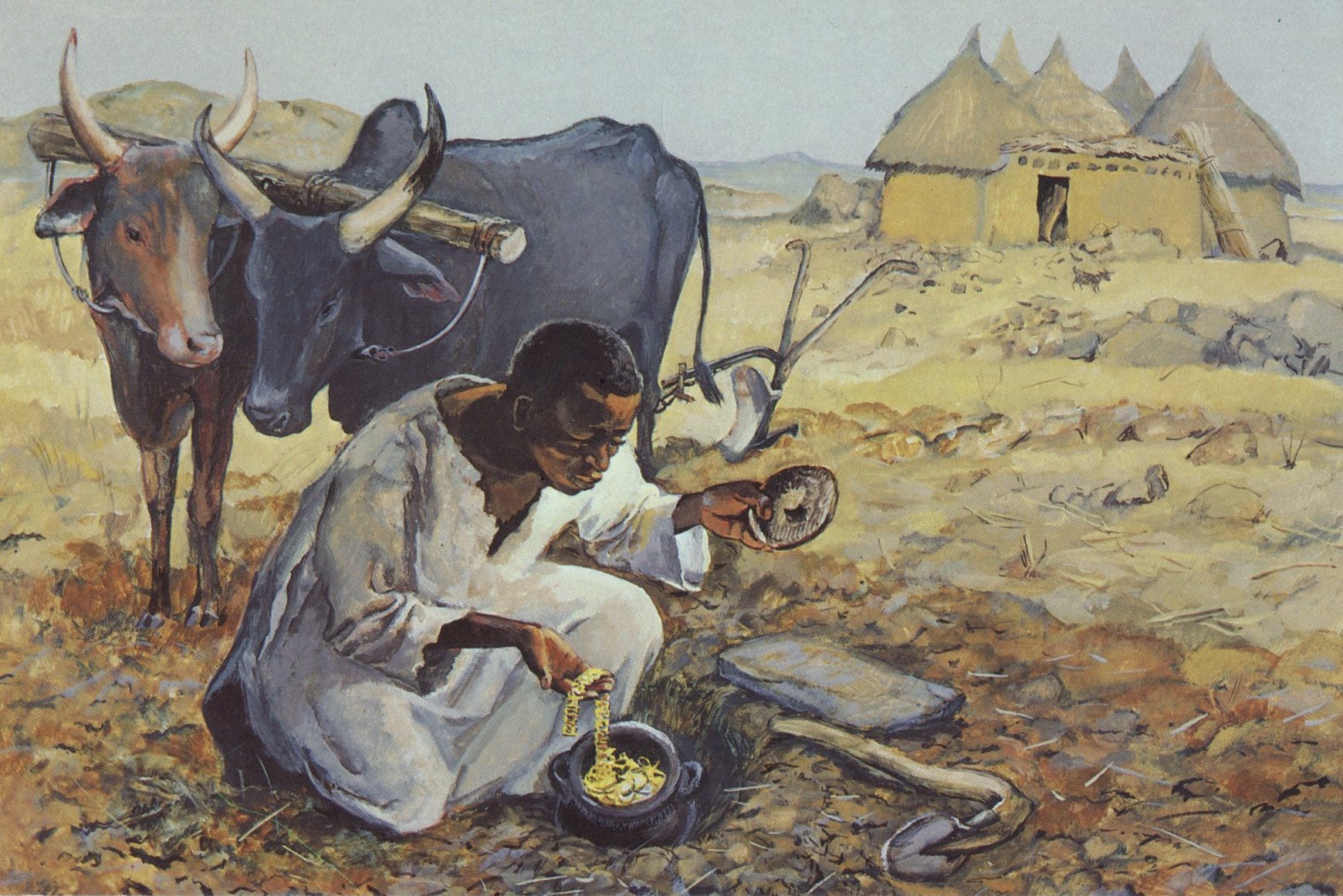
Image Credit: Jesus Mafa, The Hidden Treasure, Cameroon 1973
From Art in the Christian Tradition, a project of the Vanderbilt Divinity Library, Nashville, TN. https://diglib.library.vanderbilt.edu/act-imagelink.pl?RC=48286 [retrieved July 23, 2026]. Original source: http://www.librairie-emmanuel.fr (contact page: https://www.librairie-emmanuel.fr/contact).
Proper 12 (17), Year A
26 July 2026
Genesis 29:15-28
Psalm 105:1-11, 45b or Psalm 128
Romans 8:26-39
Matthew 13:31-33, 44-52
I am profoundly grateful for the congregation in which I was raised. It is where my faith was nurtured, where a positive vision of the Church was cast, it was a place that made me think – including about its theology and practice, where my friends were, where I first went on a silent retreat and learned that one can pray without words, or few words, or just listen for the voice of God, where I learned to understand the importance of the sacraments, mostly because even in those days we celebrated Holy Communion every week and I began receiving when I was a child. I am also deeply grateful because the Church really was my family.
But when I graduated from high school it was time to leave. In part because I moved away to school, which necessitated finding a new congregation, in part because it can be helpful to get a different take on the Gospel, both in preaching and teaching as well as in practise.
One of the things I needed to get away from was a theology that contradicted the depth and mystery of our sacramental practices. It wasn’t cool to exclude someone from Holy Communion because they were gay or because they stayed over at their girlfriend’s, regardless of one’s sexual ethics. All that’s required to come to the table is to seek to share in the life of God. Wanting to share in the life of God opens us to God and such opening allows God to shape our life.
The society in which I grew up was as secular then as western Canada is now, and perhaps this gave those who took their faith seriously anxiety about losing one’s baptismal identity, about the culture shaping the Gospel, rather than the Gospel shaping us. But anxiety is never a good guide and this anxiety led our pastor to use the so-called Four Spiritual Laws for teaching and evangelism. These laws come out of Campus Crusade for Christ, which in Canada has changed its name to Power to Change Ministries. Bill Bright, one of its founders, had dropped out of seminary to start the organization. Not a good idea.
Perhaps you have heard of the so-called Four Spiritual Laws. I will just share the first one. It is this: “God loves you and offers a wonderful plan for your life.”
It sounds benign enough, maybe even sweet. After all, in the hymn On Eagles Wings, we sing
“And He will raise you up on eagle’s wings,
Bear you on the breath of dawn,
Make you to shine like the sun,
And hold you in the palm of His Hand.”
All this in allusion to Psalm 91.
And when in Matthew 10 Jesus speaks of the coming persecutions of his followers, he says
28Do not fear those who kill the body but cannot kill the soul; rather fear him who can destroy both soul and body in hell. 29Are not two sparrows sold for a penny? Yet not one of them will fall to the ground unperceived by your Father. 30And even the hairs of your head are all counted. 31So do not be afraid; you are of more value than many sparrows.
But knowing that nothing can snatch us out of God’s hand (John 10:29) is not the same as knowing the plan God has for my life. After high school my friends and I wondered what God wanted us to with the rest of our lives. Most people do not hear the voice of God as Moses did on Mount Sinai.
And then; we know that God’s will for us is good. However, one problem is that we do not always know what is good.
Furthermore, such questions about God’s will and God’s plan are generally framed in purely individual terms, which then leaves us with a private faith, and disconnected from what the Apostle Paul calls the Body of Christ, a body that has many members and many gifts.
Perhaps biggest problem is that this talk about God’s wonderful plan cannot explain tragedy, not our own tragedies, and not those of others. Perhaps you know of the contemporary Christian musician Brian Doerksen who died this past week. His brother told me that he suffered terribly while he continued to show love and gratitude to those who were with him. Of course, we all have to die but Brian was a year younger than I am.
Finally, the idea of God’s plan for me suggests that life is really all about me, when the Christian story is all about God. The talk of God’s plan makes me the centre of a story in which God is the centre, the ground, and the goal of all there is.
While most of us were not raised with the kind of theology that produced the so-called Four Spiritual Laws, the language of God’s wonderful plan has become part of a general culture, one expression of it is the assumption that everything happens for a reason. But how about October 7, how about Gaza, how about the 140 girls in Iran? Perhaps God really wanted me to find that parking spot, but would God not much more want the fighting in Ukraine, Russia, Sudan, Gaza, Lebanon, and the Gulf to end? After all, God is a God of peace and Jesus is the Prince of Peace. And would God not want to save people like Brian Doerksen from suffering? Fill in your own suffering and the suffering of people you know and love.
All this came to mind when I read our reading from Romans this week. I love that chapter, and who does not love verse 28 where Paul writes, We know that all things to work together for good for those who love God, who are called according to his purpose.
So, what does it mean then that all things work together for good for those who love God and are called according to his purpose?
Perhaps you noticed a brief reference I made earlier. I said that we don’t always know what is good. We don’t always know what’s good because we do not always have our eyes on God. And so we may mistake convenience, or expediency, or prosperity, or our own work ethic, or the realization of our own goals for good, worse yet for a greater good. I am not suggesting that there may not be value in some of these, but all of these come from our very own limited perspective and seek to order the world in a way in which we imagine it. Remember when in Mark’s Gospel 17(…) a man ran up and knelt before [Jesus], and asked him, ‘Good Teacher, what must I do to inherit eternal life?’ 18 Jesus said to him, ‘Why do you call me good? No one is good but God alone. (chapter 10)
This is clearly before the articulation of any trinitarian theology and thus a little confusing to us, but the point is that God is good and that God is the greatest good and that all other goods are ordered in the way they relate to God. Consequently, only in God can we know what is good.
Furthermore, when Paul asks rhetorically, what can separate us from the love of God and affirms that nothing at all can separate us from the love of God, we may notice that all the things he lists and that we think might separate us, are things that Jesus experienced and suffered, which shows us not only that there is no suffering Jesus has not experienced but also that suffering is not evidence for the absence of God. After all, it is on the cross when God’s love is fully revealed.
What does it mean then that all things work together for good for those who love God, who are called according to his purpose?
This beautiful assertion is not to discount our suffering which is real, but means that by God’s gracious will all things contribute to the final glorification of the children of God. Think of what Joseph said to his brothers, Even though you intended to do harm to me, God intended it for good … (Gen 50:20)
In a world which we do not control, by God’s gracious will all things will contribute to restoring us to the image of God, the image of his Son. This growing conformity to Jesus comes about through the presence of the Holy Spirit, and the presence of the Holy Spirit is gifted in our baptism, while receiving the bread and wine of Holy Communion allows Jesus to live in us, Jesus who became what we are so that we would become what he is.
God’s plan is not for me to drive a Mercedes Benz, to reference Janis Joplin, but the restoration of all of creation.
Thanks be to God.