

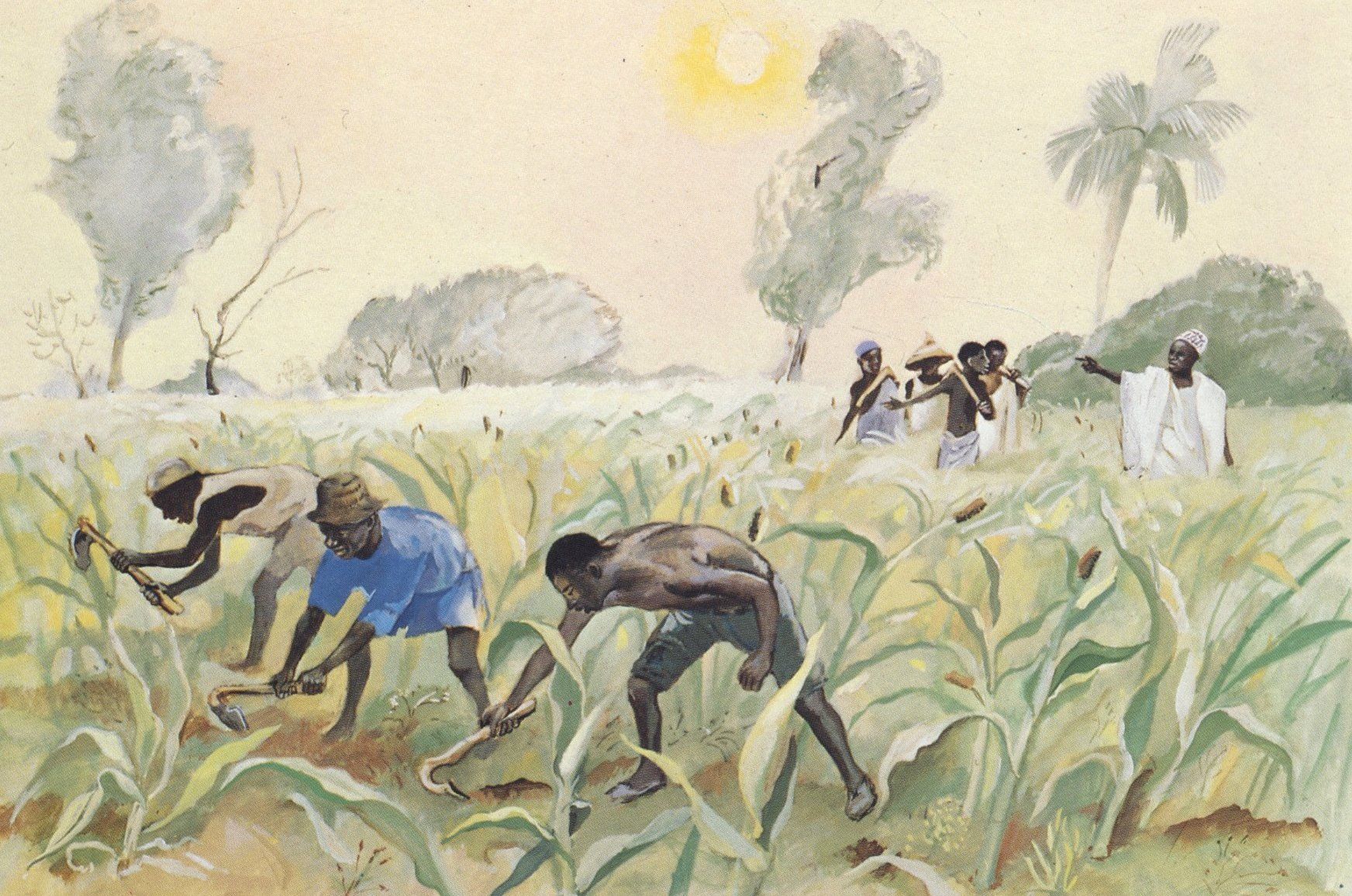
Image Credit: Late Arriving Workers, Jesus Mafa 1973 Cameroon, Africa.
Copyright Permission for non-commercial uses.
http://www.librairie-emmanuel.fr
Proper 20 (25), Year A
20 September 2026
Exodus 16:2-15
Psalm 105:1-6, 37-45
Philippians 1:21-30
Matthew 20:1-16
The Old Testament scholar Walter Brueggemann died last year. A prolific author and frequent lecturer and preacher, Brueggemann may be best known for his book “The Prophetic Imagination”. Throughout his life Brueggemann argued that the prophets of Israel established a counter narrative to that of the kings of Israel. The prophets established a counter-narrative because life in the promised land quickly began to look like life in Egypt as 95% of the population was impoverished while supporting a wealthy elite, and because the kings of Israel trusted in military alliances instead of God. And so Brueggemann argued that the church’s life and preaching must be a counter-narrative to extractive capitalism and consumerism, to militarism and exceptionalism, and to trusting in power rather than in God.
In an old interview when Brueggemann was asked about the Church’s sexuality debate, he replied “I think what has happened is that we’ve taken all of our anxiety about the old world disappearing, and we’ve dumped it all on that issue.” I have never forgotten how Brugeemann framed this in 2011, particularly as more of our old world has been disappearing since. On the occasion of Brueggemann’s death the interview was republished under the title, “When the World We Have Trusted In Is Vanishing.”1
The world we have trusted in has been vanishing for some time now as multilateral agreements are put into question, wars proliferate, environmental protections give way to economic development, civil liberties and solidarity with marginalized groups are questioned, and anger has become a political tool.
And yet for the Church the experience of a known world vanishing goes back further than the last fifteen or twenty years. In recent time it began with declining attendance, Sunday sports and shopping, and the end of mandatory collective prayer in our schools.
Those who pay attention may despair, others choose not give any of this any thought, and others yet may seek the power of the state to turn back the clock. But as people of God we need not despair, we do not want to live in ignorance, and we do not seek the power of the state to turn back the clock. We lament, which is to live with our eyes open, bringing our sorrow before God, remembering that our future is neither in nostalgia nor power, but it is in God.
The parable of the workers in the vineyard is a counter-narrative to the way the world functions and the way we generally function, which is why we have difficulty with the ending of the parable in which everyone receives equal pay, regardless of how long they have worked. And so the way we have usually explained the parable was by spiritualizing it. When I was young we said that regardless of when you began to follow Jesus, whether you have done so all your life or you have a death-bed conversion, all who believe in Jesus will go to heaven.
But there are assumptions in that interpretation that need further examination. One is has to do with our understanding of God as love and that God desires everyone to be saved (1 Timothy 2:4), so maybe all will be saved, and what does that do to the notion of hell? Or as poet Scott Cairns writes, “If – whether now or in the fullness – we stipulate that God is all in all, just where or how could you position Hell?”2
The other thing is that spiritualizing the parable makes it easy for us, for it requires nothing of us. But does Jesus tell stories in order to be easy on us, does Jesus tell stories that are not a counter-narrative? Isn’t the reason that people came to hear Jesus precisely that he spoke with authority, that his speech differed from that of the religious and other people?
Looking at the wider context we notice that the parable follows on the heels of the “Rich Young Ruler” who wanted to follow Jesus but in the end chose his possessions over discipleship, a story that is then followed by Peter’s query, Look, we have left everything and followed you. What then will we have? (Matthew 19:27)
Peter, of course, speaks for us all, for we too wonder what we will have, why should we follow Jesus; at a minimum we want to know that we will be gathered at God’s banquet table, that we will go to heaven. But does this ‘going to heaven’ have any bearing on our life today?
And we should notice that Peter’s query is reward talk, and reward talk is what Jesus answers to with the Parable of the Workers in the Vineyard in which all are given enough and all are paid the same. The disciples who had left everything to follow Jesus are not promised more than any latecomer.
And so we discover that the parable goes against our sense of justice, for we live by hard work and believe everyone should, and we would even claim St Paul as our witness who said that Anyone unwilling to work should not eat. (2 Thessalonians 3:10) But Paul was not speaking against mercy, Paul was speaking against those who take God’s grace to excuse them from discipleship, but discipleship is precisely what Jesus invites his listeners into. And so we find the Parable of the Workers in the Vineyard to be the kind of counter-narrative of the prophets, and the kind that Brueggemann implored the Church to live by, and the kind of speech we would prefer to spiritualize.
A current candidate for City Council posted on social media a recent presentation they had made to the current council. The presentation concerned below market housing. The question was whether we knew how below-market housing served those in need of housing in our city. Below market sounds good until you realize what market housing actually costs, which many of us here likely do not pay because we have been in the market for too long to be subject to it. It turns out that “below market” says very little about affordability.
When I file my taxes, I am required to submit a form that gives the equivalent rental value of our home for the CRA to assess the housing allowance I am permitted to claim. I have known for at least the last 20 years that if I had to rent our house, we would have to live somewhere else. We own a townhouse only because we entered the market 32 years ago in Winnipeg. Yet our economy requires many people who work at minimum wage who cannot afford the so-called below market rents. Remember when Tsawwassen Mills opened and the mall had to create a shuttle service for its workers who could not afford to live in Delta or Tsawwassen and did not own cars, and therefore had no means of getting to work? The parable in which everyone receives an equal wage is prescient here and offers a counter-narrative to our economy.
It is clear that some things we have little influence on if any, although I would suggest that political engagement is a lot more than voting every four years. And we cannot simply bring back a world that is vanishing.
So, if we are disheartened that the world we have trusted in is vanishing, we can find hope in the counter-narrative of the prophets and the counter-narrative of Jesus, for even if the world is a certain way, that does not mean that we have to be a certain way.
Our life as church and our lives as individuals do not have to be guided by profit and efficiency but can be guided by the common good, which includes the protection of the earth that makes our life and the lives of our children possible, it includes the protection of and solidarity with those who are poor, with those who are marginalized for whatever reason, it includes that our notions of justice are not guided by retribution but by rehabilitation and restoration, and it includes the understanding that however we live we do not live unto ourselves but that our lives must somehow support the life of the community.
This is a hopeful perspective for it shows us that while we cannot affect everything, we are not powerless. It follows Mother Teresa’s dictum “Not all of us can do great things, but we can do small things with great love.” Yet putting this into practice is not just following the wisdom of Mother Teresa, but the teaching of the Gospels.
This becomes evident when we remember that the “task of the church is not to change the world [sc. as much as we may want to], but to bear witness to the fact that the world has already definitely been changed in the life, death, and resurrection of Jesus Christ.”3
The task of the Church, our task, is not to change the world but for ourselves to live in such a way that shows that God’s reign has broken in and by such living not only to sustain our hope but to give hope to the world.
Anglican priest Sue Parfitt was on trial in the UK last week for civil disobedience that included the blocking of a highway. During cross examination the prosecution suggested that she was a ‘professional convicted criminal’, having been arrested more than 30 times. She responded, “I am honoured beyond my words to be able to do this at 84 for your children and your grandchildren.”
You are unlikely to see me block traffic on the Oak Street Bridge, but God has called the Church to give witness to the counter-narrative of the Gospel, to God’s inbreaking reign, which is about justice, and about a world in which all have enough and no one has too much. This is a beautiful calling, and it is grounded in the world God has begun to bring about in the life, death, and resurrection of Jesus.
Amen.
Let us pray for the whole people of God in Christ Jesus, and for all people according to their needs. Each petition ends with Lord, in your mercy, to which we respond, hear our prayer.
~ a brief silence ~
That we may not get lost in this new time, unsure of how to live or where to go, but may know that you are the Way, the Truth and the Life. Lord in your mercy, hear our prayer.
That as the world we have trusted in vanishing, we may know you as the Lord of all, as the Alpha and the Omega, as the beginning and the end. Lord in your mercy, hear our prayer.
That you save us from a faith that is private, a faith that seeks a private heaven. Liberate us to a faith that asks for your kingdom to come, that seeks to do your will, and that trusts in your promise to make all things new. Lord in your mercy, hear our prayer.
That our discipleship be a way of life, and that the justice we seek may be for all and may be restorative. Lord in your mercy, hear our prayer.
That you save us from a politics that mistakes anger for political argument and lead us into a politics that engages with the people of our communities. Lord in your mercy, hear our prayer.
That in confusing and worrying times, we may cast all our cares on you, trust not princes or powers but trust in you. And that by the power of your Holy Spirit we may trust you to follow you. Lord in your mercy, hear our prayer.
That in vanishing Christendom we may not give up on the Body of Christ, the Church, but that the Church be the place for us to learn your counter-narrative, practice discipleship, and witness to the fact that the world has already been changed in the life, death, and resurrection of your Son Jesus. Lord in your mercy, hear our prayer.
That our discipleship not occur for the promise of reward but for the love of you and the world you love. That where our faith requires risk, we may take risks for the sake of the world you have begun to make new through Christ’s life, death, and resurrection. Lord in your mercy, hear our prayer.
We give thanks for Michael and Sherry and the life of the Church. We give thanks that in Jesus you have made us your friends and that our friendship with you makes us friends with one another. Deepen our ties and let our lives be an expression of your friendship. Lord in your mercy, hear our prayer.
We give thanks for Kristen and for physicians, surgeons, and medical teams that have saved her. We give thanks for all who love and support her, and we give thanks that the restoration of her health is sign of your love and of her calling. Bless her as she returns to serve the people of Shepherd of the Valley in Langley. Lord in your mercy, hear our prayer.
For peace in our hearts, communities, and in the world. Lord in your mercy, hear our prayer.
Healer of our every ill, grant your healing presence to all who are ill in any way, and fill them with the joy of your presence, especially …., and all we bring before you, spoken or silently … Bless those who experience the blessing and burden of age, especially …. Bless their families also that they may have strength to accompany those they love. Lord in your mercy, hear our prayer.
All these things and whatever else you see that we need, grant us, O God, for the sake of Christ who died and rose again, and now lives and reigns with you and the Holy Spirit, one God, forever and ever. Amen.
1 On Being with Krista Tippett: Walter Brueggemann, In Memoriam – When the World We Have Trusted In Is Vanishing, 22 December 2011
2 Scott Cairns: Bad Theology: A Quiz, America – The Jesuit Review, 12 December 2005
3 Robert J. Dean, For the Life of the World: Jesus Christ and the Church in the Theologies of Dietrich Bonhoeffer and Stanley Hauerwas, Eugene, OR: 2016 Cascade Books, page 12, quoted by Rodney Clapp in Living Out Of Control – Political and Personal Faith in Waning Christendom, Minneapolis, MN: 2025 Fortress Press, page 35