

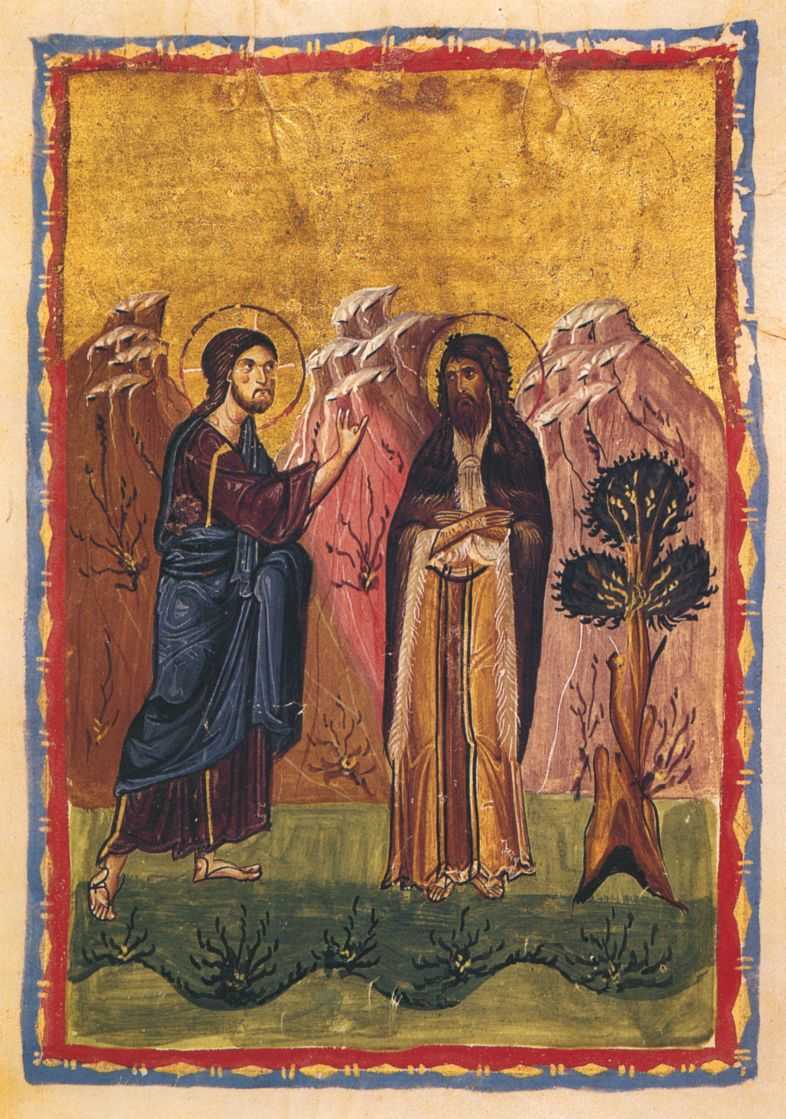
Image Credit: Jesus meets John the Baptist, Anonymous (15th century).
The work is in the public domain https://commons.wikimedia.org/wiki/File:Jesus_meets_John_the_Baptist.jpg
Prayer of the Day
God of our salvation,
we falter before the demands of your word
and turn away from your call to life.
As you showed mercy to your people of old,
pour out your mercy on us,
so that we may turn from our sinfulness
and walk the path of self-emptying love
made known in Jesus Christ,
who lives and reigns with you and the Holy Spirit,
one God, now and forever. Amen.
Proper 21 (26), Year A
27 September 2026
Exodus 17:1-7
Psalm 78:1-4, 12-16
Philippians 2:1-13
Matthew 21:23-32
This October it will be 10 years since my mother died. It will be 27 years since my father died. At the time of my father’s death my parents had been separated for 14 years and my father was happily remarried. Following my father’s funeral my mother sent a five page typed letter to the pastor who had conducted the funeral, explaining that he had gotten my father all wrong and that her ex-husband had really been a terrible person. She sent copies to my brother and to me.
The truth though was that in her eyes all of us missed the mark, whatever we were was not enough, and she made sure we knew. As I, from time to time, think about my childhood, I have wondered whether my longing for becoming, for becoming more, for transformation, for growing into the garment of salvation and the robe of righteousness with which I was clothed at my baptism, for holiness in my life could be rooted in my childhood experience of never having been found enough.
I suppose that there is no way that I will ever know. And I would like to think that because I grew up in the Church and because the Church became my primary family, that I knew that in the eyes of God I was enough – regardless of the messages I received elsewhere. And that thanks to God my desire for holiness, for transformation, for less attachment to things and more attention to people, the longing to become more like Jesus, that these things are not signs of a pathology but of the promise God has given to each of us. And why would we want to be less than that?
I don’t know if we ever think about wanting to be like Jesus, maybe that seems too tall and order, or maybe it appears blasphemous to us, for there is only one Jesus Christ. But wanting to be like Jesus has a long history and it begins with the first disciples. Jesus says, Follow me. And those who followed Jesus then and who follow Jesus now are called followers. And a follower of Jesus is someone who seeks to be like Jesus. And in today’s second reading Pual clls us to be like Jesus.
I don’t know about you, but I occasionally have doubts. After all, when in Romans 8 Paul writes about God’s future glory to a church that is suffering, he says, 24For in hope we were saved. Now hope that is seen is not hope. For who hopes for what is seen? 25But if we hope for what we do not see, we wait for it with patience. It’s the part about not seeing that I am referring to.1
But I do not doubt often, and the reason I do not doubt often is that I would not want to live a different life, and there is no one else I would want to follow other than Jesus. If my life makes sense anywhere, it is with Jesus.
Last week we heard the parable of the Workers in the Vineyard, a story of abundance and in that abundance a counter-narrative to a world of scarcity and reward. And we talked about how in a changing world we can remain committed to the Gospel of Jesus Christ, how the life of the Church and our own life can be a counter-narrative to the world around us, and thus our life can be a prefigurative politics, a prefigurative politics is to live in anticipation of God’s reign.2 I didn’t use that last expression then, but Jesus calls us into a way of life, and as those who gather around the table we know God’s abundance for all.
The theologian Stanley Hauerwas speaks of the purpose of the body of Christ, of the Church, as living lives that point to Christ – lives that, he says, are unintelligible if the one they follow is not the Son of God. Think of your life, and of our life as making no sense if the one we followed was not the Son of God.
That is not to say that we don’t fall short, but what else would we want to be the theme of our life? It is this that puts my doubts to rest.
Daniel Erlander, in his little book on Lutheranism as a Way of Life, speaks about how we understand the Bible. He distinguishes between a literal understanding that somehow sees the Bible as dictated by God and therefore requiring our assent to every story, teaching, and rule, or as a book whose divine teachings can be understood through deductive reasoning, which then also require our assent. Respectively, these are the literal and liberal ways to understand the Bible.
Erlander thinks that both of these are insufficient because both reduce faith to propositions, which turns faith into believing something to be true, but not an invitation into a way of life. Propositions leave us unmoved.
Another Lutheran pastor writes that a faith reduced to propositions is convenient because it requires so little. She says, “In order to live by the Word we must believe the Word is living. Instead, we are always looking to close the canon on God’s mission in the world. We want all of our revelation in the past tense, behind us where we can look at it. We want a God who can be sent to the taxidermist and then proudly mounted on the wall. Yes, the eyes may seem to follow you across the room, but rest assured, the beast is truly dead.”3
Against this Erlander holds what he calls “The Living Word”. The Living Word is the Word that went forth from God and called creation into being. The Living Word is Jesus who was in the beginning and who came among us. The Living Word of God speaks to us today, it “breaks into our lives, our history, shattering old ways and creating new life.”4
The poet and writer Annie Dillard died this past week. In 1982 she wrote about church people and about encountering God: “Why do people in church seem like cheerful, brainless tourists on a packaged tour of the Absolute? … Does anyone have the foggiest idea what sort of power we blithely invoke? Or, as I suspect, does no one believe a word of it? The churches are children playing on the floor with their chemistry sets, mixing up a batch of TNT to kill a Sunday morning. It is madness to wear ladies’ straw hats and velvet hats to church; we should all be wearing crash helmets. Ushers should issue life preservers and signal flares; they should lash us to our pews. For the sleeping god may wake someday and take offense, or the waking god may draw us to where we can never return.”5
And this is how we come to our Gospel reading. While Jesus’ reply about John the Baptist is clever, it is no coincidence that Jesus invokes John. Both John and Jesus preached repentance and preached that God’s reign had come near. Their preaching is not about propositions or about a taxidermied or sleeping god. Their preaching requires a response.
It is no surprise then that in the story of the two sons, the father’s question also requires a response. And since this is not an abstract exercise, Jesus turns to his listeners and to us, and asks, Which of the two did the will of his father?
When Jesus says that tax collectors and prostitutes will enter into the kingdom of God ahead of religious people, he is saying that tax collectors and sinners have responded to the Living Word, they repented, while the religious leaders remain frozen and appear to prefer a taxidermied god who makes no demands of them.
This may make us both uneasy and excite us.
It may make us uneasy because we are Lutherans and may be uncomfortable with Jesus asking us to do things and are unable to see the grace that comes from a life lived taking Jesus at his word. But for Matthew’s Jesus it is not just the thought that counts, but everything depends on doing the Father’s will. We recall that at the end of the Sermon on the Mount Jesus says, Not everyone who says to me, “Lord, Lord”, will enter the kingdom of heaven, but only one who does the will of my Father in heaven. (Matthew 7) And even Luther defined true faith as a “living, busy, active, mighty thing”.6
This may excite us because this is a faith that wants more than our assent to propositions, it wants our whole lives, and it makes us partners with God in the work of the Kingdom. It excites us because it is in following Jesus that our life makes sense. It excites us because we see that in God’s eyes we are all enough for Jesus to call us to follow.
And so our longing to become, to be transformed, to become holy in our encounter with God, to grow into the full stature of Christ, to grow into the garment of salvation and the robe of righteousness with which we were clothed at our baptism, all this makes perfect sense. It is what God has promised us and called us into. It is what it means to follow Jesus. And it is what it means to become like Jesus.
Amen.
Let us pray for the whole people of God in Christ Jesus, and for all people according to their needs. Each petition ends with Hear us, O God, to which we respond, your mercy is great.
~ a brief silence ~
We give thanks, O Lord, that – for all their failings and lack of understanding – your first disciples were enough. And we give you thanks that we also are enough, enough for you to call us to follow. Help us abandon our apathy, and by your Spirit let us surrender, for you to draw us to a place from where we cannot return. Hear us, O God. Your mercy is great.
We are here, O Lord, not because this is the proper place to be, and not because our presence is a sign of our decency and good manners, but because you, O Lord, have the words of eternal life, and our life finds completion only in following you. Hear us, O God. Your mercy is great.
We give thanks that you long for us to work in your vineyard, to be workers in your kingdom, so that our lives show forth your design and your reign. Let our delight be in your ways and consider them day and night. Hear us, O God. Your mercy is great.
Give us eyes to see and ears to hear your presence and the design of your salvation.
We give you thanks that in following you we learn to see the world as you see it, reordering our lives according to your economy of abundance and to your politics of justice. Teach us to consider our gains a loss for the sake of following you. Hear us, O God. Your mercy is great.
Following where you lead, help us to resist empty rhetoric and renew our commitment to reconciliation with the First Nations of this land, honouring those who were here before us, making amends for our sins, and seeking to live peaceably with one another. Hear us, O God. Your mercy is great.
O Lord, obedience is not our favourite word for it suggests submission and we worry not only that obedience may make us forget your grace but also that obedience to you may interfere with our own plans and designs. Yet your call to follow is grace, and your yoke is easy and your burden is light. Help us learn that it is in obedience to you that we gain freedom. Hear us, O God. Your mercy is great.
In our life of discipleship help us remember and know that you, O God, are at work in us, enabling us to will and to work for your good pleasure. Hear us, O God. Your mercy is great.
We give thanks for your holy presence in Word and Sacrament, in Church and world. Help us abandon our straw hats for crash helmets, expecting your power to call us and transform us and your Church, for our life is made complete in our relationship with you. Hear us, O God. Your mercy is great.
Healer of our every ill, grant your healing presence to all who are ill in any way, and fill them with the joy of your presence, especially …., and all we bring before you, spoken or silently … Bless those who experience the blessing and burden of age, especially …. Bless their families also that they may have strength to accompany those they love. Hear us, O God. Your mercy is great.
Lord God, by your Holy Spirit deepen in us the desire to become like your Son, to become like Jesus. Hear us, O God. Your mercy is great.
All these things and whatever else you see that we need, grant us, O God, for the sake of Christ who died and rose again, and now lives and reigns with you and the Holy Spirit, one God, forever and ever. Amen.
1 Of course, Paul also says, For now we see (…) dimly, but then we will see face to face. (1 Corinthians 13) And most of the time I can wait, and wait in hope.
2 Rodney Clapp in Living Out Of Control – Political and Personal Faith in Waning Christendom, Minneapolis, MN: 2025 Fortress Press, chapter four: Prefigurative Politics and Secularity, pp. 39ff
3 Mary W. Anderson, Living and active: Philippians 2:1-13; Matthew 21:23-32 – I often feel like a religious leader standing under judgment. 23 September 2008 in The Christian Century.
4 Daniel Erlander, Baptized We Live – Lutheranism as a Way of Life, Chelan, WA: 1981 Holden Village, page 11
5 Annie Dillard, Teaching a Stone to Talk: Expeditions and Encounters, New York, NY: 1982 Harper & Row, pp. 40-41.
6 Preface to the Epistle of St Paul to the Romans, LW35:370