

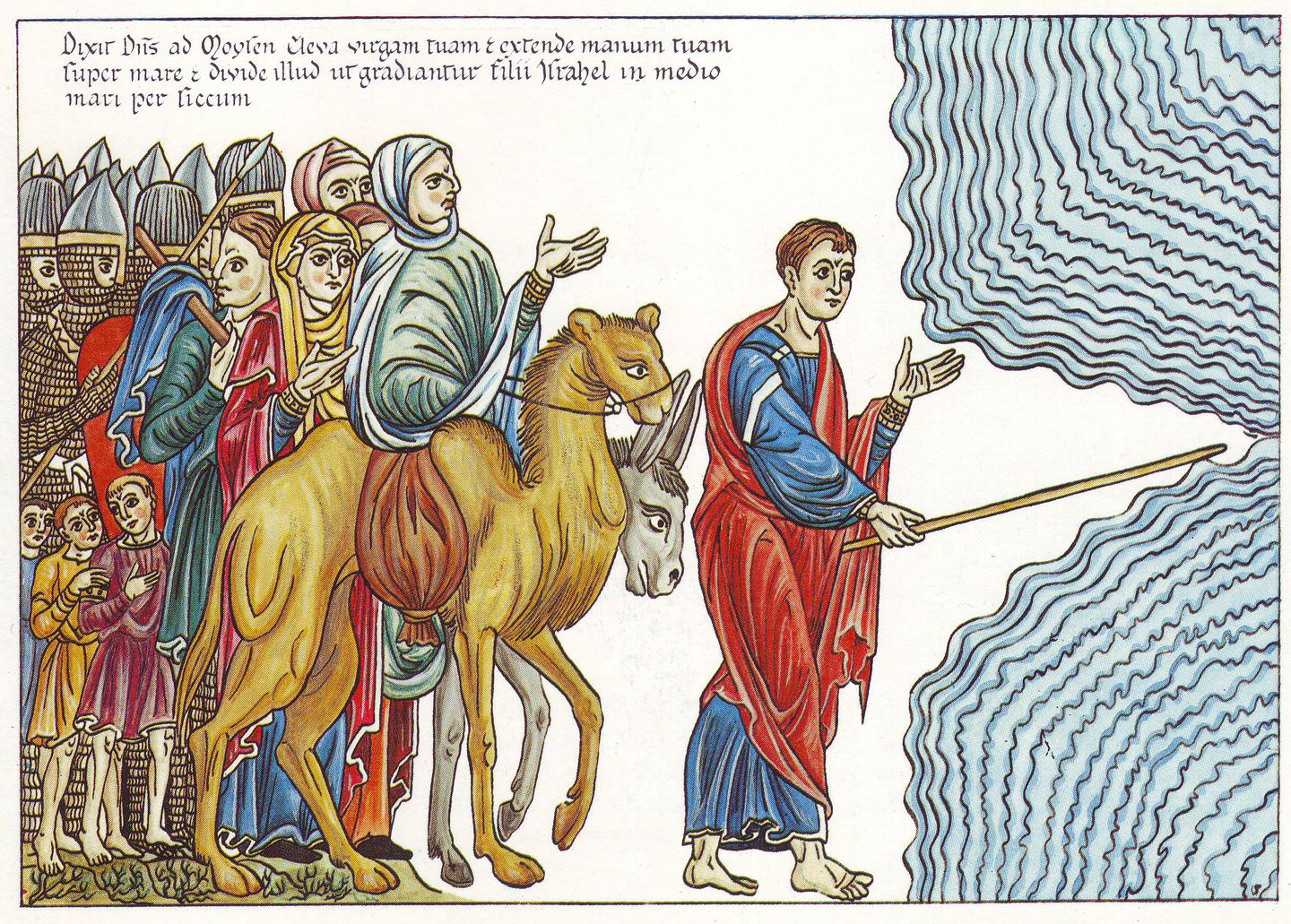
Image Credit: Herrad of Landsberg, Abbess of Hohenburg, approximately 1130-1195
An illustration from Hortus deliciarum, an illuminated encyclopedia, created as a pedagogical tool for young novices at Hohenburg Abbey. In 1870, the manuscript was destroyed in a bombing. The lllustrations had been copied preserved by Christian Maurice Engelhardt in 1818.
https://commons.wikimedia.org/wiki/File:Hortus_Deliciarum,_Moses_f%C3%BChrt_das_Volk_Israel_durch_das_Rote_Meer.JPG
Proper 19 (24), Year A
13 September 2026
Exodus 14:19-31
Psalm 114
Romans 14:1-12
Matthew 18:21-35
The deliverance of God’s people is a joyful affair, the drowning of the Egyptians is not. And we may ask how to make sense of the story in light of Jesus, a Jewish Saviour, who says to us, Love your enemies and pray for those who persecute you, 45so that you may be children of your Father in heaven; for he makes his sun rise on the evil and on the good, and sends rain on the righteous and on the unrighteous. (Matthew 5:44-45)
We are not the first who have difficulty with the drowning of the Egyptians.
The Talmud says that when on seeing the drowning Egyptians the angels were about to break into song, God silenced them declaring, “How dare you sing for joy when My creatures are dying” (Talmud, Megillah 10b and Sanhedrin 39b).1
Regarding the matter of placing the story on a map of the ancient Near East, the Old Testament scholar John Goldingay writes that while the story of the Exodus gives us many place names, it is not possible to locate any of those that are mentioned. And while there is no doubt that the story of the exodus has a historical core, the point of the story is more than the telling of history. And that is how we want to look at the story today.
When my mother-in-law has described her immigrant experience to me, there are two recurring themes. One focuses on the difference between British and Canadian English and this is underlined with a number of funny stories. The other is that when for the first time she visited England twenty years after she had come to Canada, the England she visited was not the England she had left.
My own immigrant story also consists of language encounters, but that while I could understand the language I could not always make sense of a story because to understand a story one must understand a culture.
My point is that stories can become metaphors, become themes, telling of more than a particular event but telling of the reality that frames our lives.
Stories can illumine and obscure reality. The stories above illumine an experience that is broader than the particular incidents from which they arise. If we told another story, say of a crime and attached a racial profile, it would obscure reality for it would suggest that some ethnic groups are to be feared, as if goodness and sin were not present in all of us and in all groups of people. And so we have to be careful with the stories we tell and how we tell them.
The story of Israel’s escape from Egypt is the foundational story of the people of God.
The story tells of God’s chosen familial bond with the people (the God of your ancestors), as well as of God’s preferential option for the downtrodden, as God declares to Moses at the burning bush: ‘I have observed the misery of my people who are in Egypt; I have heard their cry on account of their taskmasters. Indeed, I know their sufferings, and I have come down to deliver them …’
This experience constitutes those who had been slaves as a people. In the book of Genesis we read about Abraham, Isaac, and Jacob. Now we read about a people.
Thus this is a foundational story about identity. They are a people and their identity
– is tied to one another,
– and their identity is tied to God,
who makes himself known to a people, even God is the God of all.
Because the people’s identity is constituted by the story of deliverance, from now on they are exhorted to remember the stranger for they once were strangers in Egypt,2 and that whatever wealth and comforts they find in life, they did not earn these by their own strength but God’s provision who freed them from slavery and led them to the promised land.3 When God calls the people to faithfulness, this call is framed by the memory of the Exodus, “I am the Lord your God who led you out of Egypt …”
This carries into the New Testament where God’s people are saved not by pulling themselves up by our boot straps but by Christ’s death and resurrection, who is the Lamb of God, and where we learn that we are ‘no longer strangers and aliens, but members of the household of God’. (Ephesians 2:19)
And so the story God’s people tell about their history and identity is a story that determines the kind of lives they live and the kind of society they build.
The same is true for us. And we are as tempted as anyone before us to sing our own praises and forget the help we received along the way, or to forget our failings. Which is why it is important that we tell not just the history of pioneers and homesteaders but also of the displacement of the aboriginal peoples of Canada, not only the history of civilizational advancement but also of racist immigration policies, not only the story of technological advancement but also of environmental degradation. And vice versa. Because if we get the story wrong we will get today wrong.
We are tempted also to tell our story without God. And I am here not speaking of a Christian narrative for a secular state (or what is referred to as Christian Nationlaism), but I am speaking of you and me, for we are so used to speak of accomplishments and seek accomplishments, and say that the sky is the limit. But when we tell our story without God, we make ourselves into God. We get our priorities wrong. We become proud. We abandon community and say that people should just pull themselves up by their boot straps. One interpreter asks why the people headed toward the Reed Sea in the first place, why did God not lead them another way? And he answers because this way the people remember that it is God who saved them.
There is a peculiar verse at the beginning of chapter 14. It says that God hardened the heart of Pharaoh so that God would gain glory for himself. (v.4) You may recognize the motif of God hardening the heart of Pharaoh, which had already occurred during the plagues, a puzzling thing. But the thing was that Pharaohs and Roman emperors, modern emperors and billionaires all assume the place of God, not only in the allegiance and worship they demand but also in the lack of accountability that marks their lives. And so God gaining glory for Godself ‘over Pharaoh and all his army; so that the Egyptians shall know that God is the Lord’, is a beautiful thing for it allows the creature again to be a creature, which is to be in relationship with God and others, and it is God revealing Godself not only to the people of Israel but also to the Egyptians. And while the story is gruesome, and there is a problem with its gruesomeness (as we mentioned at the beginning) it is also a story of grace for it includes God’s self-revelation to the Egyptians. Our passage ends with these words, Israel saw the great work that the Lord did against the Egyptians. So the people feared the Lord and believed in the Lord and in his servant Moses. So both, the people and the Egyptians, saw God revealed in the events of the Exodus.
This is later echoed by the prophet Amos through whom God says,
Are you not like the Ethiopians to me,
O people of Israel? says the Lord.
Did I not bring Israel up from the land of Egypt,
and the Philistines from Caphtor and the Arameans from Kir? (Amos 9:7)4
Old Testament scholar John Goldingay points out that the Hebrew language – the language the Old Testament is written in – uses the same word for revering and for being afraid. And he beautifully reminds us of the midwives at the beginning of the story who feared God rather than Pharaoh, which is why they did not kill the Hebrew children. Goldingay concludes that at the end of the story Israel fears God and this fear of God makes it possible for the people to neither fear the future nor fear Pharaoh, and this frees them to worship God with their lives.5
And so this foundational story is not only a pious story but a story that de-centers us and that centers God; it is an anti-imperial story, for it proclaims loud and clear that there is no other God than the God of a slave people who is also the God who created the universe and is the giver of all blessings and whose nature it is to hear the cries of the afflicted.
It is not only the foundational story of a people from a long time ago, or only of the Synagogue, but it is also the story of the Church. It is our story.
Amen.
Let us pray for the whole people of God in Christ Jesus, and for all people according to their needs.
>Each petition ends with Lord, in your mercy, to which we respond, hear our prayer.
~ a brief silence ~
We give you thanks, O God, that you saved a slave people and showed the world that you have regard for the lowly. Let your people the Church have regard for the lowly, for all who suffer and carry heavy burdens. Lord in your mercy, hear our prayer.
Help us remember that you are our Saviour that we may love you rightly, and help us know you as our Saviour that we may not be prideful and become deaf to the needs of others. Lord in your mercy, hear our prayer.
We give thanks that as the people of Israel were spared by the blood of a lamb, so your Son became the Lamb of God by whom we are saved. Lord in your mercy, hear our prayer.
We give you thanks that as you saved a slave people and made them your people, you long to save all people and to lead all people into the freedom of being your children. Help us understand that Christian freedom is not expression of systems but of your nature, for to be in you is to have perfect freedom, for to be free in you makes it possible for us to follow your Son who came not to be served but to serve. Lord in your mercy, hear our prayer.
You, O Lord, declare your almighty power chiefly in showing mercy and pity. We see your power in the raising of Israel from Egypt and the raising Jesus from the dead. May your power be present in our lives that we live as people of the resurrection. Lord in your mercy, hear our prayer.
We give thanks, O God, that as you saved your people by the escape through the sea, so you save your Church through a new birth in the water of our baptism. In our baptism you have made us your own and members of your body. Help us live into what you have already made us. Lord in your mercy, hear our prayer.
As we mourn the death of the Egyptians, we give thanks that you have no pleasure in the death of the wicked, but desire that the wicked turn from their ways and live. Save us, O God, from longing for vengeance and from embracing retributive justice. Lord in your mercy, hear our prayer.
O Lord, we are people of stories. Help us examine our stories in light of your grand story with the world, knowing that it is your story that makes sense of our lives, and help us let go of the stories that do not fit into your story of salvation. Lord in your mercy, hear our prayer.
Healer of our every ill, grant your healing presence to all who are ill in any way, and fill them with the joy of your presence, especially …., and all we bring before you, spoken or silently … Bless their families also that they may have strength to accompany those they love. Bless those who experience the blessing and burden of age, especially …. Lord in your mercy, hear our prayer.
We pray for families experiencing strife that they may find peace and make peace.
We pray for those who have difficulty managing their anger, that they may learn to let go of their anger as they learn their life is held in your love. Lord in your mercy, hear our prayer.
Lord, we give thanks that as you saved a slave people and drew them out of Egypt, you draw them and us into a life with you. Help us live with you. Lord in your mercy, hear our prayer.
All these things and whatever else you see that we need, grant us, O God, for the sake of Christ who died and rose again, and now lives and reigns with you and the Holy Spirit, one God, forever and ever. Amen.
1 Why did we sing when the Egyptians drowned? – The angels were stopped from singing about the Crossing of the Red Sea but not the Israelites, The Jewish Chronicle, 18 April 2014. The article also explains the following: And for those of us who are familiar with the Jewish custom of breaking glass at the end of a Jewish wedding ceremony, this is to remind the wedding party that our cup of deliverance and celebration cannot be full when others are suffering (Berachot 31a). (…) The rabbinic telling of this story is that Pharaoh did not die but fled and eventually became the king of Nineveh. When the prophet Jonah came to him, Pharaoh immediately lead a national repentance movement (Pirkei d’Rabbi Eliezer, based on Exodus 14:28). In this telling Pharaoh becomes the paradigm of repentance and renewal.
2 You shall not wrong or oppress a resident alien, for you were aliens in the land of Egypt. (Exodus 22:21)
3 … do not exalt yourself, forgetting the Lord your God, who brought you out of the land of Egypt, out of the house of slavery, 15who led you through the great and terrible wilderness, an arid waste-land with poisonous snakes and scorpions. He made water flow for you from flint rock, 16and fed you in the wilderness with manna that your ancestors did not know, to humble you and to test you, and in the end to do you good. 17Do not say to yourself, ‘My power and the might of my own hand have gained me this wealth.’ 18But remember the Lord your God … (Deuteronomy 8)
4 Walter Brueggemann writes, “The Exodus memory is left intact for Israel’s affirmation, but the exclusiveness between Israel as an Exodus people and Yahweh as an Exodus God is broken. For now it is asserted that the God who brought up (…) Israel from Egypt does many other like deeds as well. This same God has wrought exoduses for the Philistines and the Arameans, Israel’s most persistent enemies. Yahweh is characteristically a God who enacts exoduses, and who does so in many places, perhaps everywhere.” in: Theology of the Old Testament – Testimony, Dispute, Advocacy, FortressPress: 1997 Minneapolis, MN, page 178
5 John Goldingay, Exodus and Leviticus for Everyone, WJK: 2010 Louisville, KY, page 64