

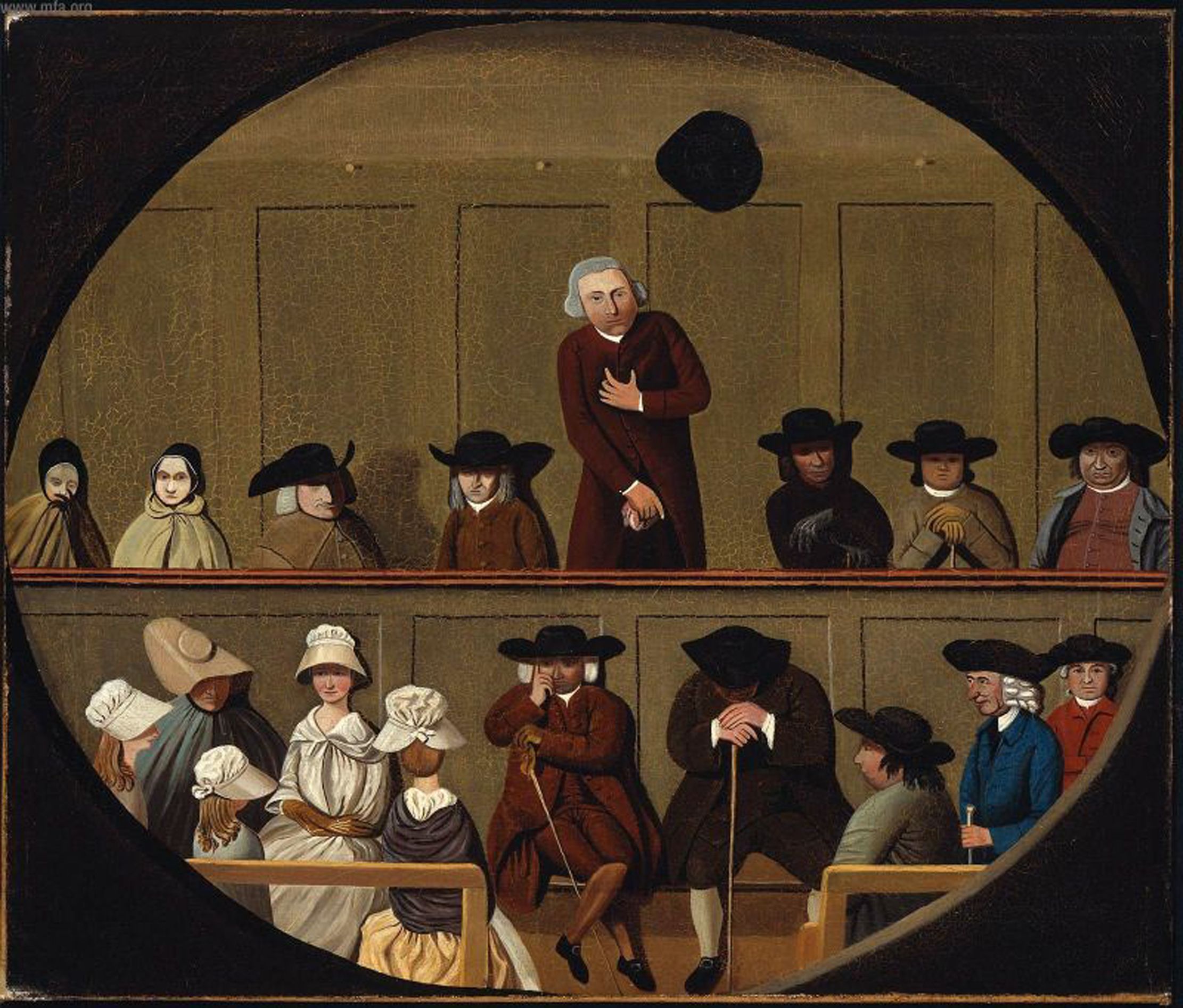
Image credit: Quaker Meeting, Museum of Fine Arts, Boston, MA
Copyright Source
Copyright Permission: Creative Commons BY-NC-SA 3.0
From Art in the Christian Tradition, a project of the Vanderbilt University Divinity Library, Nashville, TN. https://act.library.vanderbilt.edu/artworks/50940 [retrieved September 3, 2026].
Proper 18 (23), Year A
6 September 2026
Exodus 12:1-14
Psalm 149
Romans 13:8-14
Matthew 18:15-20
Our family moved to Abbotsford in the fall of 2002, one year after the Evangelical Lutheran Church in Canada and the Anglican Church of Canada had entered into full communion, meaning not merger but the full recognition of each other’s ministry. Having grown up in waning Christendom, I had always had an ecumenical bent and I had long been blessed to know that the Spirit blows where it chooses, i.e. not only in the Lutheran Church. I had always felt comfortable at Catholic Mass and in Benedictine monasteries, and I had been blessed with meaningful encounters with Evangelical Christians.
Predating both my arrival and full communion, Peace Lutheran Church had had a relationship with St Matthew’s Anglican Church, the physical expression of which was a joint service of Carols & Readings each Advent and a joint Good Friday service. This continued until it ended. I do not remember how it ended but it ended because St Matthew’s was involved in the lawsuit against the diocese over the blessing of same-sex unions and this was a lot for all involved. And I was not interested in taking sides, for it likely would have short-circuited our own conversation that was underway and had been underway for many years in the larger church. We needed to have it, but we needed to have it ourselves, not as cheerleaders in someone else’s debate.
It was in 2009 that the conservative parishes completed the divorce from the Anglican Church in Canada, with the Diocese maintaining ownership of the properties. In 2011 the Diocese inducted a new priest to rebuild the congregation. I was present at that service and I remember the beginning of Bishop Michael Ingham’s sermon. Ingham said, that in this conflict both parties had said things that better would have been left unsaid. It was a conciliatory statement to a friendly audience but it alluded to how divisive and painful the conflict had been.
Of course, we have our own memories, and I do not specifically mean Our Saviour. At a clergy meeting not long after the vote of our national convention, a colleague told that a group of people had exited their congregation and concluded the telling with “good riddance.” I do not know how hurtful and divisive things had been in their congregation, and the hurt experienced was likely the context for the statement, but I thought the Church was divided enough and that we did not need another schism, especially since we had always said that the question of same-sex unions were adiaphora, a term used during the Reformation to describe things that are important but not essential to our salvation. And if the question was indeed not essential to our salvation, then I had hoped we could live and worship together despite our differences.
Yet Bishop Ingham seemed to speak for Lutherans, too, for we had raised the stakes so high that for some it became difficult to look each other in the eye. And the reason I believe we had raised the stakes is that raising the stakes came at no cost to people who were not personally affected, and few spoke to people who were personally affected. We were arguing for someone else’s justice, not our own, or we were arguing for what we perceived a faithful interpretation of the holy scriptures, both causes where we could take the moral high ground with no cost to us. And that there was no cost to us was the trap.
Before you object, consider all that Jesus has said about wealth or about loving our enemies and doing good to those who hate us, and how following the teachings of Jesus in these regards is indeed costly yet how on these matters we all seem in agreement that that cost is either too high or that Jesus did not mean what he said, which is why we do not seem capable to have a fight about anything in the Sermon on the Mount. It is hard to conceive also that today’s church would be capable of having a fight over the dual nature of Christ, the Holy Spirit, or the doctrine of the Holy Trinity, or anything to do with the salvific work of God in Christ.
My intention of bringing up this difficult yet long past topic is not to re-open the debate, or to remind us of how painful it was – I experienced it as deeply painful. I am bringing up this memory because it relates to today’s Gospel reading in which Jesus speaks to his disciples – that is to us – about how to deal with conflict. Jesus’s assumption is clear: There will be conflict and we will sin against each other, and contrary to some older interpretations, this passage is not about excommunication, no matter how you look at it. It is not about exclusion from the community, it is about how we can live together despite our differences.
These verses are about living together despite our differences because Jesus spent much time with tax collectors and sinners, and it is about living together despite our differences because what follows these verses is Peter’s question of how often he must forgive a sibling in Christ.
It is helpful here, I think, to remember that whatever our convictions are, that we have not always held the same convictions, but have arrived at them over a period of time, and looking back upon what we once believed in regards to certain issues did not exclude us from the church previously, so why would we exclude those who hold different convictions now? It also suggests that there is no necessity for me to leave because my perspective did not win the day.
This is not to say that there cannot be conflict over serious issues that is painful, but we do well to remember that the Reformation could distinguish between ultimate and pen-ultimate things, things related to our salvation and things related to our living. Things not related to our salvation is called adiaphora.
In the early church Christians experienced persecution under Roman Emperor Diocletian. This persecution had particular impact on the church in Northern Africa. The empire demanded that Christians hand over their sacred texts for burning. Because this focused on sacred texts, it disproportionately targeted Christian clergy who were literate and had such texts. And because this persecution particularly targeted clergy, the persecution led to a shortage of clergy and when the persecutions ceased under Constantine and Licinius, the church, seeking clergy, was faced with the question of whether to restore clergy who had apostatized. This was no easy matter even if to us the sin appears a very obvious one. But none of us have experienced persecution and so we do not know what we would have done.
It took a while for the church to sort this out but eventually the way was cleared for clergy to be restored. And while this included a confession of sins, St Augustine who was bishop of Hippo at this time made it clear that the church is always a corpus permixtum, a community of saints and sinners. No wonder that 1100 years later Martin Luther, formerly an Augustinian monk, would take this one step further and speak not only of the church but of individuals as saints and sinners at the same time.
I believe that both Augustine and Luther were right. This is not to say that we should not desire holiness, only that we should not exclude on the basis of perceived sin or holiness.
That Jesus gives instructions about how to deal with sin in the community of the church suggests not only that there will be sin and that we will offend each other, but also that as much as we remain a community despite our differences, we need not be conflict averse but must name the sin or the offence, for we can only deal with the things that we name.
Naming our differences can set a beautiful example for the world around us that seems to be ever more concerned about purity and therefore groups itself into opposing camps. Yet avoiding conversation and insisting that one’s own convictions are true while those of our opponent are not has never created community.
In our passage from Romans the Apostle Paul exhorts us to owe no one anything, except to love one another, for the one who loves another has fulfilled the law. In the novel The Brothers Karamasov, the wise spiritual leader Fr. Zossima is approached by a woman, disappointed and embittered by her attempts to be charitable. Fr Zossima replies, “Love in action is a harsh and dreadful thing compared to love in dreams.”
That is the love to which we are called, it is a costly love, and it is found in a community that can name their differences but lives together despite them, and that seeks each other in the way that Jesus sought tax collectors and sinners.
Amen.
Let us pray for the whole people of God in Christ Jesus, and for all people according to their needs. Each petition ends with Lord, in your mercy, to which we respond, hear our prayer.
~ a brief silence ~
On this labour day weekend we remember all who labour and pray that they would find meaning in their work and joy in serving. And we pray that those who control and devise labour would seek this labour to serve not the quick profit but the good of all, and that workers be treated with respect. Lord in your mercy, hear our prayer.
We pray for our own labour that we would know the difference between the treasure that lasts and the treasures that will be consumed by moths and rust, so that in all our living we may strive for your Kingdom. Lord in your mercy, hear our prayer.
We give thanks that you have made us your body, that you have called us into a community. Yet it is hard, O Lord to be your body and to be a community. It is easier to be on our own, even if lonelier. But you have given us to one another to learn to love each other, not for what we do, think, or say, but because each of us is made in your image and is beloved by you. Help us then to learn to love each other, with our differences and with honesty and faithfulness. Lord in your mercy, hear our prayer.
We give thanks, Lord Jesus, that you have never abandoned us, despite our waywardness, our pride, our bullheadedness, but remained with us and always beckon us to follow you. Let us learn from you, that we may neither abandon you nor each other, but encourage each other to follow you. Lord in your mercy, hear our prayer.
Help us know that what we owe to each other is love, as St Paul reminds us that the one who loves has fulfilled the law.
And because, compared to love in dreams, love in action is a harsh and dreadful thing, let us love by and through your love. Lord in your mercy, hear our prayer.
We give thanks for this community here, for our families, neighbours, colleagues, friends, in whose presence we learn to love despite our differences.
You, Lord Jesus, pray for your disciples, for your friends to be one, as you and the Father are one, yet your Church is divided. Help us not to deepen the divide but find our unity in you. Lord in your mercy, hear our prayer.
Healer of our every ill, grant your healing presence to all who are ill in any way, and fill them with the joy of your presence, especially …., and all we bring before you, spoken or silently … Bless their families also that they may have strength to accompany those they love. Bless those who experience the blessing and burden of age, especially …. Lord in your mercy, hear our prayer.
We pray for those from whom we are separated by distance; friends, family, and our friend and co-worker Chris. Bless his studies and away from home let him always remember that our home is in you. Lord in your mercy, hear our prayer.
All these things and whatever else you see that we need, grant us, O God, for the sake of Christ who died and rose again, and now lives and reigns with you and the Holy Spirit, one God, forever and ever. Amen.