

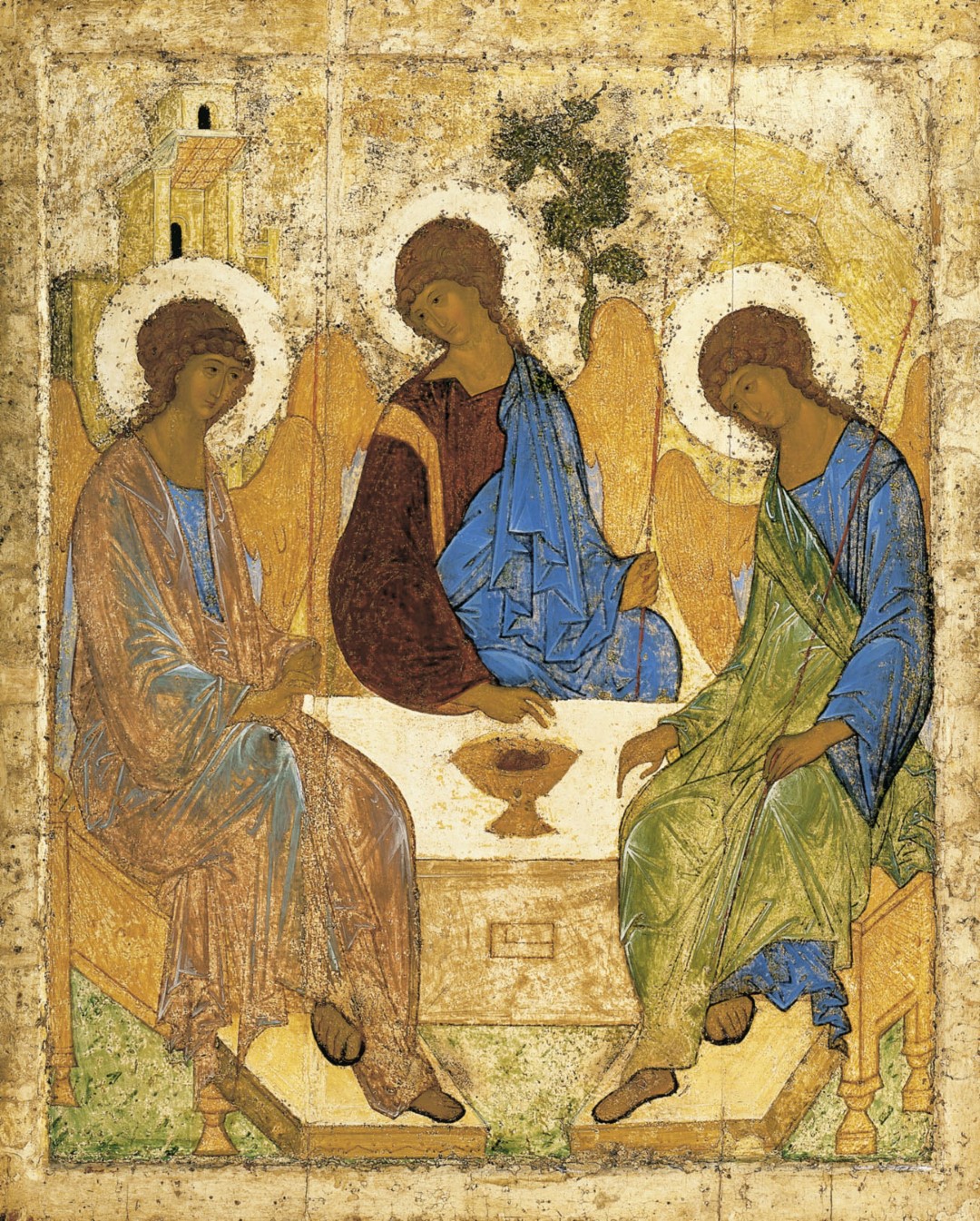
Image Credit: The Trinity (also called The Hospitality of Abraham) is an icon created by Russian painter Andrei Rublev in the early 15th century. Source: Wikipedia
Proper 6 (11), Year A
14 June 2026
Genesis 18:1-15, (21:1-7)
Psalm 116:1-2, 12-19
Romans 5:1-8
Matthew 9:35-10:8, (9-23)
When Jackie and I got married, we always knew that we wanted to have children, it wasn’t something we had to negotiate. Not everyone wants to have children, for various reasons, and some people who want children cannot have children, which often is a great source of pain. And even though modern medicine can help, it cannot always help. For some this is a deep disappointment that may last years, in part I imagine, because it relates to the feeling of being denied something we understand to be an elementary part of being human and thus it affects how we understand ourselves.
This may be the place where the story of Sarah touches us, for many of us know someone who has experienced the pain of childlessness, sometimes made greater by having undergone unsuccessful fertility treatments. Sarah did not undergo fertility treatments and while today we understand that infertility can rest with either partner, in the days of Abraham and Sarah infertility was believed to be the woman’s problem or fault, for people did not know that both sperm and egg were necessary. People believed the man simply implanted the child for the woman to bear.
But there is more to children than completing our humanity, or filling an otherwise empty spot in our lives. Children teach us that we do not live for ourselves. Even before their arrival they bring significant change and once they are here, our lives revolve around them. While under other circumstances we would reject such radical change and reorientation, in the case of change brought about by our children, we welcome it, and it is love that makes such welcome possible.
Because the arrival of children makes our lives revolve around them, they give new meaning to our lives. Children gift us with the opportunity to teach them the things we know and value, and to love them for their own sake, for while they are entrusted to us for a time, we raise them to be their own persons, to become the people God intends them to be, who may or may not keep what we taught them or live or not live in the way that we had hoped, yet we love them anyway.
Abraham and Sarah mourned for all these reasons. And then there was the lack of a future perspective, for what good was the promise of land if they could not pass it on to their progeny?
Admittedly, I cannot imagine the sorrow and disappointment of not being able to conceive.
And yet, when it comes to sharing our lives, to sharing our wisdom and our passions, to sharing our wealth and our time, to living for others, children are not the only way to do that. In fact, one would hope that for those who have raised children, that after our children have moved out our lives wouldn’t simply pivot back to ourselves but that we would continue to seek to live for more, to live for others. In today’s Gospel Jesus sends the twelve to do ministry in his name, to continue his ministry of healing.
That this can be so is consistent with Jesus’s answer in Matthew 12 when told that his mother and brothers are outside, wanting to speak to him. Jesus answered, Who is my mother, and who are my brothers?’ 49And pointing to his disciples, he said, ‘Here are my mother and my brothers! 50For whoever does the will of my Father in heaven is my brother and sister and mother.’
These words seem harsh, yet they are also a promise. The Lutheran pastor Nadia Bolz-Weber once in an interview spoke about the trans kid at her church who, rejected by their biological family, finds a new family in the community of the church.
Still we find it harsh when Jesus redefines family, for we love our families. It is reminiscent of Jesus at the wedding at Cana when his mother had come to him wanting him to help out the hosts, addressing her with Woman, what concern is that to you and to me? But we also speak of the church as our family and for someone like me whose childhood home was so very sad, I was glad to have found a home in the church, and that may also be the experience of others for this and other reasons. And I think of our family from Myanmar who come to worship with us quite regularly, even though it is a long way for them to come, they feel a bond with the church, whether they are Christian or not.
And to return to the harsh language Jesus uses about family, family – for all its blessings – can also become too small – think of those who are single or widowed and may feel like the fifth wheel on the wagon. The family can become idolatrous, which may have been the reason Jesus defines his family as those who do the will of his Father in heaven. And isn’t it interesting that such definition of God’s family does not only intentionally widen family beyond our biological family but also seems bare of theological and dogmatic boundaries. A friend in Abbotsford, once music pastor at a Vineyard church, believed that Christians and Sikhs can work together for the good of the community.
There are two things included in Jesus’s description of his family as those who do the will of his Father in heaven. The first one is that family is about belonging. This matters not only for people who came from difficult families but also for people who have no family. That this family extends beyond those who need the family of the church because their own families are either dysfunctional or non-existent is apparent by what defines our new family, namely to do the will of our Father in heaven.
And that is where today’s Gospel connects with our first reading, with the longing of Abraham and Sarah for progeny, and more deeply to the human longing for meaning and belonging. It turns out that the nuclear family isn’t the only place and not even the first place we belong, but the Body of Christ; the Church is constituted of those who do the will of our Father in heaven.
And I admit find this difficult for the larger church so often is not what we hope that it was.
And yet there are ways in which we do the will of our Father in heaven and thus cease to be the incurvatus se as Luther and Augustine described fallen humanity, curved in on itself. We care about and for each other, through phone calls, visits and sharing in each others’ lives, some of us have built a pollinator garden that all of us are proud of, not only for its beauty but because it expresses that we know ourselves as part of God’s good creation. We have over the last ten years persistently engaged in sponsoring refugees, with our money, our time, our friendship, and thus worked to take down barriers and remembered in this endeavour that the gifts that God has entrusted to us are not for us alone. And we have built the labyrinth, not just for us but for the community, with the prayer that it would rekindle faith and help people find the God who has long found them.
And then there are other things we do on our own, not letting our left hand know what our right hand is doing, with our money, our time, and our lives, and the people and concerns we devote our prayers to, living into the reign of God, that larger horizon that Sarah and Abraham longed for and that we all long for, and that makes us whole.
This, it turns out, is not a burden but it is a gift. Doing the will of our heavenly Father, discerning it, and wanting to live like this is not a condition for God to love us, God loves us already, but it is the gift that helps us discover the marvellous life into which God has called us.
Amen.