

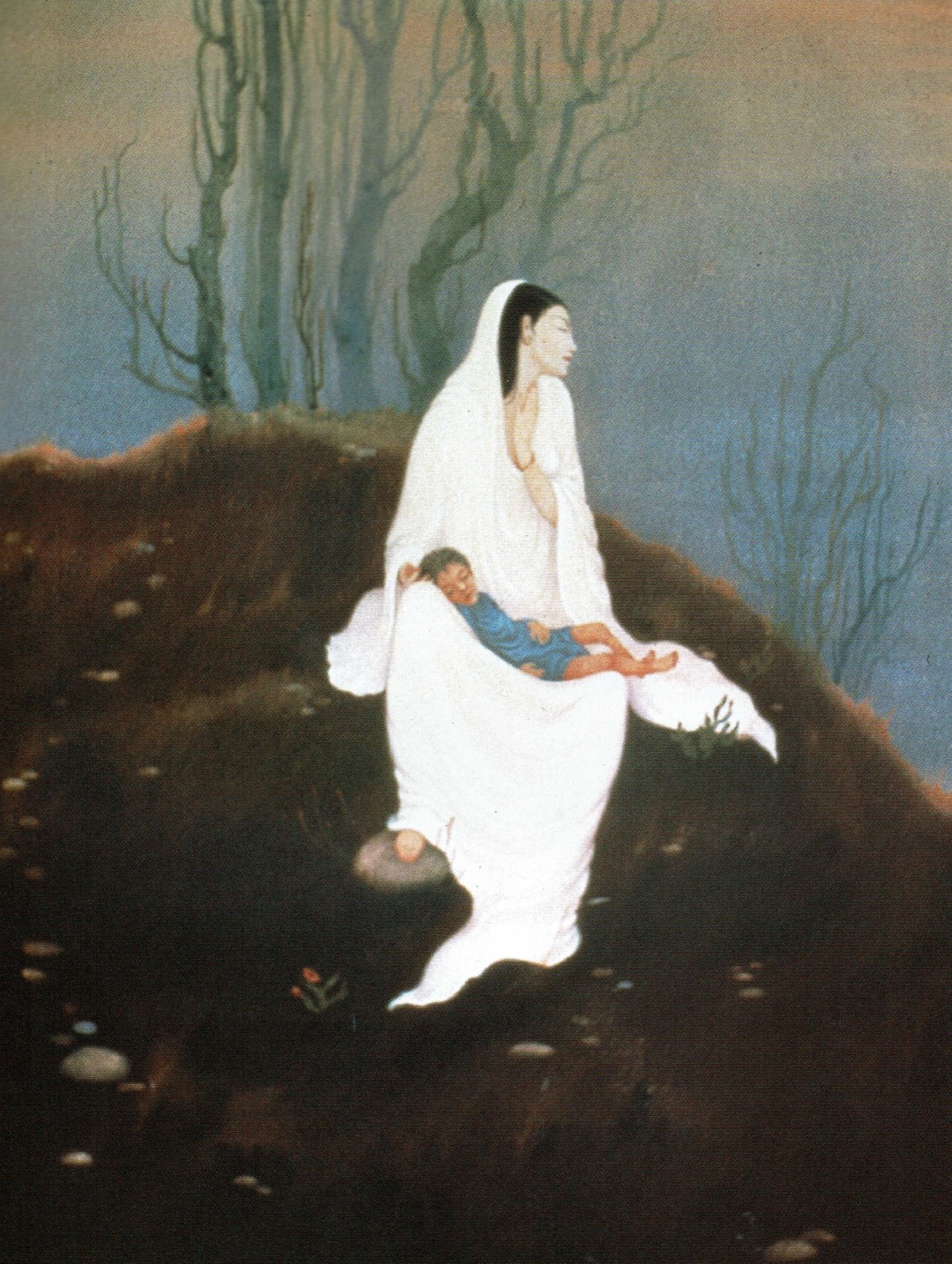
Image Credit: Hagar and Ishmael by Frank Wesley (1923-2002)
Wesley was born in Azamgarh, Uttar Pradesh into a fifth generation Christian family of Hindu and Muslim descent. He belongs to the Lucknow school of painting. His paintings reflect this influence and that of the Chughtai school of painting that flourished in India at the turn of the century. Wesley made art based on both biblical and secular themes. He used water colours, oil paintings, miniatures and wooden carvings. Wesley’s painting “Blue Madonna” was used for the first UNICEF Christmas card, while five of his paintings were exhibited at the 1950 Holy Year Exhibition in the Vatican. He is also known for designing the funeral urn for Mahatma Gandhi’s ashes.
The artist has granted permission for the non-commercial use of this image with attribution. The artist must be contacted for other uses.
Attribution: Wesley, Frank, 1923-2002. Hagar and Ishmael, from Art in the Christian Tradition, a project of the Vanderbilt Divinity Library, Nashville, TN. https://diglib.library.vanderbilt.edu/act-imagelink.pl?RC=59206 [retrieved June 16, 2026]. Original source: Estate of Frank Wesley, http://www.frankwesleyart.com/main_page.htm.
Proper 7 (12), Year A
21 June 2026
Genesis 21:8-21
Psalm 86:1-10, 16-17
Romans 6:1b-11
Matthew 10:24-39
It was, I think, in the wake of the deaths of Ahmaud Arbery (23 Feb 2020), Breonna Taylor (13 March 2020, George Floyd (25 May 2020), Rayshard Brooks (12 June 2020) and others that the movement to remove confederate flags from public buildings and to remove confederate statues gained momentum. Since racism isn’t an American prerogative, the movement found expression in other places too. In Canada this affected statues representing the monarchy and especially Queen Victoria, as well as Egerton Ryerson. For Ryerson’s role in the establishing of residential schools Ryerson University was renamed Toronto Metropolitan University.1 In Bristol (England) protesters toppled the statue of slave trader Edward Colston and pushed the statue into Bristol Harbour.2 The honouring of sinners and racists of the past without reassessment of their legacy was believed to be expression of current racism, intentional or unintentional. The protesters may not have demanded so much a debate as action but their actions demonstrated that the existence of these monuments in our midst showed we had avoided the debate about our past.
In June of 2020 the New York Times published a piece by the African-American writer Caroline Randall Williams in which she wrote “I have rape-colored skin. My light-brown-blackness is a living testament to the rules, the practices, the causes of the Old South.
If there are those who want to remember the legacy of the Confederacy, if they want monuments, well, then, my body is a monument. My skin is a monument.
(…)
I am a black, Southern woman, and of my immediate white male ancestors, all of them were rapists. My very existence is a relic of slavery and Jim Crow.
(…)
I am more than half white, and none of it was consensual. White Southern men – my ancestors – took what they wanted from women they did not love, over whom they had extraordinary power, and then failed to claim their children.”3
And so it makes sense that African-American women identified with the biblical character Hagar, for the story of Hagar represents their story. The story of Hagar begins in chapter 16 where we read,
1Now Sarai, Abram’s wife, bore him no children. She had an Egyptian slave-girl whose name was Hagar, 2and Sarai said to Abram, ‘You see that the Lord has prevented me from bearing children; go in to my slave-girl; it may be that I shall obtain children by her.’
Hagar is not consulted and is not given opportunity to consent or to refuse. This episode follows on the heels of God’s marvellous promise in chapter 15, ‘Look towards heaven and count the stars, if you are able to count them.’ (…) ‘So shall your descendants be.’ 6And he believed the Lord; and the Lord reckoned it to him as righteousness.
Sarah’s plan and Abraham’s consent is evidence of their lack of trust in God’s promise. Not that we may not all be subject to doubt, but biblical faith is lived against barrenness insisting on God’s abundance and such faith saves us from taking what is not ours.
Hagar’s story is a heart-wrenching story. She is treated a possession, her pregnancy is forced upon her, and later, when Isaac had survived infancy, she becomes an irritant, becomes disposable and is sent away. The Jewish writer Ruth Behar observes about Sarah’s grief over her barrenness, “… Sarah refuses to turn her suffering inward by humbling herself before God. No, she turns her suffering outward, creating yet worse suffering for Hagar, her Egyptian servant, the woman whose womb she thinks she controls.”4
In all of this Abraham seems little more than an extra, a bystander. He does whatever he is told, seemingly without moral convictions. Yes, he feels bad to send them away ‘because of the boy’ but he gives no thought to Hagar.
In order to understand the story it is helpful to remember the time when Hagar had run away, the scene depicted on our bulletin covers.
A few chapters earlier we read, 5Then Sarai said to Abram, ‘May the wrong done to me be on you! I gave my slave-girl to your embrace, and when she saw that she had conceived, she looked on me with contempt. May the Lord judge between you and me!’ 6But Abram said to Sarai, ‘Your slave-girl is in your power; do to her as you please.’ Then Sarai dealt harshly with her, and she ran away from her. (Gen 16) Sarah invokes divine judgment onto a situation she created. And considering the status of slaves, even considering that Hagar did not consent to be impregnated by Abraham, conception changed her social status, which is what Sarah perceived, and for this no contempt was necessary.5
And faced with such enmity for something others had done to her, Hagar runs away and finds herself in the wilderness, and in the wilderness she encounters God. We know the wilderness is a place of encounter with God, and wilderness has a deeper, a proverbial meaning, for Hagar finds herself not only in a literal wilderness. It is hard to understand that God sends her back to Sarah, but perhaps it is so she would not die in the wilderness. Yet God sends her with a promise, namely that like Isaac who will be born to Sarah, her child too shall become the ancestor of a great nation. God says to her, I will so greatly multiply your offspring that they cannot be counted for multitude, (16:10) and that her son shall be free, for that is the meaning of the verses that follow.6 The name she is to give to her son is Ishmael, ‘God has heard’, for God hears the cries of the afflicted. That God hears is is also what God says to Moses at the Burning Bush, I have observed the misery of my people …; I have heard their cry, … I know their sufferings, and I have come down to deliver them. (Ex 3:7-8)
Hagar then names the place after this theophany, after this encounter with God. And she names God. She says, ‘You are El-roi’. El-roi means the God who sees. ‘Have I really seen God and remained alive after seeing him?,’ she says.
Hagar is the only person in the Bible who names God, and it is through this communion with God that she makes “a way out of what she thought was no way.” (Delores Williams)
To return to the beginning: It cannot surprise us that for black women Hagar came to embody the possibility of triumph in impossible struggles, showing how an ex-slave mother withstood desolation by being utterly alone with God.7
When in the end Sarah makes Abraham send Hagar and Ishmael away, and Hagar again finds herself in the wilderness, this time with her son, she is free, but she and Ishmael are dying of thirst. God shows her a spring, they drink and they live and eventually make the way home to Egypt. And they are saved because God heard the voice of the boy (v.17) and God was with the boy (v. 20), for God hears the cries of the afflicted.
It stands to reason then that people like us who believe that God hears our cries and our affliction would also hear the cries of the afflicted, for we belong with God. It stands to reason that we would ask questions about our own history and its repercussions until today. Which is an appropriate thing to contemplate on this day when we celebrate Canada’s first peoples.
A truthful telling of history, individual, familial, and corporate is necessary for right relationship with God and each other, and right relationship is what God invites us into again and again.
That African-American women could identify with Hagar is not only on account of what they suffered, but also because they never mistook God for the God of the powerful. They always knew that God hears the cries of the afflicted, for that is much of what the Bible is about, and it is the story of Jesus, the One who was rejected and became the corner stone, the One by whose wounds we are healed.
Hagar encountered God in the wilderness, she did not topple any statues. But the Bible which tells us this story does topple statues, even if only proverbially, for as much as we admire Abraham and Sarah, our faith is not about them, but about the God who sees, and who hears, who is with the boy, with the afflicted, and by whose wounds we are healed.
Amen.
1 On the front lines of the statue wars: why some want to topple statues but others want to keep them up, CBC Docs · 4 Oct 2023. In 2018 Dunbar Ryerson United Church in Vancouver changed its name to Pacific Spirit United Church for the same reason.
3 Caroline Randall Williams, You Want a Confederate Monument? My Body Is a Confederate Monument, New York Times, 27 June 2020, retrieved from ZNetwork.org on the 18th of June 2026
4 Beginning Anew: A Woman’s Companion to the High Holy Days, edited by Gail Twersky Reimer and Judith A. Kates, New York, NY: 1997 Simon & Schuster, page 38
5 Polygamy always was related to creating offspring and thus the survival of the clan, as well as the economic conditions in which it could exist. I would argue the fact that polygamy has largely disappeared is related less to moral norms than to the fact that it creates the conditions for triagulation, unaccountability, and jealousy.
6 A better translation of 16:12 than the NRSV is this: “He shall be a free man, his hand will be free from everyone, and everyone’s hand will be free from him, and he will live in the presence of all his kin.” See Wes Howard Brook, S1E69 The Book of Genesis: Hagar names God (Gen 16.8-14)
7 See Beginning Anew, page 41