

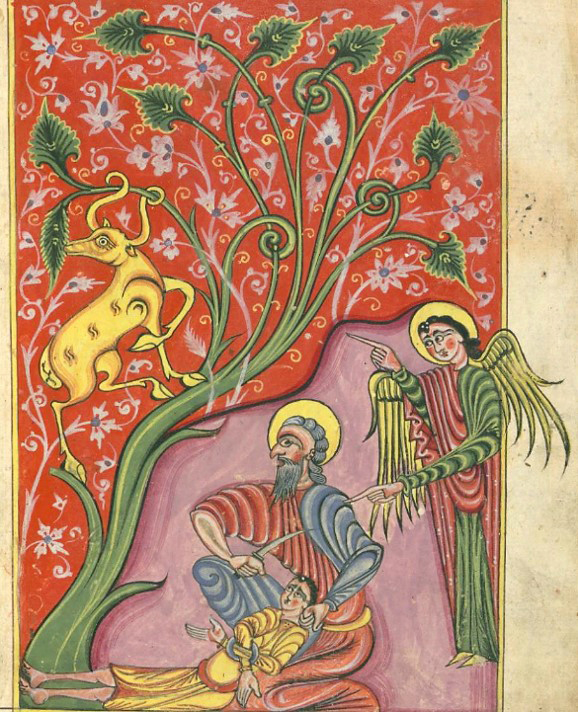
Image Credit: Sacrifice of Isaac from an Armenian Gospel book produced in 904 of the Armenian era (1455 CE) at the monastery of Gamałiēl in Xizan by the scribe Yohannēs Vardapet, son of Vardan and Dilšat, and was illuminated by the priest Xačʿatur.
From Art in the Christian Tradition, a project of the Vanderbilt Divinity Library, Nashville, TN. https://diglib.library.vanderbilt.edu/act-imagelink.pl?RC=57401 [retrieved June 24, 2026]. Original source: https://www.flickr.com/photos/medmss/8613677273.
Proper 8 (13), Year A
28 June 2026
Genesis 22:1-14
Psalm 13
Romans 6:12-23
Matthew 10:40-42
Note: This is a slightly updated version of today’s sermon.
I was in Abbotsford on Monday. The congregation I had served until ten years ago sold their building and had a service marking this moment. I had thought it easier than it turned out to be. I had thought to myself that the congregation was not closing and that they were only letting go of the building and so I could just think of all the beautiful things that had happened there over the years. But amidst these beautiful memories I did feel a profound sadness.
The service was beautiful with appropriate words, pastoral sensitivity, and a wonderful turnout, the church was practically full. Many familiar faces, and deep connections. There was a lunch following the service where there was time to reminisce, and where some of us got up to share a few words.1
There were two beautiful slide shows, one during the service, chronicling the 70 year history of the congregation, and one during lunch, showing many faces. You may know what comes next. Of course, there were pictures of our family and one particular wonderful picture of Elias that made me cry. But for the people we love, our tears are always tears of thanksgiving.
I was standing in line at the buffet when the tears welled up and next to me was standing the current chair of the congregation who had also lost a child, a number of years before Elias had died. We hugged and later I thought of the time I went to her and her husband’s house when they had received the news of the death of their daughter, and I thought to myself how little I had understood back then.
After Elias had died there was a biblical phrase that would often find its way into my thoughts, “bones of my bones, flesh of my flesh.” (Genesis 2:23) Adam uttered the words at the creation of his partner and they were uttered not only as expression of the relief from the loneliness Adam had experienced heretofore, but – I believe – also as an expression of a deep sense of community, an expression of kinship.
And so we understand that the story of the binding of Isaac is a story that carries a heavy burden. It is impossible to forget the image of little Aylan Kurdi washed up on a beach in September 2015, together with his mother and brother, drowned at sea as the family was attempting to reach Europe from Turkey, with the hopes of one day living in Canada.2 And acknowledging this burden, we may wonder what made Abraham so confident that it was no one other than God who had asked him to sacrifice the child of promise for whom he and his wife Sarah had been waiting for so many years.
I have always been skeptical when people seem to know too much about the mind of God. Years ago I run into an acquaintance in Abbotsford and congratulated her on her family’s new home, to which she replied that God had so wanted them to have that house. To me, those who claim to know the mind of God generally have too much certainty about why they are blessed while they have little to say about why others live in poverty, and they usually assume that their politics are also God’s politics.
So how did Abraham know that God wanted him to sacrifice Isaac?
This is a question worth asking, even though there is no answer to it. The text does not answer the question because it is not what the story is about, and yet some questions need to be asked even if they have no answer.
The traditional interpretation of the binding of Isaac, one that is already included in the telling of the story itself, is the obedience of Abraham. In verses 16 and 17 we read, ‘By myself I have sworn, says the Lord: Because you have done this, and have not withheld your son, your only son, 17I will indeed bless you, and I will make your offspring as numerous as the stars of heaven and as the sand that is on the seashore. But here I have another question to which there is no answer: Did the all-knowing God not know beforehand that Abraham would be obedient? And isn’t this promise given to Abraham not simply a repetition of the promise given in chapters 12, 15, and 17?
The traditional answer has been that God tested Abraham and that this test was about obedience, about who Abraham’s first loyalty belonged to. I have no issue with obedience to God, well I probably do, but at least not theoretically. In this sense the story mirrors the obedience of Mary to be the mother of Jesus, and it mirrors the life of the disciples of Jesus who leave everything to follow him. And yet that explanation does not suffice, for the thing asked is simply too dark, too awful.
The late Rabbi Jonathan Sacks seems to agree when he reminds us that throughout the Tanach, i.e. the Old Testament, the gravest sin is child sacrifice. It was not uncommon among Israel’s neighbours, but God’s people – because they are God’s – know better.
Sacks reminds us of the prophet Jeremiah’s word of judgment, 4 … the people have forsaken me, and have profaned this place by making offerings in it to other gods (…) 5and gone on building the high places of Baal to burn their children in the fire as burnt-offerings to Baal, which I did not command or decree, nor did it enter my mind. (Jeremiah 19)
And Sacks reminds us of Micah’s rhetorical question, 7Will the Lord be pleased with thousands of rams, with tens of thousands of rivers of oil? Shall I give my firstborn for my transgression, the fruit of my body for the sin of my soul?’ which Micah then answers,
8He has told you, O mortal, what is good;
and what does the Lord require of you
but to do justice, and to love kindness,
and to walk humbly with your God? (Micah 6)
Child sacrifice is not on the list but is an abomination to the Lord.
Given that the scriptures themselves testify against child sacrifice, Sacks draws the conclusion that there is something else going on here. Sacks then reminds us of Leviticus 25 and the Year of Jubilee that tell us, not unlike our indigenous neighbours would, that the land shall not be sold in perpetuity, ‘for the land is God’s; and with God we are but aliens and tenants,’ and that The earth is the Lord’s and all that is in it, the world, and those who live in it. (Psalm 24)
This makes the story of the binding of Isaac a stewardship text in the sense that in his obedience Abraham acknowledged that all things belong to God and that even our children belong to God, long before they belong to us. And this is the point Sacks is making.
My father was self-employed and as far as I understand, he was expected to take over his father’s business. It was slightly more complicated but this was the expectation and this has been the expectation in many cultures over many centuries. It makes sense when one generation has established a business or has cultivated land and established a farm, either of which are able to support and sustain the next generation, that the next generation would take over. Parents want to set up their kids well because they know that the time will come when the kids will be on their own. The thing though was that my father was not happy in this role and for his whole life wished he had sought a different career. More than once he said to me, “Don’t do what I do. I wish I had become a cabinet maker.”
Each generation has expectations of the next. That is often well intentioned, even if it implicitly carries an affirmation of the life we have made for ourselves; but we do not own our children. Our children belong to God before they belong to us. They may choose a different career or a different faith, or no faith, and we may mourn the decisions our children make, as they may mourn decisions we make, but we cannot tell them what to do because we do not own them. All we can do is love them and pray for them. We do not want to create our children in our own image, for they already bear an image, and that image is God’s. The binding of Isaac, says Rabbi Sacks, is the rejection that children are the property of their parents.3
I believe that there is something else that is going on here as well. We have already established that child sacrifice was not practiced by God’s people but that Judaism lived in opposition to it and that child sacrifice is not only rejected but that it is understood to be abhorrent to God. So why does a religious tradition tell the story of the Binding to Isaac to a people who have already rejected child sacrifice?
In the way that we have a strong emotional response to the death of a child, whether through illness, accident, or crime, so the story counts on our emotional response to child sacrifice. People may not have had the same romantic notions of childhood we have today but we see in the stories of barrenness and conception how important children were. And so the story counts on our rejection of child sacrifice, on our understanding that child sacrifice is abhorrent to God, and counts on our emotional response in the way that we may say “Amen” to a sermon or something we recognize as divinely true. In anticipating our emotional response the story creates common ground and recruits us into a different narrative, not a narrative of violence, not a narrative of scapegoating, but a narrative in which we may offer ourselves but never others, whether they be friend or foe, because offering others is not the way of God but offering ourselves is.
And so, confronted with a story that can make us doubt the witness of the scriptures, we find ourselves invited into a deeper, truer love, into the love that compelled God to create the world and enter into relationship with it. A love that does not take but gives and gives freely, invited into the love of a God who does not demand death but who dies so that we would live.
Amen.
1 I shared of my tennis playing experience many years before that a better player almost made me better and that the people of Peace Lutheran Church had made me better and how our time in that community had been a profound blessing.
3 The Binding of Isaac: A New Interpretation, “ … the rejection of the principle of patria potestas, the idea universal to all pagan cultures.”