

Proper 5 (10), Season after Pentecost
7 June 2026
Genesis 12:1-9
Psalm 33:1-12
Romans 4:13-25
Matthew 9:9-13, 18-26
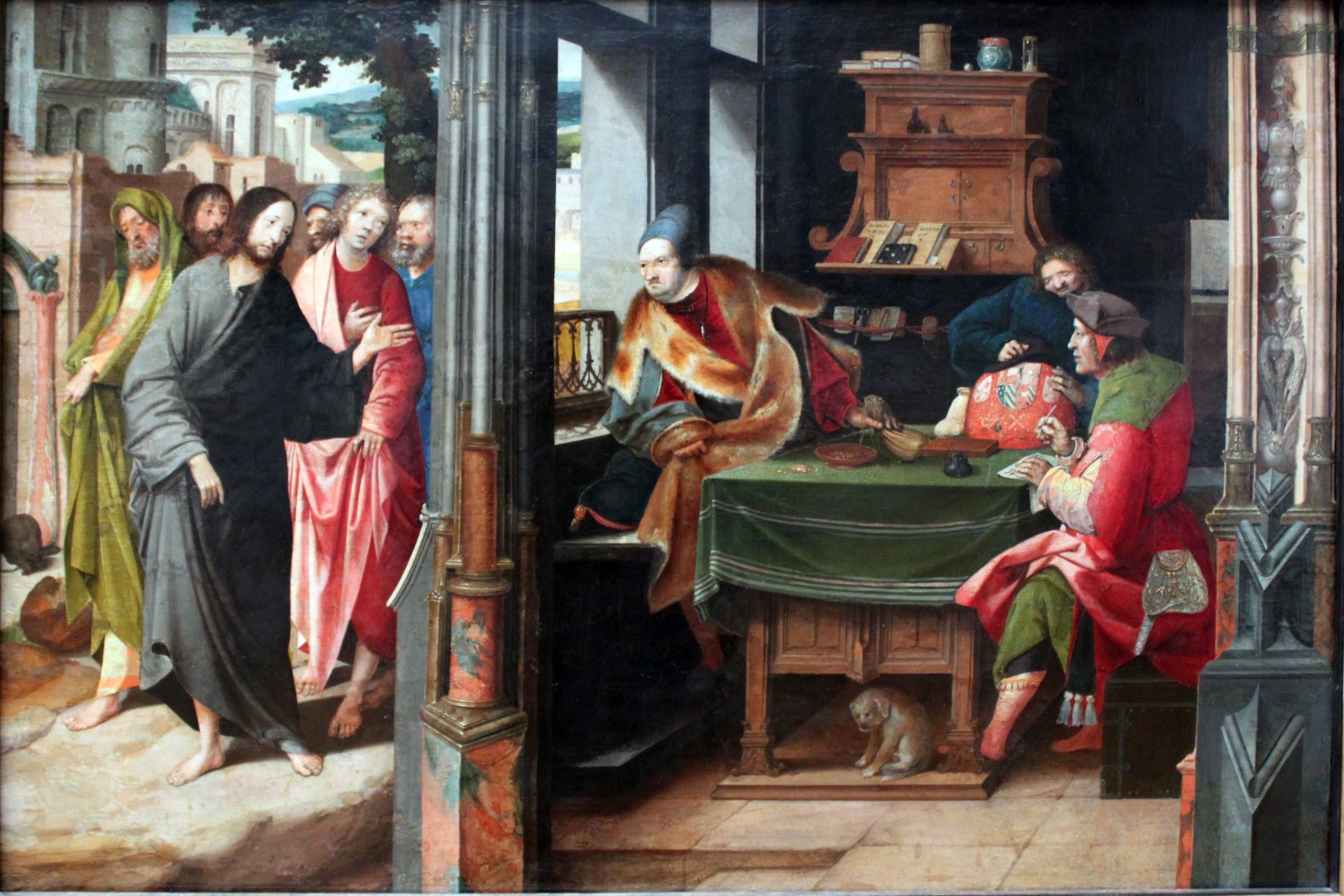
Image Credit: The Calling of St Matthew by Cornelis Engebrechtsz (1460/1465–1527). Gemäldegalerie Berlin. Source: Wikimedia.
Our Gospel reading tells of the call of St Matthew. In case you wondered, in Mark’s Gospel it is the call of Levi. It is the same person, we think, and more or less the same story. It is the call of the tax collector to follow Jesus.
The tax collectors of the Gospels are disreputable people. They are people who collaborate with the enemy, they collaborate with Rome for personal gain. It is striking that whenever the Gospels mention tax collectors and sinners, tax collectors are named as their own category. They seem a special kind of sinner.
Here Jesus happens upon one of these tax collectors, sitting in his toll both. His name is Matthew. Jesus says to him, ‘Follow me.’ And Matthew gets up and follows him. And we are inclined to think that this is a stereotypical conversion story.
But before you know it, Jesus has table fellowship with Matthew and other unnamed sinners.
And that is the twist in the story: While it is Matthew the tax collector who is called to follow Jesus, it is Jesus who follows Matthew to the table.
It is true that our reading tells us that Matthew got up and followed Jesus, but in the very next verse we find Jesus in the company of sinners and tax collectors, which suggests at the very least that Jesus did not lead Matthew into what we would consider the company of decent folk like us.
Yet this is what we commonly assume. We fill in the blanks with the verse we know from John 8, from the story of the woman caught in adultery who is dragged before Jesus. While the emphasis of that story wants us to refrain from condemning others on account of our own sin, we remember Jesus’s closing address to the woman, Go on your way, and from now on do not sin again. (John 8:11)
But Jesus does not say this to the tax collector, he does not say it once in the entire Gospel of Matthew.
That is not to say that Jesus does not call people to repent, but his calls for repentance are not directed at public sinners but at the righteous. Of course, Jesus also never says that following him is easy as the Sermon on the Mount makes clear, but the call of Matthew is not a public rebuke, it is an invitation into relationship, which is why a short while later Jesus is found eating and drinking with Matthew and his friends.
This is as surprising as it is beautiful and I cannot help but think of Jesus’s promise to his disciples at the end of this gospel to be with us always. There are no qualifications in that promise, no conditions we must fulfill for Jesus to be with us, it is just given as a gift. And here in Jesus’s presence with Matthew and his friends we see what the grace of God’s presence looks like.
Now, all the healing stories in chapter nine1 are driven not by the agenda of Jesus but by the needs of people, and while we find Jesus at the table without being told how he got there, when another person comes to Jesus and asks Jesus to lay his hand on his daughter who has just died, so that she may live, we read, And Jesus got up and followed him, with his disciples. (19) Here it is, Jesus followed him.
Looking at the story in this way reminded me of an observation about Jesus’s ministry, namely, that in the three years of his public ministry Jesus spent more time shaping the community of the disciples than preaching, more than proclaiming the Gospel.2 For us moderns who have somehow come to assume that religion is all about the head, about the propositions we believe to be true, and who find that not to be enough to satisfy our longing, understanding that Jesus spent more time shaping and training a community of disciples than he spent teaching, is a gift.
And so I wonder if Jesus following Matthew is about presence because God seeks our presence. And I wonder whether change depends not so much on the preaching of repentance but on being with others and with each other, because we know that being in the presence of God changes us. After all, presence means commitment.
We see people’s commitment to us in the fact that they choose to spend time with us. It is like with everything else. There is always enough money and enough time and we show what matters by the way we apportion it, including how we are present with others and are available, however imperfectly. It is by his presence that Jesus shows Matthew that he matters to God.
The theologian Sam Wells has made much of the first thirty years of Jesus’s life, thirty years about which we know almost nothing.3 It is not until his baptism that Jesus appears publicly and from his baptism by John to his death and his resurrection it is roughly three years. It is these three years the Gospels tell us about. But for those first thirty years we can assume that Jesus was simply with his family, his neighbours, his community, perhaps in the way he is with tax collectors and sinners.
Think of the story of Mary and Martha in Luke 10. You know, where Jesus enters a village and Martha welcomes him. Martha is the consummate hostess and the duties she assumes distract her from what’s important, which is to be with Jesus. And she complains about her sister who just sits at the feet of Jesus and listens, and Jesus replies to her, Mary has chosen the better part, which will not be taken away from her. This is a story about presence and attention and Mary is praised by Jesus because in being present, in paying attention, she imitates God.
Perhaps we know how beautiful it is to just be with others for their sake or for others to be with us for our sake. The gift of a deep friendship is that it is not defined by what one does together, or by what one talks about, one could be silent together, but that one simply enjoys to be in each other’s presence. Jesus seeks our presence and that is why Jesus sits at Matthew’s table.
In the first chapter of the Letter of James we read that Every generous act of giving, with every perfect gift, is from above … (1:17) This verse is familiar to us from stewardship talks but I want you to leave that behind for a moment. What James is saying is that every good gift being from God presupposes that everything that exists, exists from God, depends on God, and is ordered toward God (even while it is never identical with God). That’s why we can call God good but can also call a person good. This is because human goodness, as all goodness, is derived from God. Martin Luther could say that in the good we do, we are “little Christs” to each other.4
The 4th century church father St Athanasius said that “the Son of God became man so that we might become God.”5 What Athanasius and Luther are saying is that God intends us share in God’s goodness, in God’s essence, and so to restore us in God’s image.
What we see in the life of Jesus is that God gives Godself completely and without reservation, that God seeks to be with us. Jesus is God-with-us. And in our better moments we seek to be with God. It is not fire and brimstone sermons that change us, it is God’s self-giving presence that transforms us, that allows us to become little Christs.
When we receive the body of Christ in the sacrament of the altar, we do not receive the substance of the dead but we receive the living Christ, so that we may live in him and he in us.
And so when Jesus finds Matthew and seeks the company of Matthew’s friends he shows us how much God longs to be with us.
God is love and, surely, the love that moves the Sun and the other stars can move us, too.
It is in and through God’s presence that we are changed.
Amen.
1 Frederick Dale Bruner calls this chapter “The Five Miracles of Freedom”: 1a) The paralytic’s freedom from sin (the forgiveness controversy), 1b) Freedom from Separatism (the fellowship controversy), 1c) Freedom from Scrupulosity (the fasting controversy), 2a) Freedom from Sickness and Death (the in-extremis miracles), 2b) Freedom to See and Speak (the communalizing miracles). Frederick Dale Bruner, Matthew 1, The Christbook, Grand Rapids, MI: 2004 Eerdmans, p.410
2 Howard A. Snyder in The Community of the King, Downers Grove, Il: 1977 InterVarsity Christian Fellowship, p. 90
3 See Sam Wells, The Nazareth Manifesto, Oxford UK: 2015 Wiley Blackwell. Luke tells us that the child grew and became strong; he was filled with wisdom, and the grace of God was upon him. And Luke tells of the episode of the child Jesus staying in the temple. And a little while later Luke says, And Jesus increased in wisdom and in years, and in divine and human favour. (Luke 2:39ff)
4 LW, Vol. 31, pages 367-368
5 On the Incarnation