

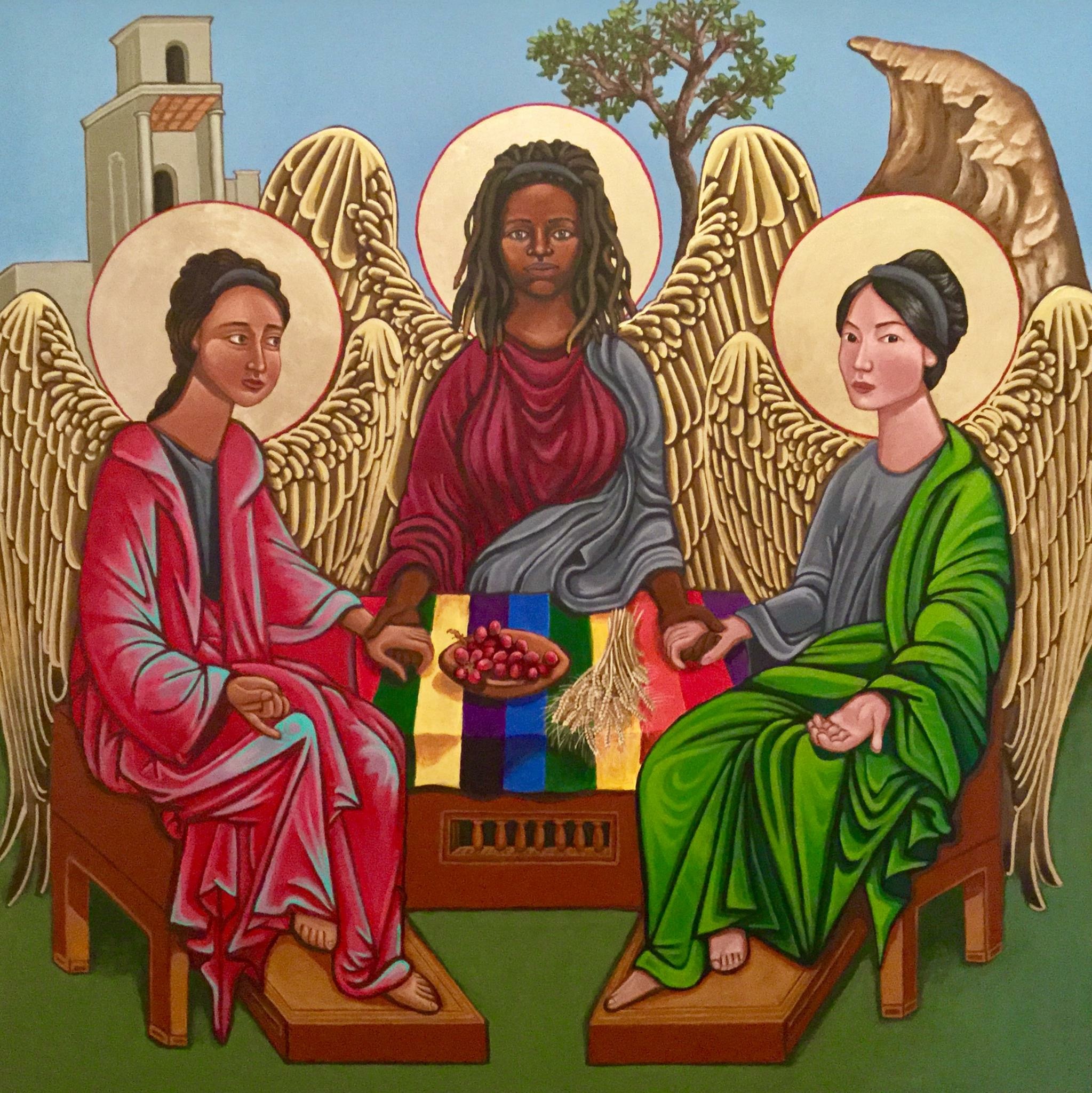
Image Credit: Trinity by Kelly Latimore. From Art in the Christian Tradition, a project of the Vanderbilt Divinity Library, Nashville, TN. https://diglib.library.vanderbilt.edu/act-imagelink.pl?RC=57123 [retrieved May 27, 2026]. The artist has granted permission for the non-commercial use of this image with attribution. The artist must be contacted for other uses: Kelly Latimore Icons, https://kellylatimoreicons.com/
Trinity Sunday, Year A
31 May 2026
Genesis 1:1-2:4a
Psalm 8
2 Corinthians 13:11-13
Matthew 28:16-20
Most of you know that I consider myself a Christian pacifist, and have for as long as I can remember. That I became a Christian pacifist was undoubtedly helped by the fact that I was born 19 years after WW II, a war my nation had started, and that my parents and grandparents remembered. And then I always believed that Jesus meant the stuff he said about loving our enemies, turning the other cheek, and to pray for those who persecute us, so that we may be children of our Father in heaven; for he makes his sun rise on the evil and on the good, and sends rain on the righteous and on the unrighteous. (Mt 5:45) And of course, Jesus lived all this by dying for the Kingdom of God rather than killing for it.
I know that not everyone who is a Christian is a pacifist and I respect that, and I trust that all of us know that war is always a political and moral failure, even a war one deems it necessary.
I grew up in a time of mandatory military service. But because Nazi Germany had punished conscientious objectors and considered them enemies of the state, West Germany had enshrined conscientious objection in its constitution. If one chose to be a conscientious objector, one would have to appear in front of a panel. One of the questions one would be asked was to imagine what one would do if one walked through a park at night and one’s girlfriend was attacked. The question was not overly astute, but it highlights the way that conscientious objection is generally understood as unrealistic and out of touch, and as irresponsible.
It is not my intention to turn you into Christian pacifists, I want to talk about the Holy Trinity. But Christian pacifism seemed a good example to not just illustrate the foolishness of the cross but the fact that followers of Jesus live by a different reality than the one before our eyes, and because we inhabit a different reality our imagination is not constrained by the logic that most often drives our politics, which is a logic of power, and consequently the avoidance of humiliation, it is about succeeding, about efficiencies, and the financial bottom line.
Yet as the followers of Jesus we know that we meet Christ in the least of these and that when we are weak God is strong, consequently we value the admonishment of St Paul to let the same mind be in us that was in Jesus Christ who,
though he was in the form of God,
did not regard equality with God
as something to be exploited,
but emptied himself,
taking the form of a slave,
being born in human likeness.
And being found in human form,
he humbled himself
and became obedient to the point of death –
even death on a cross. (Philippians 2)
Today’s readings all reference the Holy Trinity in one way or another. The Holy Trinity is mentioned in the Apostolic Greeting of our reading from 2 Corinthians, Jesus invokes it in the Great Commission, and our reading from Genesis uses the divine plural, Let us make humans in our image, according to our likeness.
The Holy Trinity is the theological attempt to make sense of our experience of God in the way that the creeds talk about God as Father, Son, and Holy Spirit. And if God is not singular but Trinity then God is community and calls those created in God’s image into that community. The Christian tradition speaks of the mutual indwelling of the three persons.
But I want to return to God as a different reality. I think we intuitively know this not only in the sense that St Augustine says that our heart is restless until it rests in God and we are incomplete without God, but also in a more ordinary sense. I believe that many people (regardless of religious affiliation), maybe most, know that there is more to life than the eye can see, even if we often go after the low-hanging fruit of letting our lives be governed primarily by what the eye can see. Of course, that is why worship is so important in grounding us in something else, in that other reality, in God.
The theologian James Alison talks about our life as creatures in a playful way.1 He says that he imagines the world and us in it and our relationship to God as a ball perfectly balanced on the nose of a sea lion.
Or put another way, Alison says that the notion that there is a God rather than simply the things we know means that we find ourselves on the inside of something. Think of the ball on the nose of the sea lion. There is something outside of that ball. Alison says that finding ourselves on the inside of this world confirms that everything we see, everything around us is real, that it exists, and that there’s an outside to it.
And then he says, and this may surprise us, the fact that there is an outside to it means that we are not trapped. And I think we all know the experience of being trapped, trapped in obligations we never agreed to or signed up for. These kinds of obligations we usually call rationalizations, and rationalizations mean that we believe we have no choice. That may refer to the economic system in which we live, or to the kind of barriers a society puts up to immigration, or the way the natural world is degraded by the economy in which we participate. But Alison says that the fact that there is a God who is outside of us (this is reminiscent of Luther’s extra nos) means that we are not trapped, that being human isn’t a trap, that life isn’t simply a series of distempered fights, squabbles over who is stronger, putting each other in places of shame so as to destroy each other, and the survival of the fittest. Being human is much more than that.
It is into this scene that Jesus steps. God who entered the world in Jesus, the second person of the Trinity, reminds us that there is an outside. It is by coming into the world that Jesus reminds us that there is an outside and by living among us Jesus shows us that there is a different way to being human. And his coming into the world makes it possible for us to transcend the rationalizations and to no longer be trapped because those who are in Christ are a new creation.
Alison comes from a particular theological place. It is a place that sees human desire as disordered and as the root of conflict. Thus the violence we experience (and there is lots of it these days) is ours, not God’s. This affirms that Jesus did not come to appease a violent God, for God is not violent, but to redeem a violent humanity. This makes sense in many ways, but just consider that it was not God who murdered Jesus but the Roman Empire.
Now disordered desire is the root of sin but the Holy Spirit gives us new desires. Alison says that as there is an outside to the way we live, there is an outside to desire. The outside to desire is what we call the Holy Spirit. It means that there is an outside to our passions and to all the ways we run each other in more or less cruel and awful ways. Our cruelty is not actually reality. Alison does not mean to suggest that cruelty is not real for people who suffer it or who commit it. Alison speaks in the way that St Augustine defined evil. St Augustine says that goodness has essence because it comes from God but that evil has no essence, has no being. That is why we can say the cruelty of the world is not what is real. Evil has no essence.
Now the Holy Spirit is crucial here. Remember what Jesus says to his disciples when he first talks about his death, about leaving them. He says, But the Advocate, the Holy Spirit, whom the Father will send in my name, will teach you everything, and remind you of all that I have said to you. (John 14)
By teaching us and reminding us the Holy Spirit reminds us of what is real and enables us to go beyond the rationalizations, the traps, the evil, and when we do, when we follow the Spirit, we enter into God, we enter into what is real. That is the extraordinary power of the Gospel.
When I first heard Alison speak of inside and outside it took me a while to understand. The inside refers to being self-sufficient and drawing only on one’s own resources, which means that it is a world lacking God’s imagination, a world of disordered desires, and a world in need of redemption.
And then Jesus, the second person of the Trinity, comes into the world and shows us what God is like. His death on the cross showed us what God is like, Jesus showed us God’s love.
The Holy Spirit helps us understand this so that we do not think that God killed Jesus and then get God all wrong, and if we got God wrong then we would get following Jesus wrong, and if that happens then we are still trapped and haven’t stepped outside of the systems we have devised.
God created the world in love, God redeemed the world in love, and God helps us understand God as love, and thus opens up a world that otherwise would be closed to us.
The Holy Trinity is love, is the three persons mutually indwelling each other, and it is the only reality that is real. And as God has come to us, so the Holy Trinity invites us into its communion.
Amen.
1 During the pandemic Alison started the YouTube channel “Praying Eucharistically”. This sermon is indebted to his Homily for Trinity Sunday (2020)