

Day of Pentecost, Year A,
24 May 2026
Numbers 11:24-30
Psalm 104:24-34, 35b
Acts 2:1-21
John 20:19-23
The church I served in Winnipeg was the first church I served following my ordination. The church was located in Winnipeg’s West End where the members of the congregation had lived before they had moved to the suburbs. By the time I arrived perhaps only a third of the members were still living in the neighbourhood. Most of them identified ethnically as German, even if their family had been here a generation or two. Following WW II the congregation had grown significantly through immigration and through the industrialization of the farm economy that caused the move of many rural residents to the city. I was told that when the new building opened in 1965 there were 400 children enrolled in Sunday School, and this was only the Sunday school. I do not know what Sunday attendance was in those days. By the time I arrived in 1994, the general decline of church attendance and periods of conflict in the congregation had let Sunday attendance drop to about 170. But as in other congregations, there was sadness about the decline and nostalgia for what was a relatively recent memory. There was also sadness about the changes that had occurred in the neighbourhood. As our members had moved to the suburbs, Portugese, Filipino, Vietnamese, and urban aboriginal people had moved in. Because the houses were smaller and older, they were more affordable. Poverty, crack houses, and prostitution had also moved to the neighbourhood.
When I arrived, a number of people expressed great admiration for Harry Lehotsky. Harry had moved to the neighbourhood to minister to the neighbourhood and to build a congregation there. For this he had the support of congregations of the North American Baptist Conference to which he belonged. He and his congregation engaged in some controversial practices like publishing the license plates of johns on the internet. These were the early days of the internet and so perhaps moral clarity was lacking. But they also bought up crack houses, renovated them, and rented them to low income families. While many people at Church of the Cross felt alien in the neighbourhood, the folks at New Life Ministries sought tangible ways to show God’s love to their neighbours with more than words.
Thinking back to those days, I believe some people in the congregation I served hoped for me to be a Harry Lehotsky, even while they too wanted things to go back to the days they remembered. Others spoke of our neighbours as undesirables, language that was never challenged by those who admired Harry.
I was fresh out of seminary when I arrived in Winnipeg. And at least the engagement with poverty and social issues was not something I had been taught. Yet when on Sundays people came to our door seeking some kind of support, the ushers always sent them to me.
When the ushers sent our neighbours to me instead of themselves listening to our neigbours’ needs, I always wondered what made them think that I was an expert at connecting with the poor. I did not articulate it back then, but my intuition was, “You have been a follower of Jesus longer than I have, and these have been your neighbours longer than they have been mine. What is it that makes you uncomfortable and why, and what makes you think that I may be more qualified than you to show compassion?” Compassion means to suffer with.
Our reading from Numbers is preceded by the complaining of the people to Moses and Moses’ complaining to God about the peoples’ burdens that have landed on his shoulders. Moses calls God to task and says, 12Did I conceive all this people? Did I give birth to them, that you should say to me, “Carry them in your bosom, as a nurse carries a sucking child”, to the land that you promised on oath to their ancestors? 14I am not able to carry all this people alone, for they are too heavy for me. 15If this is the way you are going to treat me, put me to death at once – if I have found favour in your sight – and do not let me see my misery.’
Upon Moses’ lament God commissions Moses to appoint seventy elders for God to pour God’s Spirit on, and thus for them to share in Moses’ burden, even if only for a time.
The people’s complaint is shaped by nostalgia for Egypt, a nostalgia that has forgotten slavery and infanticide and only remembers meat, cucumbers, melons, leeks, onions, and garlic. Sort of like after a generation or so, the memory of the old country and its culture becomes reduced to ethnic dishes.
But none of us are immune to nostalgia and so it may be helpful for us learn that the Hebrew name for the Book of Numbers is “In the Wilderness” (בְּמִדְבַּר, B’midbar). This is because the entire book is a journey through the wilderness. The church may find itself in the wilderness. And increasingly as our world is becoming less stable, all of us, inside and outside of the church, find ourselves in a wilderness where nostalgia is a very real temptation.
Yet the people cannot return and at least in some ways the same is true for us. Neither church nor world have to be the way they are now, but they will not be again what they once were. And just as Moses was not the saviour, nor Harry Lehotsky, nor any pastor or person we have known, but only people along the way, so has God been seeking us since the beginning of creation, for that was the purpose of creation, so that
(…) the earth will be filled
with the knowledge of the glory of the Lord,
as the waters cover the sea. (Habakkuk 2:14)
Peter, in his Jerusalem sermon on the day of Pentecost, quotes not Habakkuk but Joel.
17In the last days it will be, God declares,
that I will pour out my Spirit upon all flesh,
and your sons and your daughters shall prophesy,
and your young men shall see visions,
and your old men shall dream dreams.
18Even upon my slaves, both men and women,
in those days I will pour out my Spirit;
and they shall prophesy.
It is this democratic outpouring of God’s Spirit that we celebrate today. God’s Spirit is poured out on all disciples. On all of them, on you and on me. This does not mean that everyone of us can do all things, there are still particular gifts (as St Paul reminds us), but it does mean that welcoming, listening, and serving are things delegated not only to the professionals or those designated. It means that ministry belongs to the Church; it belongs to us all.
That God’s people shall prophesy and have visions means that the Church is a prophetic community that reads and interprets the scriptures together and whose speech transcends the devotional and therapeutic. The Holy Spirit shapes us into a community that articulates God’s vision for the world, a vision that informs our service in the world, a vision that is often counter-cultural.
For my Winnipeg context it meant that there was nothing regrettable about our new neighbours who had been there long before I arrived, rather, they were God’s gift to us, people from whom we could learn, and with whom we could make the neighbourhood more into something that aligned with the mission of Jesus to
to bring good news to the poor,
to proclaim release to the captives
and recovery of sight to the blind,
to let the oppressed go free,
and to proclaim the year of the Lord’s favour.’ (Luke 4)
On Pentecost God’s Spirit is poured out on all God’s people, the Spirit given to us is prophetic, it is equipping, and it is vocational. The disciples are no longer behind locked doors and they are no longer silent, but they speak and act in God’s name.
And that is the gift of the Spirit and the freedom of the Gospel.
Amen.
Image Credit:
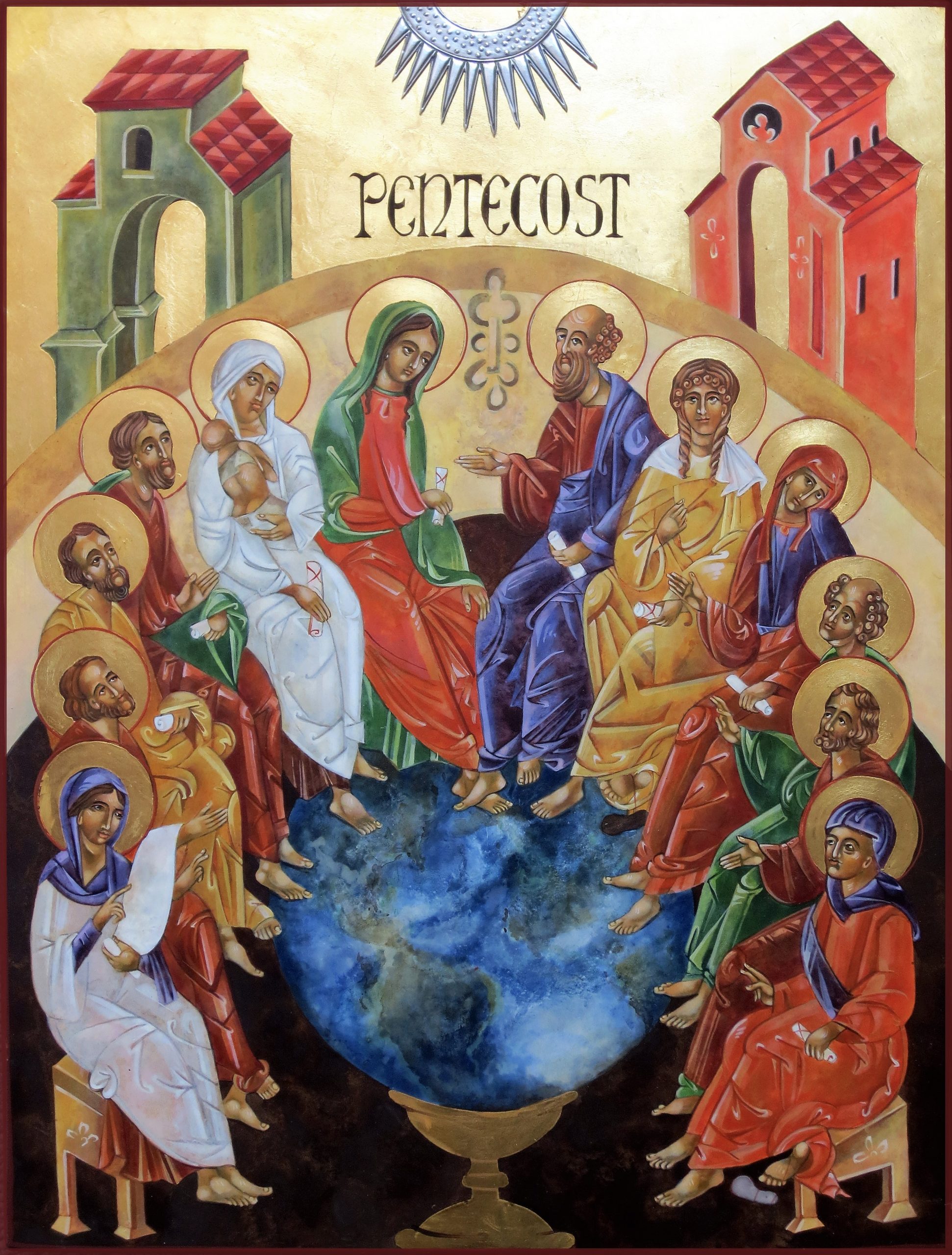
Pentecost (A Second Version)
Commentary by the Artist:
“Acts 2: 17,18 God says, I will pour out my Spirit on all people. Your sons and daughters will prophesy… Even on my servants, both men and women, I will pour out my Spirit in those days, and they will prophesy.” Pentecost was the Jewish holiday of Shavuot, or Festival of Weeks, a holiday in honor of the first fruits of the harvest. The annual celebration commemorates receiving the laws – the Torah – on Mount Sinai – fifty days after the first day of Passover and the Exodus from Egypt. According to the book of Acts, the disciples are gathered in one place. The disciples hold books while others hold scrolls. In later icons you find four disciples holding books and crosses on their stoles representing how the church hierarchy was forming…In the second version I have included women. I believe they too were there as witness and recipients, receiving the holy spirit and advocate in full measure. All of them present have their feet firmly placed on the earth. We are a collective species having been given a world to love and cherish. Our Earth abounds with all that is necessary for abundant life and the spirit of God has been given in full to humanity. Let us live in peace.”
Narrative Icon Collection
The collection of 12 narrated biblical event and feast days are taken from my book Life in Christ 2021, Knowledge of God made visible in Jesus the Man.
Mary Jane Miller is a self-taught Byzantine style iconographer with over 28 years of experience, born in New York and living in Mexico full time. Her collections of sacred art are contemporary, with a proficient command of egg tempera. The work is extraordinarily rich in style and has been exhibited in museums and churches in both the United States and Mexico. As an author, Miller blends historical content and personal insights to arrive at contemporary conclusions about faith. Her six self-published books include Icon Painting Revealed, Mary in iconography, In Light of Women, and Life in Christ and The Stations. Miller has been published online and in publications such as Divine Temple, Russian Orthodox Journal, Faith and Forum Magazine, Liturgy Today and Profiles of Catholicism. She teaches 4 courses annually, 5-day immersion workshops throughout the US and Mexico. Website: https://www.millericons.com/, https://sanmiguelicons.com/
The artist has granted permission for the non-commercial use of this image with attribution. The artist must be contacted for other uses.
from Art in the Christian Tradition, a project of the Vanderbilt Divinity Library, Nashville, TN. https://diglib.library.vanderbilt.edu/act-imagelink.pl?RC=59681 [retrieved May 20, 2026]. Original source: Mary Jane Miller, https://www.millericons.com/