

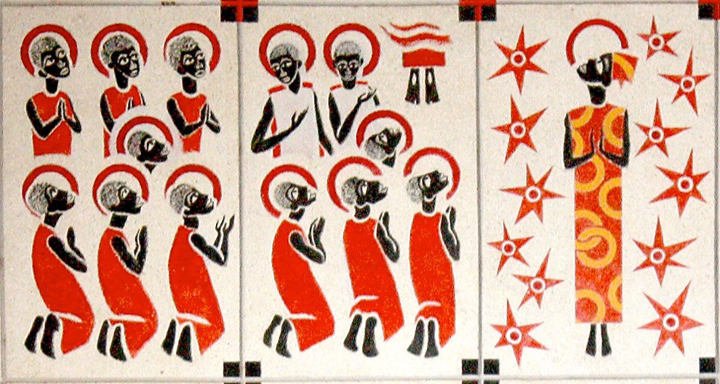
Image Credit: Ascension of Christ, Fr George Saget (1963), Altar mural at Abbaye de Keur Moussa (Senegal), https://commons.wikimedia.org/wiki/File:KeurMoussaAutel.jpg
Ascension Day 2026 or My Grandfather Part 2
Ascension of the Lord
14 May 2026
Acts 1:1-11
Psalm 47 or Psalm 93
Ephesians 1:15-23
Luke 24:44-53
Preacher: Ron Vonk
Last year I also had the privilege of speaking on Ascension Sunday. Last year I told you about my maternal grandfather who died one month short of his 102nd birthday. I described my grandfather as a witness for Jesus even at a time in his life when he was confined to a wheelchair in an extended care home. As a witness for Jesus my grandfather listened carefully to his visitors when they talked to him. After each visit my grandfather prayed for God to help visitors with whatever problems they had shared with my grandfather. My grandfather often told people, “My sins are forgiven because of the grace of God.”
This year I want to tell you more about my grandfather. My grandfather said some terrible things about first nation’s people. He was unkind to first nations’ people. He did not appreciate the horrors many of these people faced as children in residential schools.
Much of my grandfather’s prejudice against first nations’ people was the result of his work with tuberculous patients in the Aberhart hospital where my grandfather worked as a nursing orderly. Indigenous patients in the hospital were isolated from other patients. They were also isolated from their home communities. Survivors of tuberculous in hospitals like Aberhart report lack of communication with family, poor care, and, in some cases, abuse. My grandfather played a part in a medical system that failed first nation’s people suffering from tuberculous.
How can I reconcile this picture of a kindly old man in a wheelchair who celebrated God’s grace to him but also held deep seated disgust for a group of people who are also eligible for the same grace God extended to my grandfather?
Today’s gospel reading from Luke helps us to understand people like my grandfather. The disciples also carried a deep seated disgust for another group of people. The disciples were disgusted by the gentiles. The disciples were disgusted by people like us who are not Jews. I pray that Luke’s account of the ascension of Jesus helps us understand God’s grace to us and to others. I pray that Luke’s account helps us to better understand ourselves and helps us understand some of our own personal failures.
I want to focus on 3 main points in our gospel reading. The first point is in verses 45 that tells us Jesus opened the disciples’ minds to understand the scriptures. The second point is in verse 48 that tells us that the disciples are witnesses to the suffering and rising from the dead of Jesus. The third point is in verse 52 where we read that the disciples worship Jesus and return to Jerusalem with great joy. The disciples worship as they wait for power on high that we will learn about at Pentecost.
I begin with point #1. Jesus opens the disciples’ minds to understand the scriptures. Jesus tells the disciples that the Old Testament points to the Messiah’s suffering and rising from the dead and the Old Testament tells the disciples that repentance and forgiveness of sins is to be proclaimed in the Messiah’s name to all nations.
There is a problem with what Jesus tells his disciples. The Old Testament’s relationship to these reminders by Jesus are anything but obvious. Yes, the Old Testament does speak about a suffering servant. Isaiah 53 verses 7 and 8 are a good example (often applied to the nation of Israel as a whole). Isaiah says this, “He was oppressed and he was afflicted …. By perversion of justice he was taken away …. Stricken for the transgression of my people.”
The Old Testament also speaks about some kind of resurrection on the third day. Hosea 6 verse 2 is a good example. Hosea says this, “After 2 days he will revive us; on the 3rd day he will raise us up, that we may live before him.” Hosea implies that the condemned people of Israel will be resurrected on the 3rd day. Only after the resurrection are the disciples able to connect Isaiah and Hosea’s ideas together and apply them to Jesus. But for us the connections are not as obvious as we might like.
Let me explain how Old Testament passages like Hosea apply to Jesus. The New Testament clearly places the blame for the death of Jesus on people like us. We pervert justice. We sin as they perverted justice and they sinned. Notice what Jesus does with Hosea’s words. Jesus joins us in our position as condemned people. We stand condemned with Israel. Jesus stands with us. Jesus claims that because he rose on the third day, we are raised up on that same third day! Great news!
We need the help of these early followers of Jesus and we need the help of the writers of the Old Testament to understand the reality and the implications of the death, resurrection and the ascension of Jesus. That help is made available to us through our reading of the scripture.
When it comes to our lack of understanding, we are in good company with many of the people we meet in the gospel of Luke. I want to point out some examples. In Luke 2 when Jesus is 12 years old and sitting among the teachers at the temple, Mary his mother does not understand that Jesus “must” be in his father’s house. In Luke 8 many of those who listen to Jesus do not understand the parables. In Luke 9 the disciples do not understand that Jesus is going to be betrayed. Luke tells us that the disciples are afraid to ask Jesus about his betrayal. The implications of such a betrayal are just too much for the disciples to even think about. Finally in Luke 18 after Jesus adds gruesome details about his betrayal, Luke again tells us, “the disciples understand nothing …. They do not grasp what is being said.”
I suspect we have sympathy for Mary and the disciples of Jesus. Mary was his mother. She wanted her 12 year old son home with her. The disciples were part of an oppressed people group. They wanted a Messiah like King David who would lead his people in a successful military campaign against hated gentile nations. Death of their Messiah was not part of their plan. Today I am not sure we want a Messiah who calls us to repent and live a life of sacrifice for others. Like us, the disciples need Jesus to open their minds and we need Jesus to open our minds to understand the scriptures.
Now point #2. The disciples are witnesses to the suffering and rising from the dead of Jesus. Repentance and forgiveness of sins is to be proclaimed in the name of Jesus to all nations. This is God’s plan now and has been God’s plan all alone – a plan that the disciples understand now as they read Old Testament passages like Isaiah and Hosea.
But like us the disciples resist God’s plan to proclaim repentance and forgiveness of sins to hated people groups. It took repeated reminders and prodding’s by the Holy Spirit for the disciples to realize God accepts people from all nations and from all ethnic groups. The book of Acts is filled with examples of disciples’ resistance to God’s plan. After the disciples came to terms with a suffering and dying Messiah they still needed to come to terms with accepting gentiles like us into God’s family without distinction. And after 20 centuries of preaching a crucified Messiah accepting all people equally, our problem accepting all people still haunts our churches.
Accepting all people equally was a problem in the church in which I was raised. 100% of us were Dutch Reformed Christians. I suspect accepting all people equally was also a problem in Lutheran churches. My grandfather had a problem accepting first nation’s people. I pray God help us to speak about our faith not only to people we are comfortable with, people like us, but also to people we do not know well because of cultural differences. We are witnesses. We proclaim repentance and forgiveness of sins in the name of Jesus to all nations.
Point #1. Jesus opens our minds to understand the scriptures. Point #2. We are witnesses. Finally, point #3. We worship.
Notice that as Jesus leaves his disciples, Jesus blesses his disciples. Jesus does not leave without a word of blessing. Jesus puts the disciples under the protection of God. The disciples respond to the blessing with worship. They worship Jesus. They return to Jerusalem with great joy. And after that they are continually in the temple blessing God.
I like the fact that the gospel of Luke both begins and ends at the temple. And it begins and ends with joy and worship.
Luke begins with people praying outside the temple and the priest Zechariah in the temple at worship receiving a word from God. Luke begins with Mary’s song of praise. The gospel begins with words like, “my spirit rejoices in God my Saviour.” Luke begins with an old man named Simeon at the temple praising God. The gospel begins with praise and worship.
As Luke begins at the temple with God at work in the lives of people like Zechariah and Mary and Simeon, Luke ends with God at work in the disciples who are also at the temple blessing God. God is at work and something marvelous is about to happen at the beginning of Luke. God is as work and something marvelous is about to happen at the end of Luke. God is also at work in our lives and something marvelous is about to happen.
I admit that my grandfather struggled with prejudice all of his life. As a young child I heard my parents and grandparents speak disparagingly about German people. Some of their prejudices were the result of the horrors of World War 2. When my grandfather cared for first nation’s people in Aberhart hospital some of that same prejudicial thinking came out again. The idea of accepting all people equally did not come easily for my grandfather. While my grandfather knew that his sins were forgiven because of the grace of God, he had trouble accepting that this same grace was extended to people he looked down upon.
Just before my grandfather died, I placed my hands on my grandfather and I pronounced the priestly blessing on him. We know the words well as Christoph also pronounces similar words on us each Sunday. (Numbers 6) “The Lord bless you and keep you, the Lord make his face shine upon you and be gracious to you, the Lord turn his face toward you and give you peace.” These were my final words to my grandfather.
After my final words of blessing on my grandfather, my grandfather’s final words to me were “the grace of God” and the single word “thank you.” His final words to me were words of grace, forgiveness and thankfulness.
And now these final words from the gospel of Luke and these final words from my grandfather are words to us this morning. Our sins are forgiven because of the grace of God. Jesus continues to open our minds to the words of scripture. Now we will soon go out to our worlds as witnesses to the suffering and rising from the dead of Jesus. As worship ends we return to our homes with joy. We return to our homes under the blessing of God who began his work in us with a word of blessing.
Thanks be to God.