

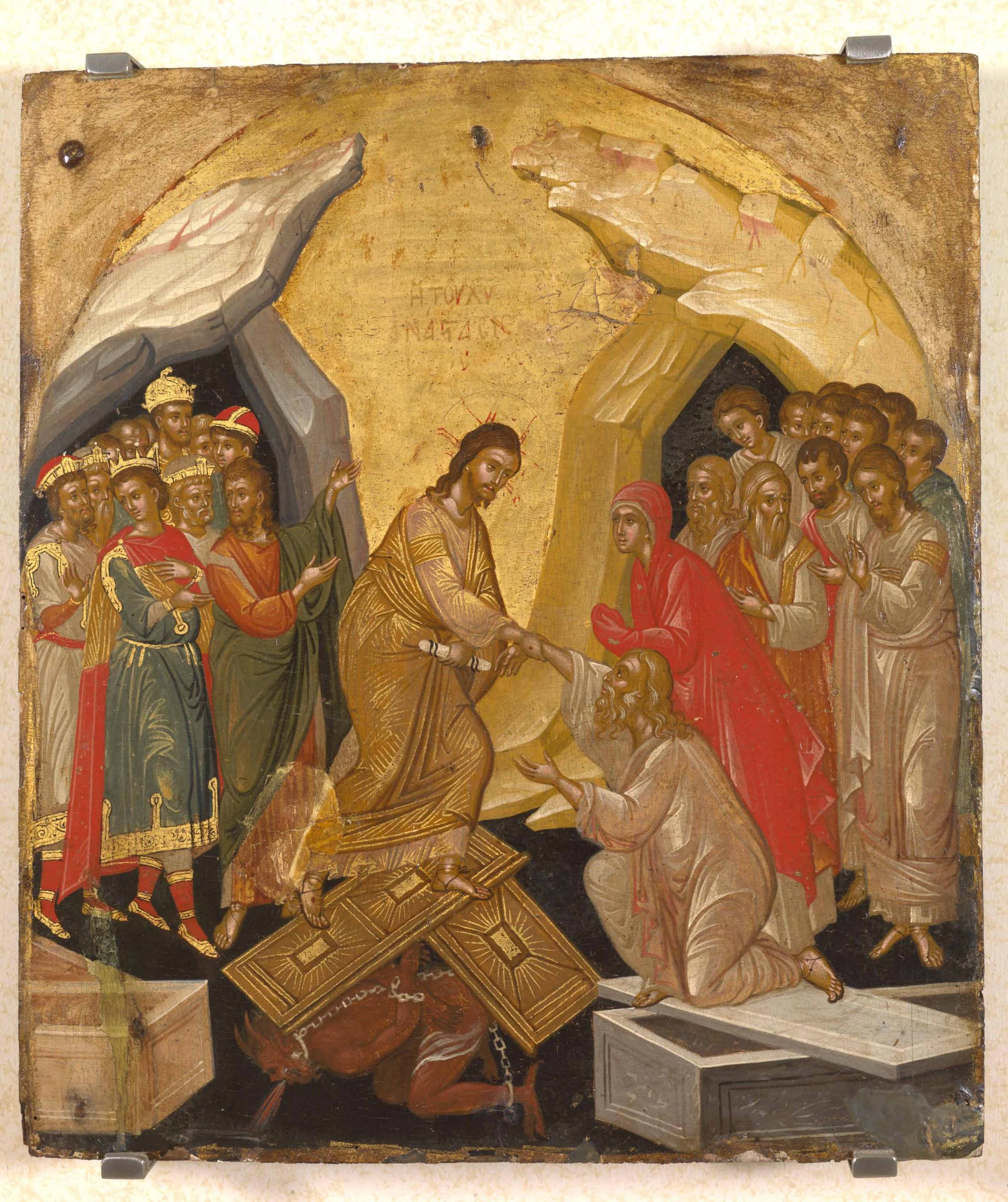
Image Credit: The Resurrection of Christ also known as Descent into Hades or Harrowing of Hell is a late 16th century icon. Here Christ is not surrounded by glory and there are no angels with the symbols of the Passion. Adam kneels on the sarcophagus lid, which is placed diagonally. John the Baptist points to Christ with a theatrical gesture and Hell breathes fire from his mouth. The writing on the painting is The Resurrection of Christ (Η Τον Χριστού Ανάστασιν).
https://en.wikipedia.org/wiki/Harrowing_of_Hell#/media/File:Harrowing_of_hell_by_M.Bathas_(16th_c.).jpg
Sixth Sunday of Easter, Year A
10 May 2026
Acts 17:22-31
Psalm 66:8-20
1 Peter 3:13-22
John 14:15-21
When I first came to Canada I was surprised to discover a number of German loanwords part of the English language, not just words like kindergarten and beer garden but also hinterland, blitzkrieg and Schadenfreude. Of course, Schadenfreude is the pleasure we experience at the misfortune of others. Germans, not to be outdone, have imported the word fairness in return.
Now, Schadenfreude is a universal human experience, even though it is not a noble one. Both fairness and Schadenfreude are actually about justice or about what we perceive as such. Schadenfreude is what we embrace naturally and then call it fairness, or karma, or what goes around comes around. However, God does not operate that way. 8For my thoughts are not your thoughts, nor are your ways my ways, says the Lord. 9For as the heavens are higher than the earth, so are my ways higher than your ways and my thoughts than your thoughts. (Isaiah 55)
You know the story of Israel’s bondage in Egypt. It was through Joseph that his brothers and his elderly father Jacob had come to Egypt. Joseph had had dreams, and had also been his father’s favourite, something that had not gone well. In jealousy, his brothers had sought to take his life but on the intervention of his oldest brother Reuben his life was saved and he was sold into slavery instead, ending up in Egypt. After his rise to a position of great authority and when his brothers come to Egypt to escape famine and at last Joseph and his brothers reconcile, Joseph does not say to his brothers, “What goes around comes around,” but he says, Even though you intended to do harm to me, God intended it for good, in order to preserve a numerous people, as he is doing today. (Genesis 50)
The Book of Exodus begins by naming Joseph’s family and then tells us that … a new king arose over Egypt, who did not know Joseph. He said to his people, ‘Look, the Israelite people are more numerous and more powerful than we. (Exodus 1)
The first recorded incident of xenophobic fear, “There are more of them than of us.” This sets the stage for the yoke of slavery God’s people endure and for the story of Moses whom God calls to deliver the people. There is the Burning Bush where God calls Moses, the plagues, and at last the escape from Egypt, followed by the giving of the 10 commandments and God making covenant with not just patriarchs and matriarchs but with a people.
When in the dramatic escape through the sea Pharaoh and the Egyptian Army drown, Moses and his sister Miriam lead the people in song. They call God a warrior, and Miriam sings,
Sing to the Lord, for he has triumphed gloriously;
horse and rider he has thrown into the sea. (Exodus 15)
If the Pharaoh’s statement about us and them is the first recorded xenophobic statement, then this may be the first documentation of Schadenfreude.
Yet even though it is clear why the Israelites would celebrate their rescue, already the Talmud questions the celebration, at least indirectly. (The Talmud is an important Jewish commentary dating back to the 6th century).
The story is told that “[o]n seeing the drowning Egyptians the angels were about to break into song when God silenced them declaring, ‘How dare you sing for joy when My creatures are dying’ (Talmud, Megillah 10b and Sanhedrin 39b).1 Of course, God had created the Egyptians, too.
The First Letter to Peter was written to a people experiencing persecution. Christians during the time the letter was written were a small minority, even in places where churches were flourishing. Perhaps there were 40,000 Christians in an empire of 70 million.2 We also know that the Christians addressed in the letter were people without power which is why the letter addresses slaves and not slaveholders.
One of the ways in which Peter seeks to console people in their suffering is by reminding them of the suffering of Christ. Verses 18 to 22 of our reading are a quotation of an early Christian hymn, and is comforting both, for what it says and for the recipient’s familiarity with it in the way that we find comfort in familiar scripture or hymns.
The widow of a friend and colleague of mine used to end her e-mails with the words “leaning on the everlasting arms.”3
And so quoting the hymn, Peter speaks of the suffering of Jesus, a suffering the addressees of the letter understand first-hand even though the affliction of Jesus was not only by sinners but it was also for sinners.4 Peter writes, 18For Christ also suffered for sins once for all, the righteous for the unrighteous, in order to bring you to God.
The hymn proclaims the hope of those who trust in Jesus, and thereby shifts the focus away from their own suffering to Jesus. And this is particularly helpful, for when we experience suffering it is so easy to no longer see anything else.
But it is what comes next that strikes me as remarkable. Peter writes,
He was put to death in the flesh, but made alive in the spirit, 19in which also he went and made a proclamation to the spirits in prison, 20who in former times did not obey, when God waited patiently in the days of Noah, during the building of the ark, in which a few, that is, eight people, were saved through water.
Did you catch that? This is what we profess in the Apostles’ Creed. “He descended to the dead.”
Peter says, Jesus went and made a proclamation to the spirits in prison, 20who in former times did not obey, when God waited patiently in the days of Noah, during the building of the ark, in which a few, that is, eight people, were saved through water.
The phrase of the Apostles’ Creed can be interpreted that in Jesus God took no shortcuts to our salvation, i.e. he even descended into hell. But I find this verse remarkable not only because it explains a perhaps otherwise obscure phrase of the Apostles’ Creed. I find it remarkable that Peter here identifies God’s intent to save not only those the letter is addressed to, not only the followers of Jesus, but those who in former times did not obey, i.e. the unrighteous. It is congruent with what Paul says in Romans five, Christ died for the ungodly. There is only mercy and no Schadenfreude at the lot of the unrighteous.
This is not the usual way a persecuted group seeks to resolve their suffering. The human instinct is to say that if we can’t punish them, then God will and that their suffering would constitute divine justice. It is what people lament in our justice system even though inflicting the same on a perpetrator as a perpetrator has done will not make anything undone, nor help the pepetrator to turn from their sinful ways and live.
Instead, the Church remembers that Christ came for sinners and that the church’s own saving through the waters of baptism is not unlike God’s saving of Noah and his family, but that God’s mercy does not stop there for God’s desire to save goes all the way back and no one is exempt from God’s desire to save.
Christ “descended to the dead” used to be translated as Christ “descended into hell.” While it may seem obscure to us, it not only is a post-script to the flood story of Genesis 6 to 9 and its very resolution but it also has animated the Christian imagination.
The Eastern Orthodox tradition calls this the Harrowing of Hell. The apocryphal Gospel of Nicodemus5 tells of Christ breaking the “indissoluble” chains and visiting “us” who were sitting in the deep darkness of trespasses and “in the shadow of death.” It tells of Jesus stretching out his hand and saying, “Come to me, all you my saints that have my image and likeness.” Of course, all of us were made in the image and likeness of God (Genesis 1:26). At the culmination of the story of the Harrowing of Hell (in the Gospel of Nicodemus) Jesus makes the “sign of the cross” on Adam and all his saints and then ascends from Hades.6
I take great comfort in seeing that those who are suffering are also a community who preserved a letter that encouraged them to look to Christ and to remember that God desires everyone to be saved and to come to the knowledge of the truth (1 Tim 2:4), and that that includes their enemies. Even though 1 Peter was written first, it echoes the sensitivity of the Talmud when it tells us that God forbade the angels to rejoice in the perishing of the Egyptians, and it is able to affirm God to be at work where we see nothing. Think of Joseph’s word to his brothers, Even though you intended to do harm to me, God intended it for good.
Understanding God’s desire for salvation we can then understand Paul’s speech on the Areopagus not simply a smart rhetorical move but expression of the love of God, for Paul did not turn away from what repulsed him, namely the worship of idols, but turns with affection to those who worship idols, thereby mirroring the movement and affection of God. Paul’s words on the Areopagus are driven by the irrepressible longing of God to embrace wayward creatures by every means possible.7 God is love and God knows no Schadenfreude.
Those who abide in him and he in them are given the gift of such love.
Thanks be to God.
Amen.
1 Why did we sing when the Egyptians drowned? The angels were stopped from singing about the Crossing of the Red Sea but not the Israelites, The Jewish Chronicle, 18 April 2014.
2 Ramsay McMullen referenced by Fred Craddock in First and Second Peter and Jude, Westminster John Knox: 1995 Louisville, KY, page 14
3 What a Fellowship, What a Joy Divine, Evangelical Lutheran Worship ♫ 774, text by Elisha A Hoffman
4 Ibid. Craddock page 62
5 The earliest manuscript dates back to the 6th century, yet the ideas discussed to the middle of the 3rd. See Hunter Coates, The Harrowing of Hades in the Gospel of Nicodemus, posted on 19 November 2024 by Fr Aidan Kimel
6 Ibid.
7 Willie James Jennings, Acts, Belief – A Theological Commentary, Westminster John Knox: 2017 Louisville, KY, page 176