

click to access archived live stream
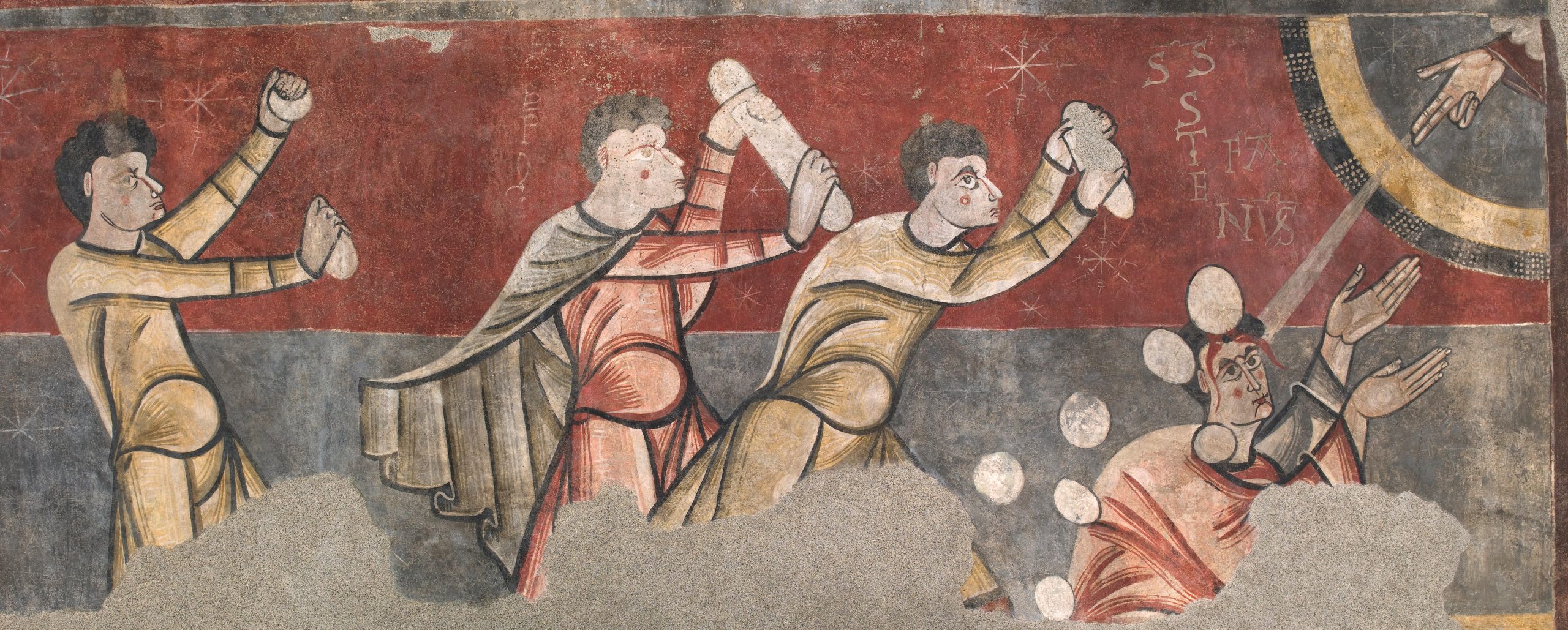
Image Credit: Stoning of Saint Stephen from Sant Joan de Boí (ca. 1100), anonymous, Museu Nacional d’Art de Catalunya in Barcelona, Spain. Art in the Christian Tradition, a project of the Vanderbilt Divinity Library, Nashville, TN. https://diglib.library.vanderbilt.edu/act-imagelink.pl?RC=55858 [retrieved April 29, 2026].
Fifth Sunday of Easter, Year A
3 May 2026
Acts 7:55-60
Psalm 31:1-5, 15-16
1 Peter 2:2-10
John 14:1-14
A lasting memory of our time in Manitoba are the New Year’s Levees of Manitoba’s lieutenant governor. With one exception, I was the only pastor of the Synod who attended during our years there. Not only do Jackie and I like good Christmas cake, which was served alongside wonderful shortbread and other treats, but we enjoyed meeting the lieutenant governor, MPs and MLA’s, judges, bishops, military brass, and one year Governor General Roméo LeBlanc and his wife Diana Fowler. It was one of the few occasions for which we would hire a babysitter. One of my memories from those days is a Manitoba MP introducing himself by giving his name, then adding MP,1 to which Jackie replied, “Jackie Reiners, mom.”
It is good for the Church to be present in the world and it is important to build connections in the community. But the levees provided a special pleasure because they seemed from a time past. The church had been in decline for some time but here everyone was pretending we were still part of the inner circle of power. And all of us knew that that was not the case.
We have long ceased to be part of the inner circle of power, yet we still have the privilege of tax credits, of voice in public conversations, of land, and of education. Yet privilege was not the experience of the early church, not the experience of the church in the Book of Acts, and not the experience of Stephen, the first martyr of the Church.
Today we long for the stability we once knew, when the church was close to the centre of society, when people came to church not just to worship but to network, and when the church had no competition on Sunday mornings. Yet if our only memory of the church dates back to the 1950s we have an incomplete picture of the calling and the life of the Church. Such incomplete vision can lead us astray.2
The Apostle Stephen died a martyr and we would not consider the days of martyrdom the good old days we wish to return to. That, however, is the story that we heard in our first reading. Our passage begins with the rage of the authorities which quickly leads to Stephen’s death. Stephen dies with the words of Christ on his lips, a sign of how his life was intertwined with that of Jesus.
While they were stoning Stephen, he prayed, “Lord Jesus, receive my spirit.” Then he knelt down and cried out in a loud voice, “Lord, do not hold this sin against them.” When he had said this, he died. (Acts 7:59-60)
But Stephen sees his death coming and between the rage of the authorities and his death we learn that Stephen filled with the Holy Spirit, (…) gazed into heaven and saw the glory of God and Jesus standing at the right hand of God. “Look,” he said, “I see the heavens opened and the Son of Man standing at the right hand of God!” But they covered their ears, and with a loud shout all rushed together against him. (7:55-56)
The Catholic theologian William Cavanaugh explains that “This is not simply a personal vision by Stephen of his own eternal reward. Stephen is pointing to the gap that has opened in the barrier between heaven and earth, just as the curtain of the Temple is rent asunder at the death of Jesus. Here, in imitating Jesus, in likewise cheating death of its sting, [Stephen] witnesses to the outpouring of the kingdom of heaven on earth. Heaven does not simply await [Stephen] in another space and time upon his (…) death. (…) The [faithful] imagination sees that, although they presume to kill us, Christ has vanquished the powers of death once and for all. A martyr is one who lives as if death does not finally exist.”3
We may think of Catherine of Siena’s beautiful word that “all the way to heaven is heaven because Jesus said that he is the way.”
Martyrdom remains part of what it means to follow Jesus, even if this has not been our experience. Yet it has been the experience of the Church of all times and places. The word martyr is Greek and means witness. Therefore, martyrs like Stephen are witnesses to the Lord Jesus. In this way being a martyr is diametrically opposed to having a seat at the table of the powerful. It is opposed because God has regard for the lowly while generally the powerful do not, and it is those with power who kill.
We celebrate Holy Communion each week. This was the practice of the early church that devoted themselves to the apostles’ teaching and fellowship, to the breaking of bread and the prayers (Acts 2:42), and it is a practice the church has recovered over the last 100 years.
Think for a moment about what we call the Body of Christ. In the context of Holy Communion it is a reference to receiving Christ in the sacrament. It is also the literal body of Jesus that walked the earth, was nailed to the cross, and rose from the dead. In the Eucharistic Prayer we recall Jesus’s command to ‘do this in remembrance of him.’4 The liturgy calls this anamnesis, remembering.
Our third understanding of the Body of Christ is the gathered community of the followers of Jesus. In Colossians St Paul says, He is the head of the body, the church (1:18), and in 1 Corinthians, Paul writes, For just as the body is one and has many members, and all the members of the body, though many, are one body, so it is with Christ. For in the one Spirit we were all baptized into one body—Jews or Greeks, slaves or free—and we were all made to drink of one Spirit. (1 Cor 12)
It is significant that the term the Body of Christ covers all three of these understandings. It is not just one of them but all three.
In our reading from 1 Peter we learn that God has shaped us into a people, we are not simply individuals who believe in Jesus, but God has incorporated us into the Body of Christ. In our Gospel reading Thomas asks Jesus for the way to the Father, and it turns out that Jesus is the Way, and so if we walk with Jesus, then our life will begin to look like the life of Jesus. That is the witness of Stephen.5
As Jesus celebrates the Last Supper with his disciples, he says, Do this in remembrance of me. This remembering is not merely a cognitive exercise, nor is it only a devotional practice, remembering that Jesus suffered for me, almost as if the Body of Christ was not also the community of the Church. Rather, “communion is a participation in the body of Christ, and the body of Christ is a body marked by death and resurrection. As a pamphlet from the Archdiocese of San Salvador has it, “To participate in the mass is to unite all our work, suffering, struggle, and death to the suffering and death of Jesus.’”6 San Salvador is, of course, where Archbishop Romero was martyred while celebrating Holy Communion.
And so we understand that Holy Communion is not simply a commemoration of a past dying, the dying of Jesus at the hands of the Romans. Rather, Holy Communion makes present that dying, incorporating us into a body marked with the signs of death, such that Christians, as Paul says, are ‘always carrying in the body the death of Jesus, so that the life of Jesus may also be made visible in our bodies’ (2 Cor 4:10). The eucharist, in other words, creates a body of people who by definition stand in the line of fire.7
Or put differently, “martyrdom recalls into being a people, the people of God, and makes their life, visible to themselves, to the powers, and to the whole world.”8
You may wonder what that means for us, who may be nostalgic for the church of the 50ies but remain comfortable and isolated from many of the stories we see on the news. “What can I do about it,” we may shrug.
Returning to the celebration of Holy Communion, Paul, in his instructions to the church at Corinth, says, For all who eat and drink without discerning the body, eat and drink judgment against themselves. (1 Cor. 11:29) For the Corinthians that meant to discern the injustices and inequalities among them. We live in a world of great injustices and inequalities, and that must mean that injustices and inequalities must concern us, for they do harm to the Body of Christ, to those who suffer but also to those who say that it is not our problem. It is about witness, which is what martyrdom is, so that we live in such a way that our lives would be unintelligible if God wasn’t present to us through the life, death, and resurrection of Jesus Christ.
Amen.
1 The late David Iftody of the Provencher riding.
2 The Guardian view on American Christianity: change and decay, Editorial, 15 January 2017.
3 Ibid. pp. 178-179
4 1 Corinthians 11
5 Last week was the 10th anniversary of the death of priest and activist Daniel Berrigan. Berrigan once said, “if you want to follow Jesus, you better look good on wood.”
6 William T. Cavanaugh, Dying for the eucharist or being killed by it? Romero’s challenge to first-world Christians, Theology Today, Volume 58, Issue 2, July 2001: 177-189), p. 182
7 Ibid. p. 177
8 Ibid. pp.181-182