
click to access archived live stream
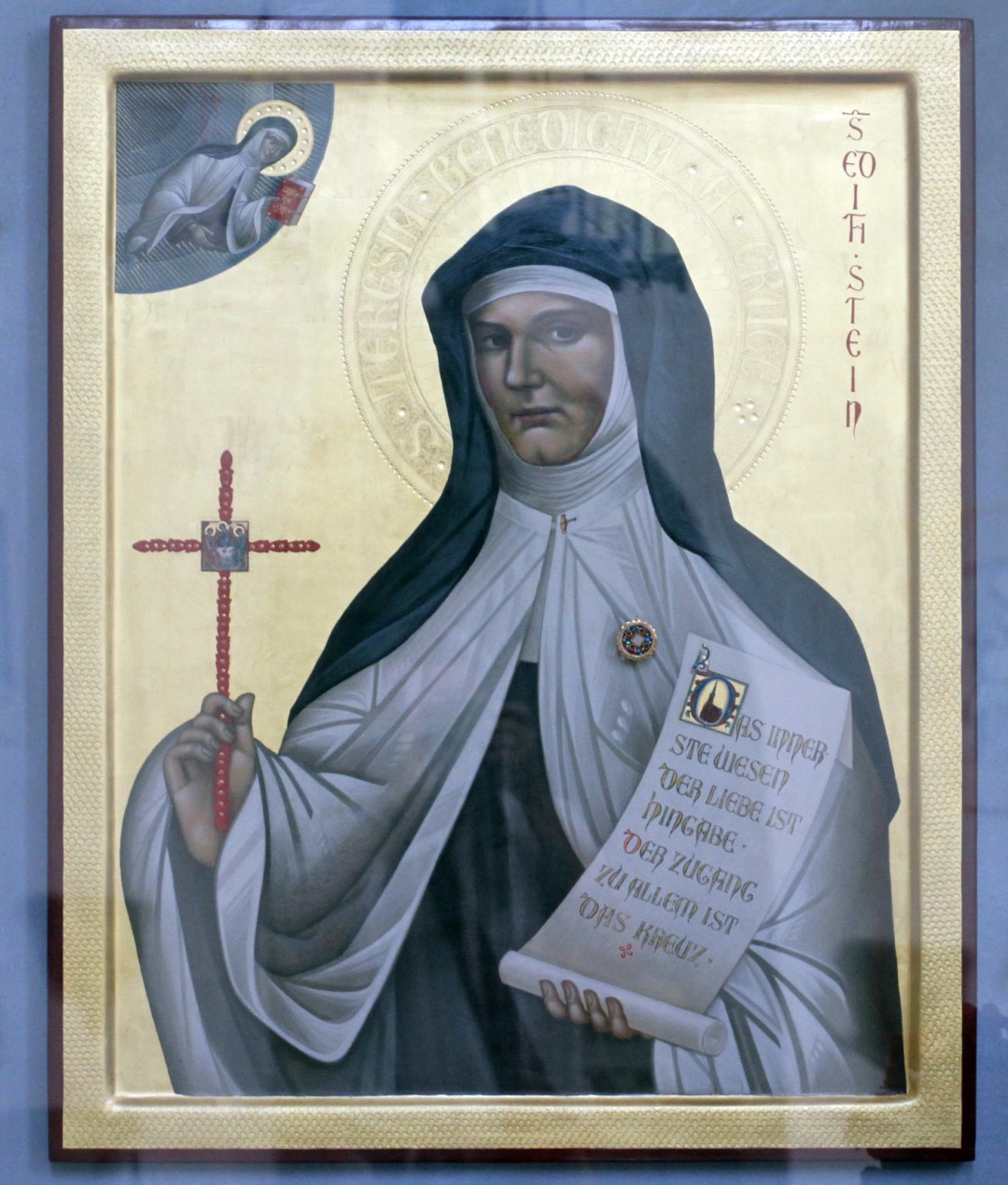
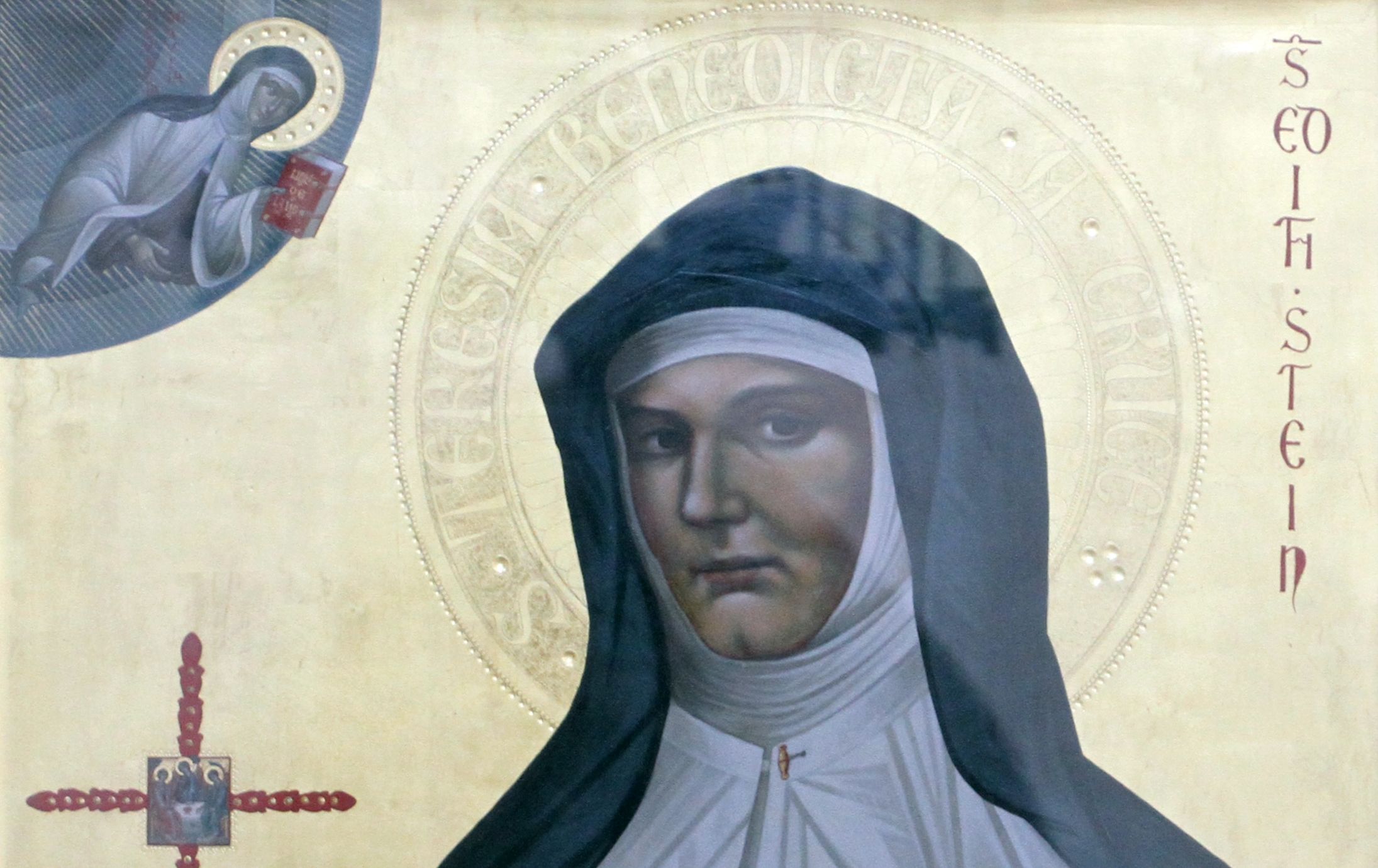
Image Credit: Icon in Bad Bergzabern.
The scroll shows a quote from her works, “The innermost essence of love is devotion, the cross is the entry to all things.”
Source: Wikipedia
Fourth Sunday of Easter, Year A
26 April 2026
Acts 2:42-47
Psalm 23
1 Peter 2:(13-18)19-25
John 10:1-10
The separation of church and state is anchored in the constitution of modern democratic states. Christian Nationalism muddles this by seeking the loyalty of the Church for the goals of the state and vice versa. It is unable to distinguish between church and state. Christian nationalism is about power, yet following Jesus is about serving.
William Cavanaugh says that the separation of church and state has come to disguise the fact that the modern nation state can exercise great violence, all the while maintaining that religion is violent. This promotes the idea that our violence is rational, peacemaking, and necessary while the violence of others is religious and therefore it is irrational.1
Religion has indeed been violent and continues to be so in many places (just listen to the American Secretary of War), but what the state really demands when it reduces religion to the realm of the private is the absolute loyalty and adherence that is due only to God. The Christian pacifist Stanley Hauerwas has pointed out that when you are allowed to kill in the name of the state but not in the name of religion, this means that the state demands an allegiance that rightly only belongs to God, though God wants us to love our enemies.
I grew up in the church and you will not be surprised that there were Bible passages that puzzled us. Two of them were these:
• When in the Book of Acts Peter and the Apostles answer the authorities about why they had violated the prohibition to preach about Jesus, they say, ‘We must obey God rather than any human authority.’ (Acts 5:29) They then quickly add a little sermon on the occasion.2 What they are saying is that they cannot be silent about the things their hearts are full of, regardless of what the authorities say or think.
• The second passage also speaks to the Church’s relationship to worldly authority. In Romans 13 Paul writes, Let every person be subject to the governing authorities; for there is no authority except from God, and those authorities that exist have been instituted by God. (v.1)
The thing was that we did not know how to square that circle, though we were leaning toward the Apostles’ statement in Acts about obeying God rather than human authority not only because we were young and skeptical of authority but also because the verse from Acts articulates the primacy of God in all things, and this in turn explains the witness of the martyrs, and the witness of martyrs was part of our recent collective memory; Dietrich Bonhoeffer, Corrie ten Boom, Maximilian Kolbe were saints whose lives we had some knowledge of and who had obeyed God rather than human authority.
But I want to stay with the passage from Romans a little longer. It is never a good idea to isolate a verse or two from its larger context. Paul had begun chapter 12 with the exhortation ‘not to be conformed to this world, but to be transformed by the renewing of our minds, so that we may discern what is the will of God – what is good and acceptable and perfect.’ (v.2)
This cannot mean that Christians are to acquiesce to worldly authority for that would be to conform. And chapter 12 ends with these words (and remember the original text contained no chapter or verse numbering), 14Bless those who persecute you; (…) 15 (…) do not be haughty, but associate with the lowly; (…) 17Do not repay anyone evil for evil, but take thought for what is noble in the sight of all. 18If it is possible, so far as it depends on you, live peaceably with all. 19Beloved, never avenge yourselves, but leave room for the wrath of God; for it is written, ‘Vengeance is mine, I will repay, says the Lord.’ 20No, ‘if your enemies are hungry, feed them; if they are thirsty, give them something to drink; for by doing this you will heap burning coals on their heads.’ 21Do not be overcome by evil, but overcome evil with good.
Three things stand out: The lowly are rarely of concern to the powerful, except perhaps to keep them lowly, yet they are of concern to God. Paul also rejects any kind of vengeance. ‘No,’ he says, ‘if your enemies are hungry, feed them; if they are thirsty, give them something to drink;(…)’ 21Do not be overcome by evil, but overcome evil with good.
Finally, when in Romans Paul says to be subject to the governing authorities because all authorities that exist have been instituted by God (Romans 13:1), Paul effectively says that government is subject to God. With this claim Paul echoes Jesus’s reply to Pilate in John’s Gospel, You would have no power over me unless it had been given you from above. (19:11) This is to say that the state has no self-appointed authority. In other words, Paul agrees with Peter that we must obey God first.
This is important for understanding our reading from 1 Peter. Both texts counsel to accept the authority of human institutions. Romans invoked the same discomfort in us as 1 Peter’s admonishment to accept the authority of every human institution (v. 13) and that slaves should accept the authority of their masters with all deference. (v.18)
To understand 1 Peter it is important to note that Peter is speaking not to masters but to slaves. This means that Peter is not providing a justification for slavery, even if slave holders have used these verses as such. Rather, slaves are counselled to let God be their master which is why their behaviour is not to be dependent on whether their slave master is cruel or kind. This is a kind of civil disobedience toward their slave master, for the slave master cannot determine their response, but only God can.3 That only God can determine my response (and all of my life) is precisely what animated the civil rights movement. The civil rights movement did not enact vengeance, it did not enact violence, it did not pay back with the same coin, but its actions were guided by the peace of God who makes the sun rise on the evil and on the good, and sends rain on the righteous and on the unrighteous. (Matthew 5:45)
Understanding this, we see that Peter does not advocate for unjust social structures but that Peter seeks to support those who are suffering injustice under those structures.
Our passage ends with reference to the suffering of Jesus. Peter writes, Christ also suffered for you, leaving you an example, so that you should follow in his steps. (v.21) He himself bore our sins in his body on the cross, so that, having died to sins, we might live for righteousness; by his wounds you have been healed. (v.24)
These are perhaps the hardest words, for we seek to avoid suffering at all cost. As much as we love Jesus, we do not wish to follow in his steps. And yet we are not counselled to seek suffering, only that when we suffer unjustly that our suffering unites us with Christ, though we have trouble imagining it.
Edith Stein was born into an Orthodox Jewish family on Yom Kippur 1891. At university Stein studied philosophy and earned her PhD in 1917. At first she was unable to obtain a professorship because she was a woman, later because she was a Jew.
While her faith had faltered in her childhood, it was rekindled when she visited a friend whose husband had died at the front in 1917. The encounter left a mark as her friend approached the tragedy as a person of faith. Later Stein would say, “This was my first encounter with the Cross and the divine power it imparts to those who bear it … it was the moment when my unbelief collapsed and Christ began to shine his light on me – Christ in the mystery of the Cross.” This, I think, gets us a little closer to following in Christ’s footsteps, though I do not claim to fully understand.
In those days Stein was writing philosophy. However, she also read the New Testament, the Lutheran philosopher Søren Kierkegaard, and Ignatius of Loyola’s Spiritual Exercises, and she intuitively knew that what she had read were things that needed to be lived.
In the summer of 1921 she visited a friend from her university days. Both her friend and her husband were converts to Christianity. It was here that Stein picked up the autobiography of St. Teresa of Avila and read it that very night. It became a life-changing experience.4
In 1933 Edith Stein became a Carmelite nun. To save them from the reach of the Nazis Edith and her sister Rosa were brought to a Carmelite house in Holland on the last day of 1938. But the Germans invaded Holland only 17 months later and on the 2nd of August 1942 both sisters were arrested by the Nazis. Their first stations were camps in Holland before they were shipped to Auschwitz that same month. They were murdered on the 9th of August.
Edith Stein saw all of this coming, and while she certainly did not seek it, she could say that the cross of Christ is like a seed that is planted in our heart and that grows and shapes everything that we do and are.5 In her life we see the cross growing to its greatest fulfillment. This is likely not the mystery of the cross we seek, – though David can sing of God’s presence in the darkest valley – nor may it become ours, but it is the mystery of the sacrificial love of Christ. May the seed of the cross grow in our hearts also. The seed of the cross is also the seed of obeying God more than human authority.
This, I think, is the mystery that our reading ends with, 21For to this you have been called, because Christ also suffered for you, leaving you an example, so that you should follow in his steps. (…) 23When he was abused, he did not return abuse; when he suffered, he did not threaten; but he entrusted himself to the one who judges justly. 24He himself bore our sins in his body on the cross, so that, free from sins, we might live for righteousness; by his wounds you have been healed. 25For you were going astray like sheep, but now you have returned to the shepherd and guardian of your souls.
Amen.
1 William T. Cavanaugh, Does Religion Cause Violence? Behind the common question lies a morass of unclear thinking. Harvard Divinity Bulletin, Spring/Summer 2007
2 30The God of our ancestors raised up Jesus, whom you had killed by hanging him on a tree. 31God exalted him at his right hand as Leader and Saviour, so that he might give repentance to Israel and forgiveness of sins. 32And we are witnesses to these things, and so is the Holy Spirit whom God has given to those who obey him.’
3 Speaking of civil disobedience, having all things in common as we heard in our first reading is also an act of civil disobedience in a society that wants us to consume and accumulate.
4 She later wrote: “My longing for truth was a single prayer.” See Teresa Benedict of the Cross Edith Stein (1891-1942), nun, Discalced Carmelite, martyr
5 In “The Science of the Cross” (Kreuzeswissenschaft), also see Following Truth in a World on Fire: Edith Stein’s legacy and modern-day martyrdom (Plough Quarterly)