

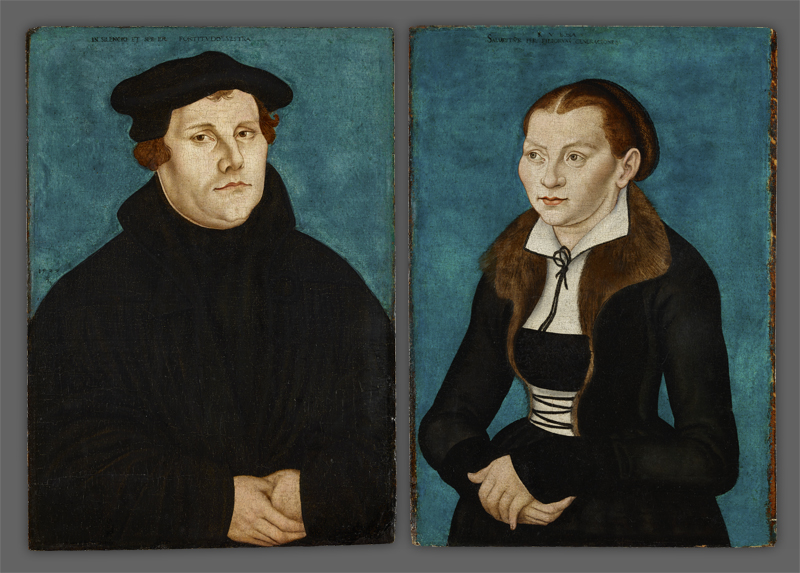
Image Credit: Lucas Cranach d. Ä., Doppelbildnis Martin Luthers und Katharinas von Bora (1529), Malerei auf Buchenholz, Stiftung Deutsches Historisches Museum, Berlin, KKL-Nrn. IV.M21a und IV.M21b
Reformation Sunday
25 October 2026
Preacher: Dr Rebecca Goyan Barnes
Jeremiah 31:31-34
Psalm 46
Romans 3:19-28
John 8:31-36
Did you know the ELW (hymn book) is 20 years old? It was published officially in 2006, although a few of us probably attended an introductory workshop with it before then. Do you remember looking at your first copy? Did you check to see if your favourite hymn was still included? Mine wasn’t and I’m still bitter about that. Of course, the musicians amongst us may not regret moving to the new book, as the green LBW, published in 1978, was criticized because the harmonizations were “too modern”.
Where am I going with this? I’ll bet most of us can still recite the confession from the LBW – “we confess that we are in bondage to sin and cannot free ourselves”. The ELW has reworded the confession to “we are captive to sin and cannot free ourselves”. While these words seem similar, they actually have very different meanings. According to the Longman Dictionary of Contemporary English, being in bondage to something or someone can mean being mentally, emotionally, or spiritually trapped by it. However, it also refers to literal slavery – being owned as property by another. Being captive to something means being under its control, influence, or power and unable to break free or act independently. It can also imply being held as a prisoner, but this is different than being a slave. Broadly, being a prisoner can imply that our own actions landed us in this position, whereas being a slave happens through the actions of another, though the reverse can happen.
In today’s gospel, Jesus is speaking to some Jewish people who believe in him and his ministry. Jesus tells them “If you hold to my teaching, you are really my disciples. Then you will know the truth and the truth will set you free.” They answer him “We are Abraham’s descendants and have never been slaves of anyone. How can you say that we shall be set free?” Jesus replies, “Very truly I tell you, everyone who is sins is a slave to sin.”
Thanks to the Bible Gateway, I checked every English translation available. The vast majority use the term “slave”, though some use “servant” or “bondsman”. It’s reasonable to assume that the writer was indeed referring to slavery. Much of the wording of our services and hymns come from phrases in the bible and the beginning of our corporate confession comes from this verse and another in Romans. Since we have free will, perhaps being a captive to sin is a better image than being in bondage to sin.
Also note that the people state that “they have never been slaves of anyone”. Does this not strike you as odd? A perfect example of “those who do not remember their history are doomed to repeat it” perhaps? In addition to the release from slavery in Egypt (which may or may not have happened, but we won’t go there today), the Jewish nation had been taken captive by the Assyrians and three times by the Babylonians by the time Jesus was around. And at the time of Jesus, their country is under Roman Occupation. Perhaps Mark Twain describes this best: “The Egyptians, the Babylonians and the Persians rose, filled the planet with sound and splendor, then faded to dream-stuff and passed away; the Greeks and Romans followed and made a vast noise, and they were gone…The Jew saw them all, survived them all.”
With their history of slavery and bondage, the Jewish people viewed freedom as a precious treasure. But here Jesus claims religious heritage does not bring true freedom: truth does. “Truth” is a theme in John’s Gospel, but it does not refer to a concept or something that is correct. Instead, “Aletheia” or “truth” is fully personified and embodied in Jesus. When the truth sets you free, it is through knowing Jesus and following his teachings that leads to spiritual liberation.
When I originally set out to write my sermon, I was going to focus on slavery. Let’s go back to that a little bit. You would think that Lutherans would be against slavery, wouldn’t you? That our ancestors in the faith must have been active in social justice and great abolitionists, right? Not so much…
In the defense of Canadian Lutherans, by the time the mass immigration came to Canada, slavery was already outlawed by the British Government. As such, we need to look to our neighbours to the south to see how the Lutheran church was active…or rather, passive.
Historian Martin Marty comments that Lutherans have excelled in building educational institutions, supporting their historic immigrant communities, and serving others through acts of mercy and kindness—and have fared less well doing the work of social justice. When Lutherans came to the expanding United States, they resided across the regions and thus became involved in the institution of slavery. In some instances, they became slave owners; in others, they opposed slavery, but rarely did they become ardent abolitionists. Lutheran newcomers were naturally occupied with their own lives and daily concerns. Where slavery was a necessity for the plantation economy, Lutherans (including pastors) owned slaves. Lutherans in the Confederate states were dedicated to preserving white superiority and slavery as a way of life, despite bringing many slaves into the Lutheran church. It wasn’t until 1838 that abolitionism made itself known as a cause in the Northern Synods. In the 1840’s, anti-slavery resolutions were made at several General Synods, with little success. While many members likely privately thought that slavery was immoral, outwardly most of them tolerated or accepted the practice passively, even if they did not support it outright. Racial slavery was the law of the land and just as Martin Luther urged his followers to allegiance to the governing authorities of the time, Lutherans followed the law.
This is kind of depressing, isn’t it? But today we celebrate Reformation Sunday. Thanks be to God, we are a church that keeps reforming. The ELCIC, to which we belong, is very active in combatting human trafficking, which is a modern form of slavery. From the ELCIC website in the Compassionate Justice and Public Policy section, the following statements appear:
– The ELCIC feels called to address sexual exploitation and human trafficking.
– The ELCIC affirms and supports the initiatives of The Lutheran World Federation (LWF), the Canadian Council of Churches (CCC) and the Women’s Inter-Church Council of Canada (WICC) to eliminate human trafficking.
– Congregations, rostered leaders and synods are asked to provide leadership in preaching, teaching and other forms of public witness against the commercial exploitation of human beings.
– We commit ourselves as church to respond faithfully to opportunities for partnerships and cooperation between church and society working for legislation that will protect persons liberated from being trafficked and playing roles in bringing about cultural transformation and the elimination of trafficking.
These statements and the resources that follow them, are a result of a 2013 Resolution on Addressing Sexual Exploitation and Human Trafficking, approved at the 14th biennial convention of the ELCIC. While not all of the links are working, I encourage you to take a look at what is there. While we may not have the glorious history with slavery that one might hope for, we ARE doing something now.
What are we doing? Well, every refugee we support removes one more person from the pool of people with potential to be trafficked. In cooperation with other churches, community members, and family, we have helped to bring a family from Eritrea including 4 adults and 1 child and a family from Myanmar including 2 adults and 2 children to Canada. We have applications in to bring family members from both of these families, so that another 4 adults and 6 children can be reunited with our current refugee families. That’s 10 adults and 9 children who are now less vulnerable to being enveloped into human trafficking. It might not seem like much in the grand scheme of things, but big things are accomplished by little steps. Every person is important.
On this Reformation Sunday, we acknowledge that we are captive to sin and cannot free ourselves. However, we also have the truth: that Jesus sets the captives free as promised in Isaiah and in knowing the truth, we are set free. Let us be a church that continues to reform and set other captives free.
Amen.
Let us pray for the whole people of God in Christ Jesus, and for all people according to their needs. Each petition ends with Hear us, O God, to which we respond, your mercy is great.
~ a brief silence ~
Lord God, although we live in the free world, we are possessed by our possessions, plagued by fear, think and act like all others, and we have difficulty imagining that freedom could mean something other than the market.
We praise you that it does not have to be this way, that because in Christ you have made us free, we can follow you Son and serve others in your name. Hear us, O God. Your mercy is great.
Lord God, help us understand the paradox that even though your children are free and subject to no one, yet as Martin Luther reminds us, your children are also the most dutiful servants of all, and subject to everyone. Hear us, O God. Your mercy is great.
Therefore, we pray, that you would save your Church from the desire to rule and to dominate and help it discover its mission in working for justice alongside those who are suffering. Hear us, O God. Your mercy is great.
Deepen our faith that we may no longer think and say what all others think and say but in humility listen to your Spirit, and learn to pay attention to the last, the least, the lost, and the forgotten. Hear us, O God. Your mercy is great.
In a post-Christian world, help us love our siblings in other denominations and learn from them, even while we remember the gifts of our own tradition. Especially we pray for our Baptist siblings with whom we share our building as well as our Anglican, United, Presbyterian, and Catholic friends. Hear us, O God. Your mercy is great.
We give thanks this day for the Evangelical Lutheran Church in Canada, all of its ministries, and all of its expressions. We give thanks for the grace we have received in this community and for the saints who have gone before us. Bless our church in all of its expressions that it be your church, and renew our vision for these times. Hear us, O God. Your mercy is great.
Healer of our every ill, grant your healing presence to all who are ill in any way, and fill them with the joy of your presence, especially …., and all we bring before you, spoken or silently … Bless those who experience the blessing and burden of age, especially …. Bless their families also that they may have strength to accompany those they love. Hear us, O God. Your mercy is great.
All these things and whatever else you see that we need, grant us, O God, for the sake of Christ who died and rose again, and now lives and reigns with you and the Holy Spirit, one God, forever and ever. Amen.