

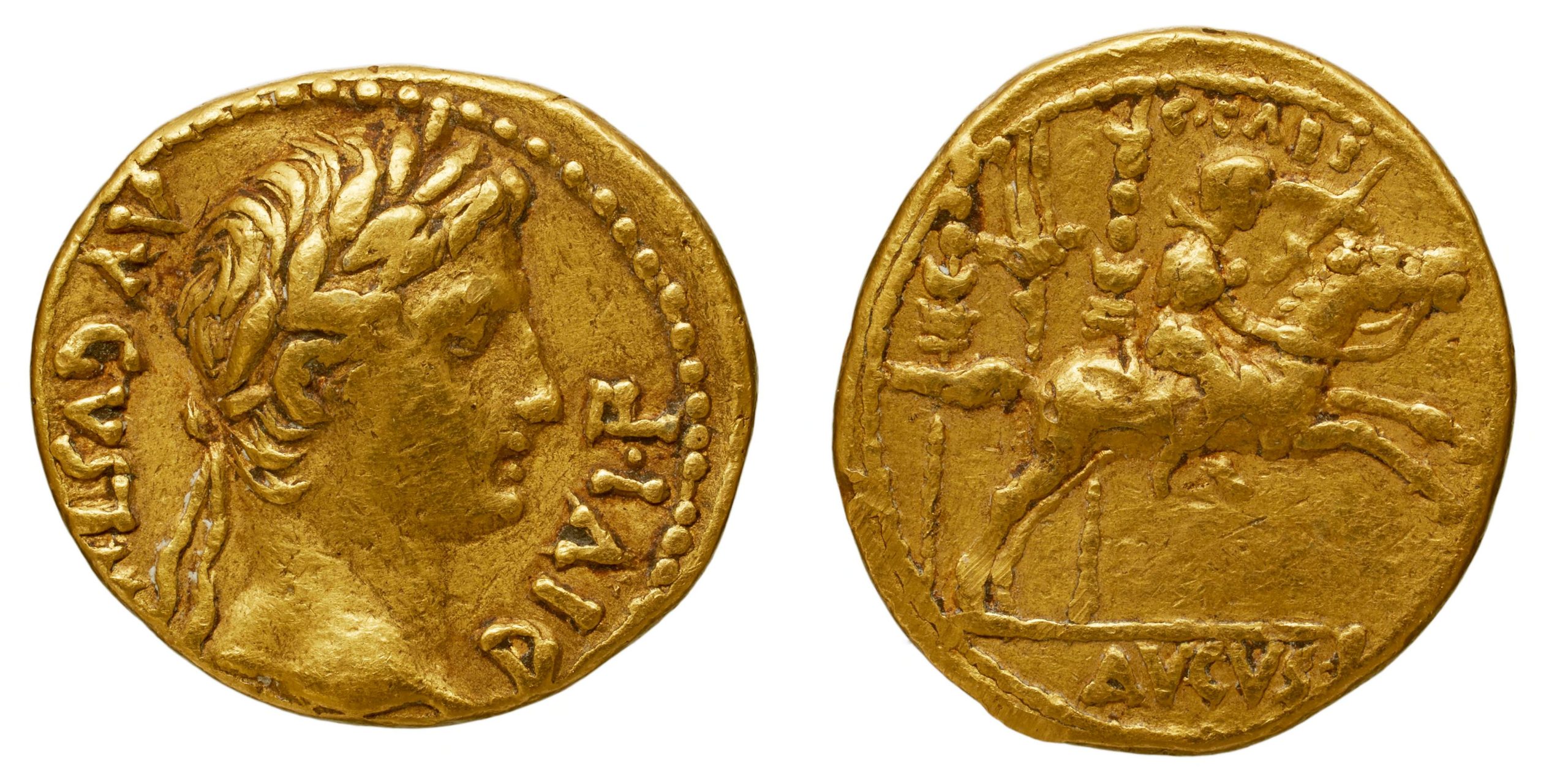
Image Credit: Roman Coin of Caesar Augustus, Bibliothèque Nationale, Paris
Copyright Source : https://commons.wikimedia.org/wiki/File:Aureus,_Auguste,_Lyon,_btv1b104440369.jpg
From Art in the Christian Tradition, a project of the Vanderbilt University Divinity Library, Nashville, TN.
Proper 24 (29), Year A
18 October 2026
Exodus 33:12-23
Psalm 99
1 Thessalonians 1:1-10
Matthew 22:15-22
We live in changing times. We have known this for some time, maybe years, and have said it often. When we speak of change we used to define it as fragmentation, politically and also culturally, and not just elsewhere but also here. There is a reason we speak of culture wars. For at least a year the change we have noticed also consists of the movement from a uni-polar world to a multi-polar world, and the changing relationships our southern neighbour has with the world.
Our leaders are uncertain about how to address culture wars but address the political and economic challenges by seeking different partnerships and doubling down on resource extraction and new technologies. And if we think that what we have been doing thus far is not a problem, this makes perfect sense. And in all fairness, the political situation is such that we seek refuge in what we know. We have long believed that technology will save us, and that prosperity will only ever increase, even while we know that many of our problems are caused by technology and that the planet cannot accommodate our need for an ever higher standard of living.
Consequently, climate change has become less relevant to us. We no longer doubt it, we know that we have passed the 1.5°C mark, but we will address the climate later, for now we have good reasons to double down on our current economic model. And we do not frame this as a moral question, even though we are sinning against future generations and against the earth itself.
Yet some argue that the earth’s climate is of greater concern than the economy, for what’s a job on an uninhabitable planet, which isn’t to say that the climate doesn’t already have a significant impact on the economy.
Sam Wells, the vicar of St Martin in the Fields, spoke about this two weeks ago when he said, “the root of much of the denial and complacency of the last forty years has been the sense that it won’t actually affect me. It may be tough on Venice, Bangladesh, and the Maldives, but I’ll have access to enough protective devices to seal me off from whatever damage it does.”1
Wells is right about our denial and rationalizations, but what strikes me is that Bill Clinton continues to be right, it’s all about the economy. But if the economy is all we have, and the economy shapes our moral compass rather than our moral compass the economy, then we are dealing with an idol. We then worship at the altar of ever increasing returns. And entailed in this idol worship is that we do not trust God to bring about something new. And because we are so attached to what is, we no longer hear God saying,
18 Do not remember the former things,
or consider the things of old.
19 I am about to do a new thing;
now it springs forth, do you not perceive it?
I will make a way in the wilderness
and rivers in the desert. (Isaiah 43)
A traditional reading of today’s Gospel about paying taxes has been a “both sides” kind of thing. But receiving the passage in this way is to neuter the Gospel. “Both sides” not what Jesus is saying. Reading into the text an ancient version of the separation of church and state constitutes ignorance of history and of scripture. Emperors always wanted the absolute loyalty of their subjects, not only Roman emperors who claimed divinity; and the separation of church and state that came about during the enlightenment was about empowering the state. But God has always wanted all of us, after all, we are commanded to ‘love the Lord our God with all our heart, and with all our soul, and with all our might.’ (Deuteronomy 6:5-6; Matthew 22:37)
To suggest that Jesus is making some Solomonic compromise when he says, Give therefore to Caesar the things that are Caesar’s and to God the things that are God’s, forgets that Solomon suggested that only one of the two women could be the mother of the child and that the one who was the mother should be given the child.2
To suggest that Jesus thought that anything belonged to the emperor suggests that Jesus did not know the scriptures and did not seek to be faithful to them.3
Remember that we read in Deuteronomy that, heaven and the heaven of heavens belong to the Lord your God, the earth with all that is in it. (10:14)
Remember that 1 Chronicles proclaims, For all things come from you, and of your own have we given you. (29:14 – note the connection to our the hymn “We Give Thee but Thine Own”)
Remember that Psalm 24 declares, The earth is the Lord’s and all that is in it (24:1), and that we read in Psalm 89, The heavens are yours, the earth also is yours; the world and all that is in it—you have founded them. (Psalm 89:11)
And so it is inconceivable that Jesus would give up the conviction that God is the ground and source of all, the One to Whom all things belong, and say, “You just do whatever. You can serve two masters.”4
I am not suggesting that there are easy answers to the problems we face, and I do not have the answers. But it would be wise to acknowledge the seriousness of the crisis facing us and not pretend that the climate can be put on the back burner. Remember that to follow Jesus requires change. The disciples left behind everything they knew. And remember that only in chapter 20 Jesus said to his disciples, ‘You know that the rulers of the Gentiles lord it over them, and their great ones are tyrants over them. 26It will not be so among you; but whoever wishes to be great among you must be your servant, 27and whoever wishes to be first among you must be your slave; 28just as the Son of Man came not to be served but to serve, and to give his life a ransom for many.’
And so we find that being a follower of Jesus may not make our life easier but harder. And if we can accept that, which would be refreshing in a world in which we are told we can have everything and it will cost us nothing, even though it may cost us our soul,5 then we are people who live out the kind of freedom the Apostle Paul talks about, freedom from things that oppress and freedom to serve God and neighbour.
There are a few things worth noting about how Jesus solves the riddle presented to him. One is that he references a text from Ecclesiastes which speaks of wisdom giving a shining countenance. It is obvious that the image on the coin shines, but nor because of wisdom.6
But the main thing is this: Jesus’s question to look at whose image is on the coin reminds us that all people are created in the image of God, even the emperor, even the political enemy, even any enemy.
In our baptism into Christ God has begun our restoration and made us part of the body of Christ, and called us out of darkness into his marvellous light in order that we may proclaim God’s mighty acts. (1 Peter 2) This is God’s promise, a promise on which we can build, and a promise that frees us from the restraints to our imagination that are put upon us.
And so we are a people of hope and courage who know that even when the future looks difficult, and when we seem caught between a rock and a hard place, that God is our future, and that because God is God, we need not be practical atheists any longer, who profess God in their hearts but not with their lives. We can let go of false certainties and can hear again that God is about to do a new thing. Thanks be to God!
Amen.
Prayer of the Day
O God,
whose image we bear
and whose name we carry,
yours is the world and all it contains.
Recall us to our true allegiance,
so that above the powers and rulers of this world
you alone may claim our loyalty and love.
We make our prayer
through our Lord Jesus Christ, your Son,
who lives and reigns with you
in the unity of the Holy Spirit,
God for ever and ever. Amen.
Let us pray for the whole people of God in Christ Jesus, and for all people according to their needs. Each petition ends with Hear us, O God, to which we respond, your mercy is great.
~ a brief silence ~
For our relationships with emperors, governments, and the world in which we live, that we honour all people as those who bear your image, but that in all things your people remember that before we are anything else, we are citizens of your kingdom. Hear us, O God. Your mercy is great.
That your Holy Spirit inspire in us faithful imagination, that we not live within the constraints of the imagination of the market economy but in view of the horizon of your justice and your reign.
We are mindful of the devastation wars cause, not only to people and nations but also to the earth and its climate. Help us seek better ways to address our conflicts. Hear us, O God. Your mercy is great.
That we learn that all belongs to you and that it is of your own that we give to you. Make us generous and bold, not harbouring resources but sharing for the good of all, and remembering those already affected by climate change. Hear us, O God. Your mercy is great.
That we learn again to love the earth that your hands have made and remember that we are made of the dust of the ground, and imbued with your Spirit, so that our lives may honour the earth and its maker. Hear us, O God. Your mercy is great.
For newly elected mayors, councillors, and school boards in our province that they may serve their communities with humility, and learn to work together for the good of all.
For the electorate, that we remember that democracy is exercised daily not only every four years, and that we take interest and participate in the affairs of our communities, holding each other to account. Hear us, O God. Your mercy is great.
That those of us who are disappointed this day would pray for our political enemies and remember that even our political adversaries bear your image. Hear us, O God. Your mercy is great.
Lord, we are shocked at what happened at CFB Wainwright, even while we do not exactly know what it is that happened. We pray for families, friends, comrades, loved ones, for those injured, and for first responders that they find healing. Hear us, O God. Your mercy is great.
Healer of our every ill, grant your healing presence to all who are ill in any way, and fill them with the joy of your presence, especially …., and all we bring before you, spoken or silently … Bless those who experience the blessing and burden of age, especially …. Bless their families also that they may have strength to accompany those they love. Hear us, O God. Your mercy is great.
All these things and whatever else you see that we need, grant us, O God, for the sake of Christ who died and rose again, and now lives and reigns with you and the Holy Spirit, one God, forever and ever. Amen.
1 Homily at Christ Church Cathedral in Vancouver, BC, previously published as Changing the Moral Climate.
2 1 Kings 3:16ff
3 Regarding our relationship to the emperor, Rodney Clapp writes, “Caesar, having created money, is money’s master.” and quoting Jacques Ellul, “and Caesar is legitimate master of nothing but what he fabricates for himself.” Living Out of Control – Political & Personal Faith in Waning Christendom, Minneapolis, MN: 2025 Fortress Press, page 79
4 Matthew 6:24 is a verse about wealth, but about the idolatry of wealth.
5 See Luke 12, the parable of The Rich Fool
6 It is James Alison who highlights the connection between Ecclesiastes 7:29 – 8:2, first pointed out by J. Duncan M. Derrett. When in New Testament Greek you want to say “to show deference to no one, and to not regard people with partiality”, you literally say, “you do not look upon the face of people (men),” but this is precisely what Jesus asks them to do when he asks them to present a coin and look at the face that is on it. And Jesus looks at it, too.1 God may be impartial but God is not neutral. The passage begins with the statement that God made human beings straightforward, but they have devised many schemes (Ecclesiastes 7:29), which would be hard to miss for his opponents. The passage continues, 8:1Who is like the wise man? And who knows the interpretation of a thing? Wisdom makes one’s face shine, and the hardness of one’s countenance is changed. (Ecclesiastes 8:1) Jesus makes them look at the coin, and undoubtedly the face on the coin shone, but not for wisdom but simply because it is metal. And so Jesus states in effect that there is no wisdom in the face on the coin. Neither coin nor emperor have wisdom, for the fear of the Lord is the beginning of wisdom. (Proverbs 9:10) The last verse of the reference passage says, Keep the king’s command because of your sacred oath. (Ecclesiastes 8:2) But the Hebrew text reads, “mark the king’s mouth”, which Jesus had them do by looking at the coin. And so Jesus, to whom they had said that he doesn’t look upon the face of people, had gotten them to look on the face of the emperor, which showed no signs of wisdom.