

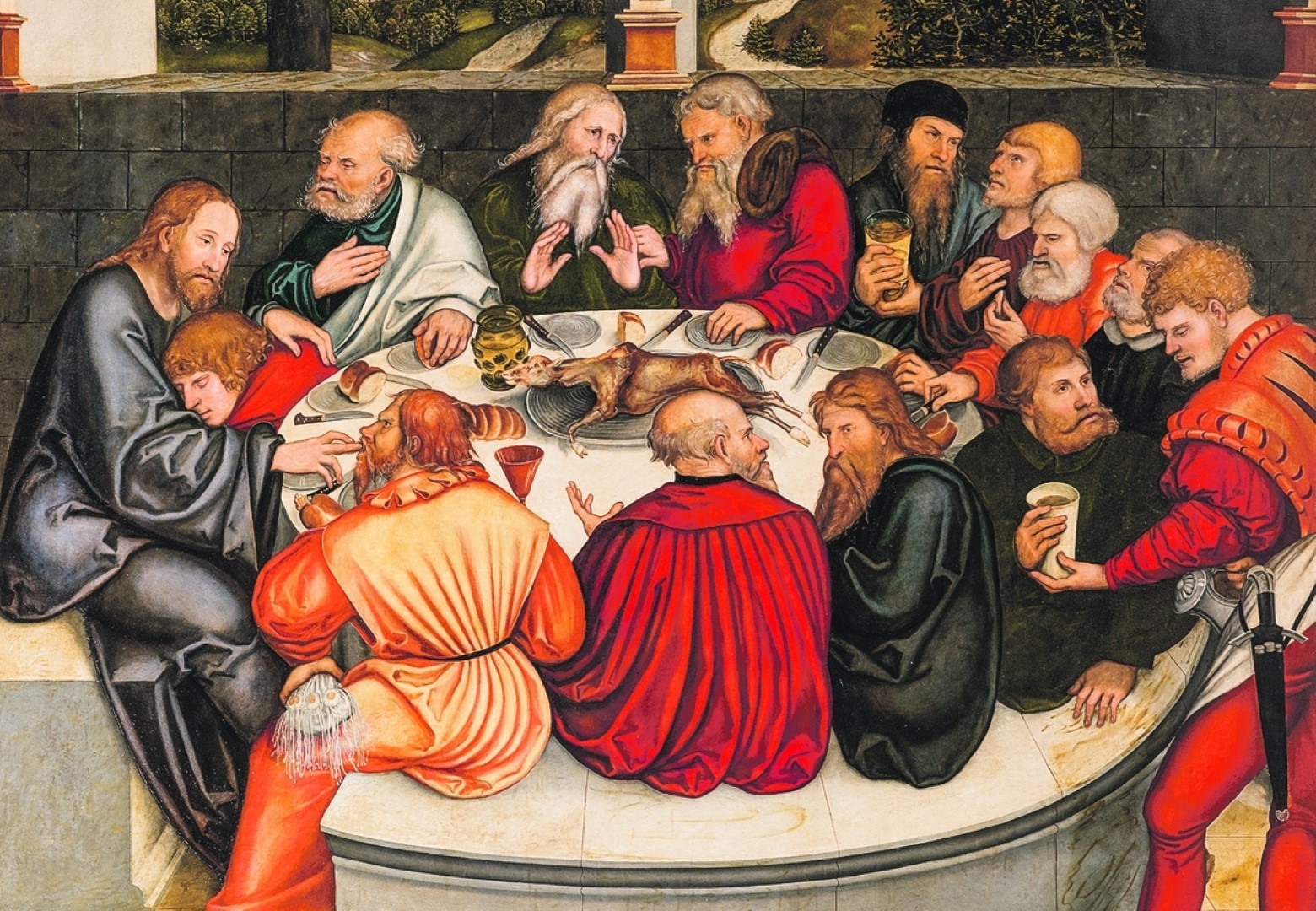
Image Credit: Jesus among his disciples, represented by citizens of Wittenberg (1547). Lucas Cranach the Elder (1472–1553). St. Marien, Wittenberg. Lucas Cranach the Younger passes the chalice to Martin Luther (als Junker Jörg).
Thanksgiving Sunday, Year A
11 October 2026
Deuteronomy 8:7-18
Psalm 65
2 Corinthians 9:6-15
Luke 17:11-19
I have been thinking about Thanksgiving.
It is a celebration that is deeply connected to our identity. And its observance is expected and mandatory.
While we consider saying thank you an essential part of living in community, we observe Thanksgiving only once a year, and since Thanksgiving is marked in the secular calendar, not everyone is certain who to give thanks to and what to give thanks for.
Because, like Christmas and Mother’s Day, Thanksgiving is anchored in coming together as family, I would suggest that Thanksgiving is about belonging. We come together because we belong together, even if some come late, don’t bring anything, or behave in odd ways. That’s family, it may be us, and besides, what can you do?
Of course, family taking such a central place raises the question about what you do if you happen to be single and live away from family. When I came to study in Canada I was invited for Thanksgiving. I don’t mean to suggest that people didn’t actually want me to come, I believe they did want me to come, but I was invited out of a sense of social responsibility because my friends didn’t want me to be alone on Thanksgiving. After all, my family was a long way away. Little did they know that Thanksgiving carries different cultural connotations where I came from.
Yet even though in Germany Thanksgiving is very much a harvest festival and it mostly is observed by the church, I would still argue that even there it is about belonging. Let me explain the different dimensions of belonging.
The first dimension is the one we think of first. Here Thanksgiving is a family celebration. While the food is important, more important is that we are together. We travel significant distances just to be together and we are likely to give special consideration to people who are alone or for whom travel has become too arduous. Here Thanksgiving is about being together because we belong together. In Genesis two God says that it is not good for us to be alone.
The second dimension is faith. The followers of Jesus know who to give thanks to and our first reading is very clear as to what to give thanks for, everything, really, though the Apostle Paul will later expand that (16Rejoice always, 17pray without ceasing, 18give thanks in all circumstances; for this is the will of God in Christ Jesus for you. 1 Thess 5). But on the threshold to the promised land the people of God are exhorted not to forget the Lord, 17Do not say to yourself, ‘My power and the might of my own hand have gotten me this wealth.’ 18But remember the LORD your God, for it is he who gives you power to get wealth, so that he may confirm his covenant that he swore to your ancestors, as he is doing today.
In other words, all we have and are, we owe to God. For had God not brought us into being, given us breath and strength, we would have nothing and would not be.
And this remembering carries social responsibility, not only on Thanksgiving. In a time when we assume that wealth is normal and that it is OK to be a billionaire, for we wouldn’t mind being a billionaire either, it is important to remember that in a society of subsistence farming, wealth did not mean what it means today. In our reading wealth means not to starve, it means to have your physical needs met. And we may remember that the 10 commandments were given (Exodus 20, Deuteronomy 5) to prevent Israel from recreating the unjust society they had left when they had left Egypt, to prevent the social stratification of Egypt. That these commandments included the commandment to keep the sabbath meant not only that the people were to treat everyone equally, including foreigners, servants, and even livestock, but the Sabbath command also helped them remember that they lived not by their own strength but by God’s provision. This perspective matters because knowing that all is God’s makes it that much easier to part with what we have for the sake of others.
The third dimension of Thanksgiving is the community of the Church. Elementarily this is because it is here where we remember that our lives depend on God and that our lives are made complete in the worship of God. Yet it is also because Jesus called a community of disciples, Jesus spoke of the Church, and before there was the Church there were God’s people led out of slavery. Our faith is shaped by life in community. Certainly, Jesus wants to live in our heart, yet the way Jesus lives in our whole lives is by living in the community of the church where we pray, worship, lament, praise, and give thanks together; where we learn to forgive and serve, and wrestle together what it means to follow Jesus not just in our heart but with our whole lives, including with our financial and material means. The community of the church is a place where we encourage one another, where we worship together, but also a place where we hold each other accountable. This is the moment when Thanksgiving is transformed into Thanksliving. The first doesn’t mean much without the second but the second lets the first one come to life.
The fourth dimension of belonging is belonging to the earth. We remember that in the language of most of the Old Testament the word for the first human is “adam” and the word for the earth from which we were taken is “adamah”. The English language reflects this in “human” and “humus”, even though we have pretty much forgotten about it. Here is the verse from Genesis 2, then the Lord God formed human from the dust of the ground, and breathed into the nostrils the breath of life. Later, when Adam and Eve are banished from the Garden, God says,
19By the sweat of your face
you shall eat bread
until you return to the ground,
for out of it you were taken;
you are dust,
and to dust you shall return.
This does not lift the blessing but it seeks to explain why in a good creation life can be so hard.
That belonging to the earth could be a dimension of Thanksgiving may strike us as odd, after all we are people who long for heaven, however, if we can only go to heaven after we die, most of us aren’t quite ready. Thankfully, God comes to us and we pray for God’s will to be done on earth as in heaven. Therefore, heaven is no excuse for the abuse of the earth.
Perhaps this is the way that people who do not hold the faith we hold or any faith can relate to Thanksgiving and are able to identify who to give thanks to, namely the earth that blesses us with its abundance. But this is hard for all of us and requires practice, for we live in the industrial world and for most of us food comes from the store, and the earth if for the extraction of resources and profits.
But we are part of the earth, we cannot live without the earth, which is why climate change is such an important concern. Realizing this we may see the interconnectedness of all things. Wendell Berry who died last month says that we care for what we love, and to care for the world, we must know and love a particular place in it – not as an abstraction, but in all that place’s inherent complexity.1 Thanksgiving is an expression of love, for how can we not love the earth that nurtures us.
A fifth dimension of belonging is knowing that we belong to the human family. We have different nationalities, histories, cultures, and all the rest of it. I was going to say that we come from different nations and tribes but being tribal has gotten in the way of receiving one another. But Genesis one and two trace humanity back to common ancestors. This is an anthropological statement. We have the same origin, the same creator, all of us are human. If only we can focus on what we have in common and not question the humanity of those we deem different.
I believe this is why the festival of Thanksgiving is so central to our lives. It tells us that we belong, with family and friends, with God, with the Church, with humanity, with the earth.
I am grateful to the people who invited me for Thanksgiving in 1987, for they showed me that I belong, even as a stranger in a foreign land.
We are not homeless, we belong, and for that we give thanks indeed.
Amen.
Prayer of the Day
Gracious One,
you satisfy the need of every living creature.
Fill us with gratitude for the abundance of the earth
and for the bonds of love and care
that unite all creation into one family.
May our thanks be the soil
in which dreams of justice grow and thrive;
through Jesus Christ, the Lord of the harvest. Amen.
or:
God, whose word is engrained
in all we eat and drink:
free us from the greed
that destroys the roots of life;
teach us to eat the living bread
in whom all hungers are satisfied
by the life that gives of itself and is never sapped,
Jesus Christ, the living Word. Amen.
Let us pray for the whole people of God in Christ Jesus, and for all people according to their needs. Each petition ends with Hear us, O God, to which we respond, your mercy is great.
~ a brief silence ~
We give thanks that you, O God, give us a place of belonging, for you have called us to follow your Son and given us a seat at your table. Help us live into what it means to belong to you, for belonging to you is both gift and calling. Hear us, O God. Your mercy is great.
We give thanks, O Lord, that we belong to the earth, the fruit of which provides for our bodies and the beauty of which refreshes our soul. Help us moderns learn what it means to belong to the earth, of which we were made. Help us remember that the earth and all that is in it belongs to you. Grant us eyes to see the destruction we cause, that we may learn to honour the earth and to keep it. Hear us, O God. Your mercy is great.
We give thanks, O God, for the human family. We see differences but you see your beloved children. Help us see what you see that we would honour each other and that our life give witness to your affection. Hear us, O God. Your mercy is great.
We give thanks for our families, for it is in our families that our life began. It is in our families that we learned to love and it is in our families that we learned that love is hard. Bless our celebrations and help us love as you love. Hear us, O God. Your mercy is great.
We give you thanks for the Church, not only as a place for those who are lonely or estranged from their earthly families, but as the community that together lives into your promises and imagines your future. Let our worship and our life together be a school of friendship and discipleship that our lives may little by little resemble the life of your Son Jesus. Hear us, O God. Your mercy is great.
Healer of our every ill, grant your healing presence to all who are ill in any way, and fill them with the joy of your presence, especially …., and all we bring before you, spoken or silently … Bless those who experience the blessing and burden of age, especially …. Bless their families also that they may have strength to accompany those they love. Hear us, O God. Your mercy is great.
We pray for refugees and people who are stateless, for the outcast and those told and shown that they do not belong. May they receive the welcome of communities, and may your Church be a witness to your saving love and embrace. Hear us, O God. Your mercy is great.
All these things and whatever else you see that we need, grant us, O God, for the sake of Christ who died and rose again, and now lives and reigns with you and the Holy Spirit, one God, forever and ever. Amen.
1Wendell Berry, It All Turns on Affection, Berkely, CA: 2012 Counterpoint, page 35