

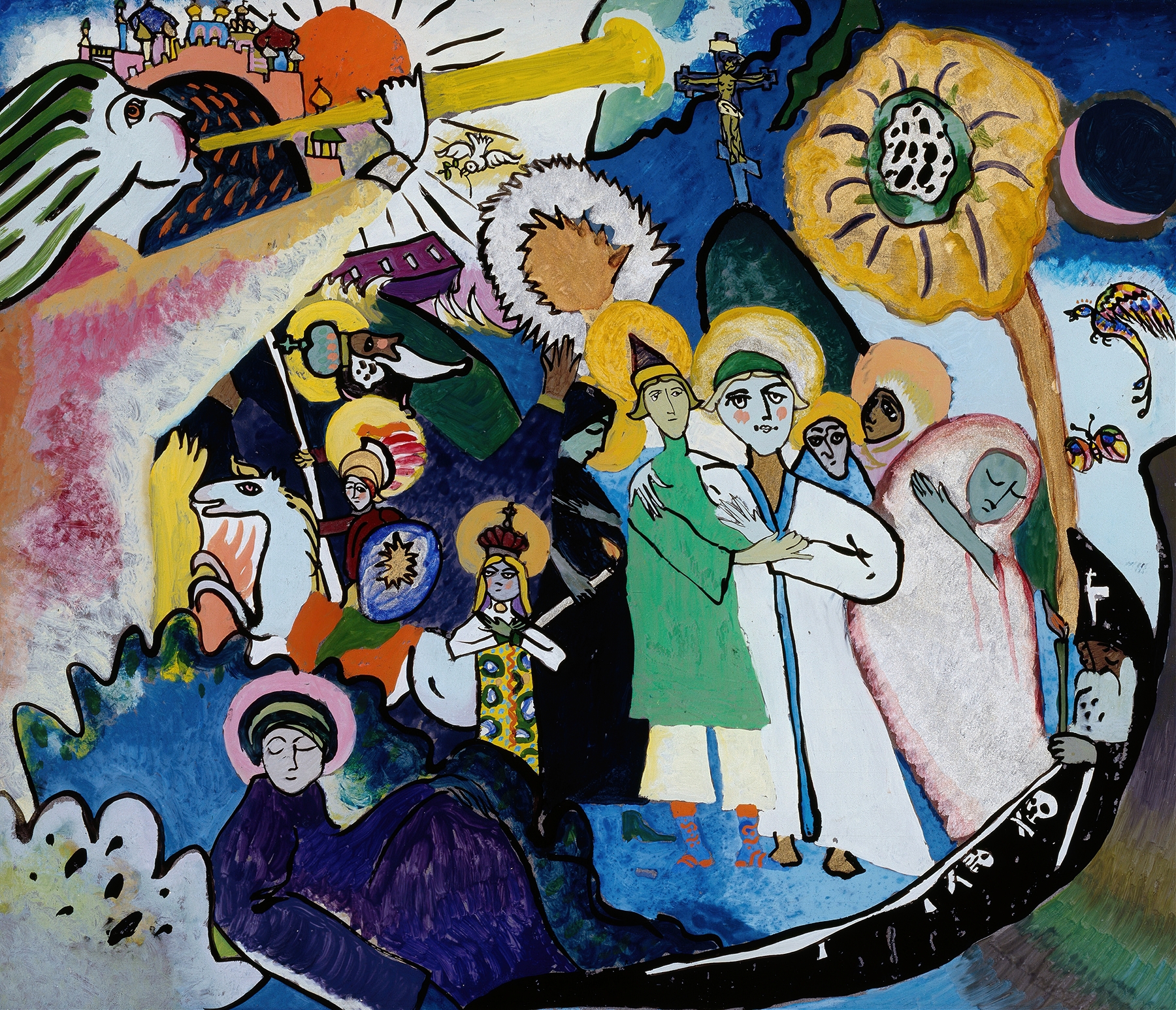
Image credit: All Saints Day I (1911), Vasily Kandinsky (Russian, 1866 – 1944)
The work is in the public domain. https://artvee.com/dl/all-saints-day-i/
All Saints Day, Year A
1 November 2026
Revelation 7:9-17
Psalm 34:1-10, 22
1 John 3:1-3
Matthew 5:1-12
I remember the 90th birthday reception for Emma Dalke. Emma lived in the seniors’ highrise across the lane from the church. Emma is one of my saints, for her love of Lord and Church, her deep faith, her generous spirit, the kindness with which she treated others, and her humility which made her seek the truth. Sometime in the late 90s my friend Tony, a United Church minister, asked whether I could translate the letters of his Austrian grandmother. However, the letters were written in old German cursive script which I am not able to read and so I asked Emma whether she would. And for a number of weeks on his days off, Tony would visit Emma with his laptop and Emma would translate the letters for him. Tony also was a man of deep faith. He also was the first minister I knew who was gay and while Emma may have had an opinion about that, she practised the kind of divine impartiality the apostle Peter speaks about in the Book of Acts. (10:34)
Emma’s 90th birthday reception took place in the lounge of the highrise where she lived. Her family was there, as well as friends, neighbours, and members of the church. When my co-pastor extended his well wishes and congratulations, she smiled and replied, “And don’t wish me many more.”
Emma had a deep and abiding faith; trusting in God’s promises, she was not afraid to die.
The second and last time my father came to visit was in October of 1998. He came together with my brother. The tourism highlight took place in Riding Mountain National Park and consisted of seeing a mother bear with three cubs, one of them albino, or a spirit bear. During the visit my father was tired, more than usual, which we attributed to jet lag and the fact that he was older than he had been when he had visited three years earlier. By February, and long back home, my father experienced some language loss as well as difficulty with mathematical calculations. The first assumption was that he may have suffered a stroke, but the MRI showed a brain tumour. I was there for the MRI and we all visited the next summer. By then, my father had had surgery to remove the tumour, followed by radiation treatments that had left him exhausted. Sadly, the tumour grew back quickly and my father would have elected the surgery again but the surgery was not offered without radiation which he declined and so he prepared for his death. I was in my first congregation and thought I couldn’t take time until after All Saints. I explained to my dad that I’d come in early November and he told me that if I did, he’d no longer be there. So I got there on the 20th or the 21st of October and stayed for a week. The day after I left, my father fell into a coma, and three days later he died. He was right when he told me that if I came in November, he wouldn’t be there anymore. Psalm 23 carried him through those days and his marker bears the inscription, “The Lord is my shepherd, I shall not want.”
I remember these months because they were about my father whom I loved. But I remember them also because of the vulnerability we all experienced, most of all my dad. And I remember these days because my father made choices that were informed by his faith. It is important to note that my father was no spiritual giant. He had not grown up in the faith and found his way into the faith later in life. For much of his life he was conflicted because he was unhappily married and for many years was not only married to my mother but also had an affair with a woman that like my mother he did not love. In the years before he took ill he was happily remarried but did not attend church, mostly, I think, because he thought of himself as a sinner, for sin loomed large in the version of Christianity he had first encountered.
These kinds of conversations with Emma and with my father are rare because on the whole we do not talk about death. We know we will die one day but we prefer not to think about it. I mean, we may organize our affairs, and we may downsize but our relationship with medicine is mechanistic and consumer oriented, we expect medical professionals to solve our problems so that we can go and live forever, although we would not say so.
A couple of years ago a new medical clinic opened in our neighbourhood. The clinic specializes in anti-aging treatments. I suppose I am old enough to go there, but what struck me here and with other such clinics is the denial of age, for aren’t my wrinkles a sign of the years I have lived, and am I not grateful for those years? It would be impossible to imagine my life without the preceding 60.
The denial embodied in such clinics is the expression of a culture that worships youth and knows little to do with what it means to grow old. And implicit in its denial of aging is a denial of death.
But today is All Saints Sunday when we give thanks for those who have gone before us, and you don’t get to rise from the dead unless you first die.
When I consider our inability to speak of our own deaths I wonder if this inability is related not only to the death-denying culture in which we live but is also expression of our inability to articulate our hope of heaven. Popular culture sees heaven simply as the continuity of life on earth, so that if we golfed here we will golf in eternity, except perhaps without paying green fees. But remember the story of the Sadducees who come to Jesus. They make up an elaborate story of a woman who consecutively marries seven brothers in order to produce offspring for the first brother, her first husband who had died before they had conceived. The Sadducees ask Jesus whose wife the woman will be in heaven. Jesus gives an answer that may be distressing to some and promising to others when he replies, You are wrong, because you know neither the scriptures nor the power of God. 30For in the resurrection they neither marry nor are given in marriage, but are like angels in heaven. (Matthew 22:29-30) The point Jesus is making is that heaven is the time and place when God will make all things new. To simply assume the continuity of things present is a sign of our limited imagination, perhaps not only a denial of death but also a denial of the world to come.
For us, who are followers of Jesus, what is it that motivates us to seek a life that is faithful to Jesus? What is it that makes us want to belong to the Body of Christ? What is it that makes us choose a more difficult and counter-cultural path out of faithfulness to Jesus?
I believe that our motivation is two-fold. First, it is that we seek eternal life, or in the common parlance, we want to go to heaven. But our handicap here is that we have a limited vision of heaven, as most often we see it as the continuation of our life here; and that, I think, is one of the reasons we have difficulty thinking and speaking about our own death.
The African American theologian Brian Blount writes about the white robes of the saints in today’s passage from Revelation, and there was a great multitude that no one could count, from every nation, from all tribes and peoples and languages, standing before the throne and before the Lamb, robed in white, with palm branches in their hands. (v.9) Blount says that “These figures, presumably the same folk as our slaughtered souls of 6:9-11, achieved their high laundry marks only after washing their robes in the blood of the Lamb. (…) this high powered plasma detergent is the cleansing force that enables God and God’s people to wipe out the stain of Rome’s oppressive, satanic power. (…)
In other words, the white robe, metaphorically speaking, is not a noun, it is an action verb. The robe signifies the washing in the blood that brings about the transformative justice God’s people have been seeking. They haven’t just been ‘given’ white robes; they have earned them by washing, that is, acting in the way of the Lord.”1 And transformative justice was and is a dangerous thing.
The part of the white robe being declared an action verb may strike us as odd, but it aligns with Catherine of Siena’s beautiful word that ‘all the way to heaven is heaven, for Jesus said I am the way.’ It speaks to the imagination of the followers of Jesus to know and hold in our hearts that God will make all things new and therefore for the followers of Jesus to share in that newness, and thus to imagine more than the golf courses we didn’t get to play in our time on earth.
There is one more thing. If we go back to the beginning of our reading and remember that there is talk of a great multitude from every nation that no one can count (v.9), then we will see that heaven is not a promise to spend eternity alone, doing what I like doing here, but that it is about the reconciliation of all people. If we remember that sin is always social, sin is never just what I do but always affects others, and that all the conflict and warring in the world is the result of sin, then heaven is the end of conflict and of war, is the place where we live together in peace, enjoying each other’s gifts and presence, and knowing that there is in fact enough for all.
Our second motivation for following Jesus is be be close to Jesus and to become like Jesus. We want to become like Jesus because we somehow know that that the life of Jesus was beautiful and know that, (…) in him all the fullness of God was pleased to dwell (Col 1:19); and we know that when all things are complete, we will be like him, for we will see him as he is (1 John 3:2), as our second reading tells us.
To be driven by this motivation is to imagine the life of the first disciples, yet knowing that Jesus is no further from us than he was from them. In a word, it is to love Jesus and have that love shape our life. And We know that all things work together for good for those who love God (Rom 8:28), even while this may be a mystery to us, it is the same mystery of those in white robes who have suffered and yet have received the crown of life (Rev 2:10).
But such love of Jesus, which only mirrors God’s love for us, allows us to remember our loved ones who have gone before us, knowing that they are held in the arms of God’s mercy; and such love allows us to speak of our own death, knowing that if we have been united with him in a death like his, we will certainly be united with him in a resurrection like his. (Romans 6:5)
Amen.
Prayer of the Day
Holy God,
giver of blessing to hungry and hated,
you overturn tables of privilege and greed.
Teach us a new way of being
beyond reward,
beyond revenge,
so that we may do to others
as we would have them do to us;
through Jesus Christ, who prays for all who crucify him. Amen.
Remembering the saints who have gone before us and knowing that they belong to God, we pray for the church, all in need, and God’s good creation.
~ a brief silence ~
Lord God, we give you thanks for Abraham and Sarah, our ancestors in the faith, journeying into the unknown, yet trusting your promises;
For Jacob, deceitful younger brother, yet chosen by you,
father of those called by no virtue of their own;
For Moses the lawgiver and Aaron the priest,
who led the people of Israel to freedom and the promised land;
For Esther and Deborah, saviours of their nation,
and for all who dare to act courageously at God’s call;
For Isaiah, John the Baptist and all the prophets,
who spoke your truth no matter the cost;
For Mary the virgin, full of grace,
called to be the mother of the Lord;
For Andrew and John and the first disciples,
who left all to follow your Son;
For Mary Magdalene, Salome and Mary,
first witnesses of the resurrection,
and for all who bear witness to Christ;
For Peter and Paul and all the apostles,
who preached the Gospel to all people;
For the writers of the gospels,
and for all in every generation who are blessed with a living faith;
For Stephen and Alban and the whole army of martyrs,
who have faced death for the love of Christ,
For Augustine and Aidan, Boniface and Patrick,
Henry Melchior Muhlenberg and Jean de Brebeuf, and for all who have carried the Gospel to this and other lands;
For Benedict and Francis, Hilda and Bede,
and for all who deepen our common life in Christ;
For Julien of Norwich and Teresa of Avila,
and for all who renew our vision of the mystery of God;
For Martin Luther and Philip Melanchthon,
and all who reform the church of God;
For Blaise Pascal and Søren Kierkegaard,
and all who hold fast to its continuing faith;
For the martyrs and peacemakers of our own time,
who shine as lights in the darkness;
For all those in our own lives who have brought us to this time and place
and shown us the love of God:
Especially …
and all others whose blessing we recall and whose name is in our hearts and on our lips ……
For all unsung heroes of faith,
whose names are known to God alone;
We give thanks for them with grateful hearts and glorify you, o God, in whom they put their trust.
For democracies everywhere, especially today we pray for the constitutional crisis in Poland, the election south of the border, and for our life together in our own land. Hear us, o God. Your mercy is great.
In a time of instability we pray that we may find our life in you. In a time ecological crisis we pray that at last we may learn to live in harmony with your good creation. In a time of division help us to embody the reconciliation you have worked through your Son Jesus Christ. Hear us, o God. Your mercy is great.
Make us count our days that we may gain a wise heart. Let us live in hope of the resurrection that we may live our lives for your Kingdom today. Hear us, o God. Your mercy is great.
We pray for all who are suffering in any way and give thanks to you that you are mindful of them and that their affliction is always before you. Be near them, move them, grant them your healing, especially we pray for those most dear to us ……… and for all those we bring before you spoken or silently…. Hear us, o God. Your mercy is great.
Into your hands, o God we commend ourselves and all for whom we pray, trusting in your mercy, through Jesus Christ, your Son, our Lord. Amen.
1 Brian K. Blount, Can I Get A Witness- Reading Revelation through African American Culture, Louisville, KY: 2005 Westminster John Knox, page 55