

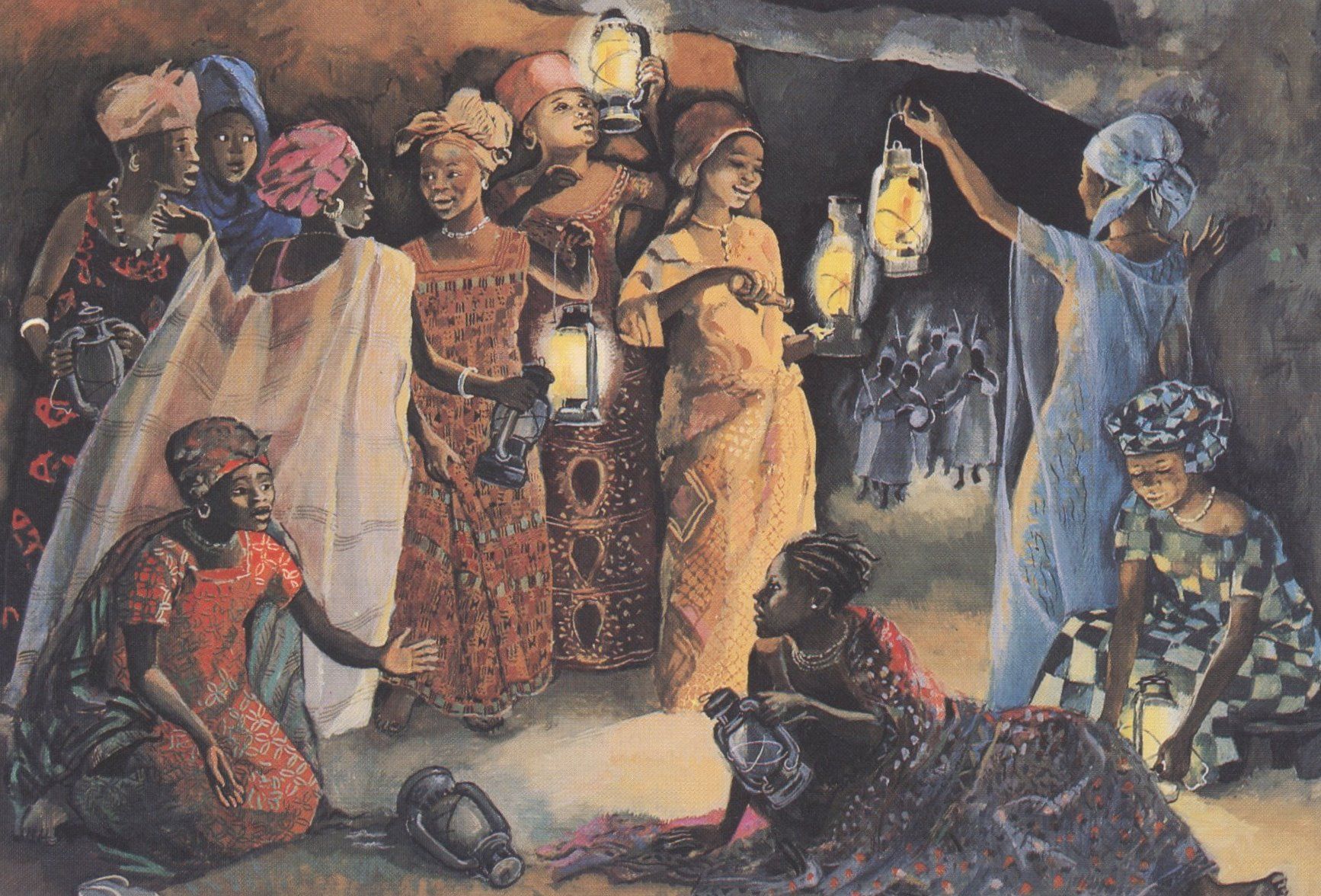
Image credit: The Ten Young Women, Jesus Mafa 1973 (Cameroon).
Copyright Permission: For non-commercial uses. From Art in the Christian Tradition, a project of the Vanderbilt University Divinity Library, Nashville, TN. https://act.library.vanderbilt.edu/artworks/48394 [retrieved November 2, 2026]. Original source: http://www.librairie-emmanuel.fr (contact page: https://www.librairie-emmanuel.fr/contact).
Jesus Mafa is a response to the New Testament readings from the Lectionary by a Christian community in Cameroon, Africa. Each of the readings was selected and adapted to dramatic interpretation by the community members. Photographs of their interpretations were made, and these were then transcribed to paintings.
Proper 27 (32), Year A
8 November 2026 – Ron Vonk
Joshua 24:1-3a, 14-25 a
Psalm 78:1-7
1 Thessalonians 4:13-18
Matthew 25:1-13
As one generation of people gets older, the time comes for that generation to pass the torch to the next generation. This morning I talk about passing the torch.
My wife’s mother was born March 11, 1910. My mother-in-law grew up in a family of 6 children – a family in which her father was a farm hand who had seasonal work during times of planting and harvesting. Money was scarce. Girls were expected to leave school and even their home at a very young age in order to take employment as domestic helpers in rich people’s homes. All money earned was sent home to help the family survive the winter months when my mother-in-law’s father was unemployed.
Money was scarce but the family’s trust in God’s goodness was strong. The church was central to the family’s life. All 6 children in the family accepted Christ at a young age. They all demonstrated their trust in God through a life of loving God and loving neighbour.
My mother-in-law’s trust in God never wavered. Her husband died unexpectedly in 1966 at the age of 54 leaving her to care for 2 teenagers still living at home and with only enough money to pay for her husband’s funeral. Her favorite memory of her 24 years of marriage was how her husband’s faith grew after a crisis in his trust in God. In 1985 when she turned 75, her family had a surprise birthday party for her. We have a photograph of my mother-in-law at that party. She is sitting in the middle of 25 children and grandchildren. She told me that she felt like the richest person in the world.
My mother-in-law died September 17, 1993 after spending her final six weeks in our home. I was at a loss as to what to talk to her about as she was dealing with a major health crisis. I decided to read her the gospel of John. I read the final chapter of John to her a day or 2 before she died. The end of my relationship with my mother-in-law came with these words, “Jesus did many other things as well.” She mysteriously replied, “Jesus has come.” “Jesus has come” are the final words my mother-in-law spoke to me.
The years 1910 to 1993 were years of tremendous change in our society. As a child my mother-in-law lived in a place where farmers seeded their crops by hand and harvesting was back breaking work. Forty years later when the family came to Canada, they came by airplane. What a change from 1910! Life in Canada began on a rural farm in Alberta in a farmhouse like the one my mother-in-law grew up in. No running water and an outdoor toilet complete with Sears catalogues for toilet paper. But then they moved to Vancouver. They experienced flush toilets, public transportation and paved roads. When they moved into their house in Vancouver each family member took a trip to the toilet just to flush it and see the water go swirling down. Exciting stuff!
The last days of my mother-in-law’s life was her time to pass the torch to her now adult children. I did not realize it at the time but the final words my mother-in-law spoke to me were words she used to pass the torch to me. After my mother-in-law’s death my family had to move into our unknown futures even as the rapid changes in our world continued. We now had to choose how we would demonstrate our own trust in God who made her the richest person in the world.
All four of our scripture readings this morning are the words spoken by people who are passing the torch. As children, the people in Joshua’s audience were slaves in Egypt. By the end of Joshua’s life they live as free people in a land with cities, a land with farms, vineyards and olive groves. Now, at the end of his life, Joshua must pass the torch to these free settled people.
In the Psalm that we chanted, we promised with the Psalmist not to hide from our children the glorious deeds of the Lord. We pass the torch to our children. In 1 Thessalonians we heard the apostle Paul encourage new Christians who are grieving the loss of fellow Christians. The people left behind must now carry the torch. Then in our gospel reading we hear Jesus at the end of his ministry tell a strange parable about 10 young women who are waiting for a bridegroom to come. With this strange parable, Jesus passes the torch to his disciples then and today Jesus passes the torch to us.
This morning we only have time to look at the passing of the torch in Joshua and in our gospel reading. I begin with Joshua whose story sounds very much like the story I told you about my mother-in-law.
Joshua calls the people of Israel together to Shechem. Shechem is the place where God promised Abraham that he would give Abraham and his descendants the land of Canaan. Shechem is also the place where Abraham’s grandson Jacob told his family to get rid of their foreign gods. Jacob’s family gave Jacob all the foreign gods they had. Jacob buried these idols at Shechem. Shechem was also the place where the people in Joshua’s generation previously committed to obey the requirements of God’s covenant with them.
The complicating factor for Joshua, Jacob and even Abraham was that even after making their commitments to serve God alone, God’s people continued to have a strange fascination for foreign gods. We can understand why. People who served these foreign gods were powerful. The Egyptians, Babylonians, and later the Persians were powerful empires. These other gods seemed more powerful than the Lord, God who Israel served.
When Joshua passes the torch he asks the people only one question. The question is simple. Whom will they serve? Will they serve the foreign gods or will they serve the Lord?
Joshua opens his challenge with a direct word from God. God tells the people that Abraham’s family served foreign gods. God took Abraham away from that family. God led Abraham to the land of Canaan. God made Abraham’s offspring many.
Israel is a nation carried by the power of God. God brought the nation into being. God guided the nation to a place of its own. But now Israel must choose their response to God. Will they again serve only the Lord and throw away the foreign gods their ancestors worshipped? A decision not to serve the Lord is a decision to serve other gods. The people have an urgent choice to make. We have an urgent choice to make.
Joshua makes the choice very personal. Regardless of their choice, Joshua and his family will serve the Lord. Joshua is willing to move ahead of his people. Joshua is clear and unambiguous. Devotion to the Lord takes priority.
The people rise to the challenge. They will not forsake the Lord to serve other gods. They remember all that God has done for them. God shapes and guides the nation. They will serve the Lord and put away the other gods in their suitcases.
But then as we read on, we heard Joshua’s shocking reply to the people’s commitment. “You cannot serve the Lord, for he is a holy God,” says Joshua. Suddenly the image of this gracious God who brought the nation into being becomes the image of a jealous God who may become a destructive presence. If the people serve other gods, then God will turn and do them harm. Their God does not share with other Gods.
To our relief, Joshua’s generation responds positively to Joshua’s charge, “No we will serve the Lord.” And they are willing to accept the consequences of their commitment. They will serve the Lord.
Joshua’s shocking charge is following by a second shocking charge. The people are still carrying foreign gods in their suitcases. It is as if the foreign gods their ancestor Jacob buried in Shechem have been dug out of the ground, washed off and put back into the people’s suitcases. As Jacob did 500 years earlier, Joshua must again tell the people to “put away the foreign gods that are among you.”
Equally shocking is the fact that we are not told if the people actually obey this final order from Joshua. All we hear is their final words. “The Lord our God we will serve, and him we will obey.” In spite of their sworn loyalty to the Lord, the people keep the images and symbols of other gods in their suitcases. The potential allure of the other gods is always there.
As Christians, we know that we serve the Lord with divided loyalties. We no longer carry images and symbols of other gods in our suitcases. But we have other distractions that move us away from our call to serve the Lord. Our modern electronic world is full of distractions that keep us away from our call to service. God simply gets crowded out of our lives.
And we know that Joshua is wrong about God not forgiving our transgressions or sins. Time and time again, God graciously takes the initiative to call us back to him. We receive this call Sunday by Sunday. We understand God’s grace clearly as we learn about the finished work of Jesus in dealing with our sins. We understand God’s grace more clearly as the Holy Spirit continuously encourages us to renew our commitment to serve the Lord. But we must not downplay or ignore Joshua’s words of warning.
Joshua’s word of warning comes to us in a very different way in our gospel reading. This time we are told a strange parable about wise and foolish bridesmaids who must wait for their bridegroom to come.
In the book of Matthew, the parable of the wise and foolish bridesmaids is part a series of 3 parables Jesus tells that follow predictions made by Jesus relating to a possible delay in his return. After these parables, Mathew tells us about the plot to kill Jesus. The 3 parables call Christians to faithfulness even as the return of Jesus is delayed and even as many of us need to pass the torch to the next generation who may have to wait for his return as well.
In today’s parable ten young women are waiting to meet a bridegroom who has been delayed. Five of them anticipate the delay and bring extra oil for their lamps in case the bridegroom comes after dark. The other 5 expect the bridegroom to come on schedule. They bring no extra oil. When the bridegroom delays, all 10 young women fall asleep. At midnight, when it is dark and all the local markets are closed, the 10 women are awoken by a shout. Here is the bridegroom! Come out to meet him!
The foolish bridesmaids first ask the wise to give them some of their oil. The request is denied. The foolish then leave to look for some oil which they do not find. They later make their way in darkness back to the banquet and beg to come in. The bridegroom refuses to let them in. After all it is dark and he cannot even see them.
At this point Jesus explains the parable with these words, “Keep awake, therefore, for you know neither the day nor the hour.” This is a lesson for all 10 women as they all fell asleep. Our first reaction is to tell Jesus that none of the 10 were able to stay awake. None were ready when the bridegroom finally came.
The flaw with the foolish women is not that they fell asleep. The flaw was that, unlike the wise, they failed to prepare for any delay. They want the bridegroom to fit their expectations. When they woke up because of the shout announcing the bridegroom’s arrival, they first turned to the wise ones for some of their oil. When this failed, they left and were not there to meet the bridegroom. They should have stayed with the bridegroom. Light from the other lamps would have been enough for all to find their way into the banquet. Unprepared for the wait, unable to think clearly, not trusting the generosity of the bridegroom, meant that they missed out on the celebrations.
It is easy to call Jesus Lord but then ignore the obligations of obedience. It is easy to get distracted. It was easy for the Israelites listening to Joshua to tell him, “We will serve the Lord.” We must act on our confession. We must be prepared. Loving God and loving neighbour is not an armchair activity.
All of us will continue to face distractions. Our challenge is not to become so distracted that we miss out on our opportunities to demonstrate our love for God and neighbour. Our challenge is not to find ourselves unprepared when the bridegroom finally comes.
Closing Prayer:
Lord be with us as work and as we wait for the return of Jesus.
Amen.
Let us pray for the whole people of God in Christ Jesus and for all people according to their needs.
~ a brief silence ~
We give thanks for people who remind us of your love and election, and who call us into a life of faithfulness to you. We give thanks for Joshua who commits himself to worship you and you only. We give you thanks for saints and martyrs who have gone before us, and for our siblings in Christ who encourage us with their own lives and witness. Hear us, O God. Your mercy is great.
Our idols are not graven images, yet we live in a world of idols. Let us see where our plans and reasoning, our strength, independence, our possessions, and even our conception of you, O God, have become the idols we worship. And having our eyes opened help us reject these idols for you, the living God. Hear us, O God. Your mercy is great.
Lord God, help us remember all you have done for us in Christ, and how our hearts are restless until they rest in you. By your Holy Spirit may such memory propel us to a life of faithful discipleship. Hear us, O God. Your mercy is great.
We give thanks that the stories your Son tells of the world to come include a table big enough for all, and a party, for to be with you, and for you to be with us is reason to celebrate. We pray that you help us form habits of faithfulness that when the hour comes, we not be found elsewhere but that our hearts and lives be marked by our joyful anticipation of your salvation. Hear us, O God. Your mercy is great.
Lord God, let us seek to form habits of faithfulness, habits in which our lives bear witness to others. In these habits of faithfulness help us know that all depends on you so that we seek you, rely on you, and are able to pass on the torch of faithful living. Hear us, O God. Your mercy is great.
As Paul encouraged the Thessalonians, so we pray for all who mourn that together we may trust in the resurrection of your Son and live in hope. Hear us, O God. Your mercy is great.
When your Son prepared his disciples for his departure he gave them his peace. In this world of strife and conflict grant us your peace, that we may be at peace in our lives and be bearers of your peace in our time and place. Hear us, O God. Your mercy is great.
Gracious God, we give you thanks for the gift of democracy here and in other lands. We pray your blessing on those who hold office and ask that they always remember that they are elected to serve the good of all. Hear us, O God. Your mercy is great.
Healer of our every ill, grant your healing presence to all who are ill in any way, and fill them with the joy of your presence, especially … and all we bring before you, spoken or silently … Bless those who experience the blessing and burden of age, especially …. Bless their families also that they may have strength to accompany those they love. Hear us, O God. Your mercy is great.
All these things and whatever else you see that we need, grant us, O God, for the sake of Christ who died and rose again, and now lives and reigns with you and the Holy Spirit, one God, forever and ever. Amen.