

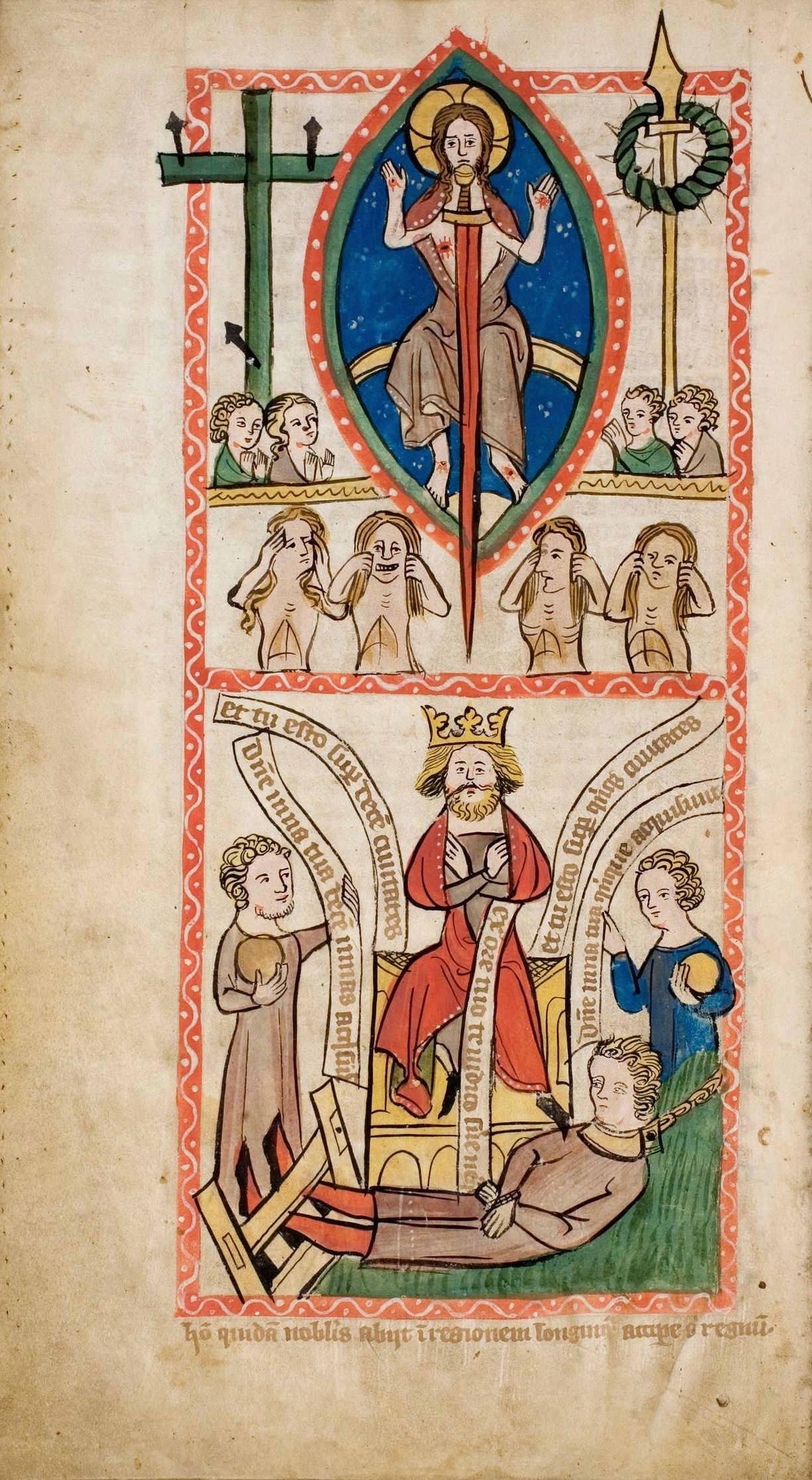
Image credit: Parable of the Talents (Anonymous). From the Speculum Humanae Salvationis (ca. 1360), Universitäts- und Landesbibliothek Darmstadt.
Copyright Source: http://commons.wikimedia.org/wiki/File:Speculum_Darmstadt_2505_68v.jpg
From Art in the Christian Tradition, a project of the Vanderbilt University Divinity Library, Nashville, TN. https://act.library.vanderbilt.edu/artworks/56005 [retrieved November 2, 2026].
Proper 28 (33)
15 November 2026
Judges 4:1-7
Psalm 123
1 Thessalonians 5:1-11
Matthew 25:14-30
When in 1992 Jackie and I moved back to Canada we bought a cookware set at The Bay in Saskatoon. It came with a 25 year warranty and 34 years later we still use it. I also remember our last few visits to The Bay, both in Richmond and downtown. The elevators weren’t working anymore, and some or most of the escalators weren’t either. Especially at the downtown store it was a long climb up to the men’s clothing department, or the housewares. Climbing the stairs I felt sympathy for the staff of the Hudson’s Bay Company, not because they too had to climb the stairs but because visiting the store made it evident that their employment had become precarious.
The Bay’s problem was not simply that the retail environment had changed but that its CEO prioritized real estate value and short-term financial manoeuvring over the hard and costly work of retail reinvention. In a Toronto Star article one executive described CEO Richard Baker as “a landlord first, a retailer second”.1 The Bay was acquired not to offer products, experiences, and anchor local economies and jobs, but to extract capital, the business model of hedge funds.
This is part of the larger economic model in which CEOs receive substantial bonuses to reduce staff through lay-offs, or move production to countries with lower employment costs to generate greater shareholder value. It is an economic model that is indifferent to local economies and local employment. I am not talking about AI but the commentator Michael Sacasas said some time ago that we should not be surprised if AI regards humans as tools, for this is what we have been since the beginning of the industrial revolution.2
A mark of capitalism has become that multinationals not only seek lower production costs and therefore will move production to the lowest bidder who offers the highest subsidies, no matter where that may be, but they also seek tax havens to reduce their taxes in the jurisdictions in which they earn their profits. Apple is no exception, but in Apple’s case, the company avoided $2.7 billion in taxes last year by funnelling profits through Singapore, Apple’s largest tax shelter, attributing up to $50 billion in profits to its hub there. According to the Financial Times, that’s slightly more than the $2.6 billion saved via its Ireland headquarters.3
There is a reading of the Parable of the Talents that suggests that all of this is a good thing. By this reading the first two servants were praised precisely because they invested in the market and earned good returns, while the master takes from the third servant the one talent he had been given, and calls him wicket and lazy. Absent from such interpretation is the question of how the money should be invested. What if it were invested in weapons manufacturing, or in carbon extracting industries, or data centres that use not only incredible amounts of energy but also water, or whether it could be invested in pornography, because the only value of capitalism is profit. Yet I think it is worth contemplating how my pension funds are invested, or yours.
Besides, such an interpretation of the parable is not only ahistoric, for capitalism did not begin until the 16th century, slowly taking on form two hundred years later when, in order to fight wars, states learned how to pool capital.
To understand the parable as the encouragement to make money and lots of it is also boring, for it would not tell us something we did not already believe, and because such interpretation only tells us what we already believe, it is nothing more than our projecting the world we know into the words of the Holy Scriptures.
But perhaps something else was on your mind when you heard the parable. Perhaps you thought that if in such reading of the parable God is assumed to be the master, then there is no room for grace, for the master in the parable is no different from the billionaires who time their employees’ bathroom breaks, if they even give them one. Such reading makes the parable all about performance and the return all to be for the master. If Christians have been understanding the Parable of the Talents in this way, it is no wonder that the gap between rich and poor has grown exponentially. Oxfam Canada reports that the richest one percent in Canada, those with a net-worth of $7M and above, hold nearly $3.9 trillion in wealth – nearly as much as the bottom 80 per cent combined. At the some time, in 2024, more than 25% of Canadians were living in food-insecure households.4
And so, if we read the parable in this way, the image of God emerging from such reading is troubling.
I want to suggest another way.
The other way consists of two convictions. The first conviction is that, while the context is about discerning the signs of the end because Jesus responds here to the disciples’ question, ‘Tell us, when will this be, and what will be the sign of your coming and of the end of the age? (24:3), the master is not setting this up as a trap but as a partnership. Each of the servants is given an extravagant amount of money and is asked to act in the master’s name, to imagine they were the master. “What would Jesus do?” is a modern phrasing of this task. While the last servant was not interested in such partnership and acted out of fear when he buried the talent he was given, what we know about God is that God is generous and extravagant. God has mercy on God’s children and has regard for all who suffer. God’s extravagant love is made manifest in Jesus who gives everything to redeem creation.
The second conviction is about abundance as in the extravagance of the task, and the extravagance of God’s mercy.
In the Sermon on the Mount, Jesus says that we cannot serve two masters, that we cannot serve God and wealth. (Matthew 6:24) Jesus then exhorts his followers not to worry about their life, what they will eat or what you will drink, or about their body, and what they will wear. He says, Is not life more than food, and the body more than clothing? 26Look at the birds of the air; they neither sow nor reap nor gather into barns, and yet your heavenly Father feeds them. Are you not of more value than they? 27And can any of you by worrying add a single hour to your span of life? 28And why do you worry about clothing? Consider the lilies of the field, how they grow; they neither toil nor spin, 29yet I tell you, even Solomon in all his glory was not clothed like one of these. 30But if God so clothes the grass of the field, which is alive today and tomorrow is thrown into the oven, will he not much more clothe you—you of little faith?
While those of us who incline to worry have found these words difficult, it remains a beautifully poetic passage. What makes the passage poetic is the parallel Jesus draws to the natural world.
It was not so long ago that the Garden City Conservation Society had its annual meeting. The meeting always ends with a tour of those lands, an interpretative walk lead by KPU professor Michael Bomford. We learn about the species present, those natural to the place, those who are invasive, the sphagnum moss, and the carbon sink bogs constitute. One of the invasive species is the blueberry plant as it is gown on local farms. It comes to the garden City Lands courtesy of birds who eat the blueberries and digest them wherever they go next. And this is how it is throughout creation. Think of maple seeds and acorns, of evergreen cones, of pollinators, and so forth.
The abundance of creation looks not to profit, nor to maximize the profit of a select few, but scatters its seed with abandon. This abundance of this generosity is the divine economy, an economy where there is enough for all. It is the economy into which the followers of Jesus are called, in which we know that everything is a gift.
The popet Wendell Berry writes,
… Nothing
Is given that is not
Taken, and nothing taken
That was not first a gift.5
The Parable of the Talents is part of a group of three parables, the last one of which is the Parable of the Sheep and the Goats, in which the King will judge the world according not to how much wealth we have accumulated, but according to what we have done to the least of these. This is the treasure that counts.
It seems to me then, that the Parable of the Talents cannot be about accumulation and the maximizing of wealth, nor the transfer of our profits into other jurisdictions, but rather about the use of our resources to the good of our communities and our neighbours, in the same way that plants produce seeds, wind and birds distribute them, and bees pollinate. To bury a talent is an irony then, for money does not grow in the way that God’s good creation does, a creation in which there is enough for all.
And regarding the first two servants, absent a capitalist economy and in light of God’s abundance, could it not be that these two servants invested the masters talents in the local communities, much like a co-op, a credit union, or trust may do, and that the doubling of the talents is more than can be measured by accountants. These two entered into a partnership. They acted in the way their master would.
We are nearing the end of the liturgical year which means that the church sets its mind on eternal things, which is why we hear these parables now. Eternal things mean a vision of the Kingdom of God, and those who follow Jesus are not called to make lots of money but to act in the way they imagine Jesus would act, for it is his return we anticipate and long for.
Amen.
Prayer of the Day
O God,
from whose abundance
all gifts and skills are lavishly bestowed:
give us courage to use our talents
as generously as you have given them,
so that, being faithful to your purpose,
we may share in your glory;
through Jesus Christ our Saviour. Amen.
Let us pray for the whole people of God in Christ Jesus and for all people according to their needs.
~ a brief silence ~
For the goodness and abundance of creation, {pause}
for the abundance of your gifts and for the gift of yourself, {pause}
for the abundance of your trust, making us your partners, we thank you, O Lord. {pause}
Guide us by your Spirit that we may honour creation, {pause}
learn that you give in abundance so that there be no want, {pause}
learn to receive gifts, including the gift of yourself, {pause}
and accept the task to be your partners, your hands, feet, and voice,
sharing your gifts, and giving of ourselves.{pause}
Hear us, O God. Your mercy is great.
Like your disciples, O Lord, we worry when we think about the end, our end, or the end of the world. Teach us that the end is the beginning of when you will make all things new, and so help us to look with joy to your coming at the end of time,
and to look with joy to your coming on every single day, every hour, and every minute.
Hear us, O God. Your mercy is great.
Lord, we live in this world, and the way this world works today is how we imagine you to work, even though your
our thoughts are not your thoughts,
and our ways are not your ways.
Grant us the imagination of your Kingdom that we may invest your gifts as you do,
not for profit but for the building of your Kingdom,
and for a world without want.
Hear us, O God. Your mercy is great.
This past week we remembered the horror of war, those who served in wars and suffered in them. We give thanks for lives given selflessly, even while asking your forgiveness where our imagination still fails us, forgetting that you call your followers not to take life but to give their lives, as you gave your life for all. Hear us, O God. Your mercy is great.
Lord, we like things, and we like to accumulate things, and yet you do not accumulate but give. Let us be people who like you live not to accumulate but to give. Hear us, O God. Your mercy is great.
Healer of our every ill, grant your healing presence to all who are ill in any way, and fill them with the joy of your presence, especially … , and all we bring before you, spoken or silently … Bless those who experience the blessing and burden of age, especially …. Bless their families also that they may have strength to accompany those they love. Hear us, O God. Your mercy is great.
We give thanks for the gift of the Church and the gift of this community. We give thanks not because the church were perfect but because you have made us your own and called us into a community. We give thanks for the promise that rests on the Church, the promise you have given to your people. Let us take you by your word and joyfully take up our call to be your people in the world, humbly acting in your name until you return in glory.
Today we give thanks for the past ten years of ministry together, for the gift of each other, and your presence that makes our life together possible, and gives us direction and purpose. Hear us, O God. Your mercy is great.
All these things and whatever else you see that we need, grant us, O God, for the sake of Christ who died and rose again, and now lives and reigns with you and the Holy Spirit, one God, forever and ever. Amen.
1 The real reason for the demise of the Hudson’s Bay Company, The Toronto Star, 4 April 2025 (updated 11 May 2025), also Did one CEO sink Hudson’s Bay?, money.ca, Leslie Kennedy, 3 August 2025
2 See L.M. Sacasas, AI as Christian Heresy – How we mediate the real is how we meditate on the voice of God, Comment Magazine, 12 March 2026
3 Apple saves $2.7bn in taxes by booking profits in Singapore, The Financial Times, 7 November 2026
4 The Rise of the Super-Rich – The State of Inequality in Canada, Oxfam, 19 January 2026; see also Statistics Canada: Distributions of household economic accounts for income, consumption, saving and wealth of Canadian households, first quarter 2025
5 Sabbath Poems (1998, VI), in This Day – Collected & New Sabbath Poems, Berkeley, CA: 2013 Counterpoint, page 188