

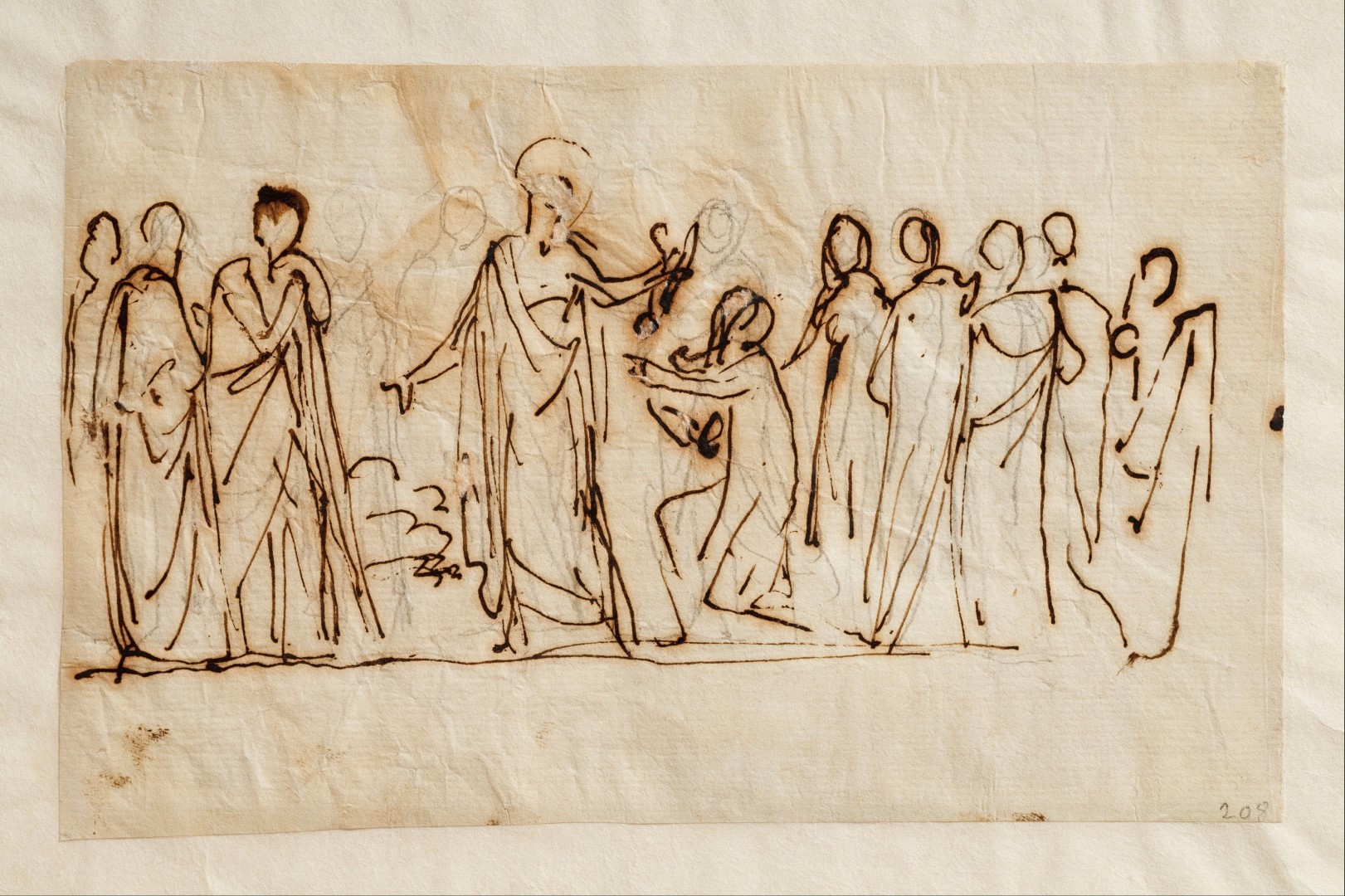
Image Credit: Christ gives the keys of the kingdom to Peter (ca. 1817-1818) by Bertel Thorvaldsen (1770-1844), Thorvaldsens Museum, Copenhagen.
http://commons.wikimedia.org/wiki/File:Bertel_Thorvaldsen_-_Christ_Giving_the_Keys_to_St._Peter_-_Google_Art_Project.jpg
The work ins in the public domain.
From Art in the Christian Tradition, a project of the Vanderbilt University Divinity Library, Nashville, TN. https://act.library.vanderbilt.edu/artworks/55928 [retrieved August 20, 2026].
Proper 16(21), Year A
23 August 2026
Isaiah 51:1-6
Psalm 138
Romans 12:1-8
Matthew 16:13-20
I began my theological studies in Bavaria. Bavaria is known not only for lederhosen, dirndls, BMWs and the Oktoberfest, besides Oberammergau’s passion play, but also for being relatively conservative. Politically and otherwise.
It was in 1975 when the ordination of women was introduced. This was approximately at the same time as in the predecessor bodies of the ELCIC. I was only 11 years old and I was not living in Bavaria. Years later I learned that in response to the ordination of women a number of Lutheran pastors converted to the Roman Catholic Church.
I always wondered why they were received. Didn’t their response to the ordination of women show a strong tendency toward literalism?
Some of you remember Bishop Jacobson. Quite some time ago Jacobson was bishop of the Synod of Alberta and the Territories. There are two things I know about him: a) he wore a miter, b) he was a clear voice in the debate about ‘communion of the baptized’ leading to our church’s 1991 statement on sacramental practices.
That he wore a miter was usually mentioned somewhat mockingly. And fair enough, for all that the church needs to do, reintroducing the wearing of funny hats is not high on my list of priorities.
After his retirement Jacobson converted to Roman Catholicism. In November of 2006 Jacobson was quoted in the The Western Catholic Reporter as saying “I realized that the teaching authority of the Church is something Jesus gave to Peter and the bishops and no other Church really can duplicate what Jesus gave … The Church needs a rock and the rock is the one Jesus gave us and it’s the holy father with the bishops and without that there is no rock.”
Jacobson alluded to a verse from the Gospel of Matthew that we find in today’s reading. His own understanding of this verse was related to what the church calls ‘apostolic succession’. Jacobson saw the authority of Jesus to rest only in the one office and sees Peter’s successors only in one church.
I have always wondered about this passage. While I have deep appreciation for the confession of Peter, I have always struggled to understand what Jesus meant when he said, “I will give you the keys of the kingdom of heaven, and whatever you bind on earth will be bound in heaven, and whatever you loose on earth will be loosed in heaven.”(Mat 16:18-19)
Regardless of what binding and loosing may mean (possibly forbidding and permitting), there is a substantial degree of authority given to Peter. Should Peter have this degree of authority? What if Peter messes up?
We know that not only Rome has (rightly) interpreted this passage as being about the church. We have too. We know Peter to represent all disciples. Whenever he speaks, we can find ourselves in him. Together with Peter I want to worship Jesus, I want to join him in his confession, “You are the Messiah, the Son of the living God.”
I also know that Peter messes up. He does not ‘get it’ as often as he does. While he wants to be faithful even unto death, he is not, at least not when Jesus is crucified. Peter’s own martyrdom follows much later. Peter is us and we are Peter.1
As we read on we discover that Peter’s marvellous insight and confession is followed almost immediately by his complete misunderstanding of what Jesus’ messiahship means. Again, we can find ourselves, and worse yet, we can find the church.
The Lutheran clergy who converted to Roman Catholicism were right in this way: the church is not perfect, the church is not the Kingdom of God. The only problem (aside from their literalism) was that they left one imperfect institution for another. And I always wondered why they were received.
What is remarkable is that Jesus speaks these words to Peter and to the church, even though, Jesus surely knew how Peter misunderstood him still, he knew that the church would still err in profound ways, get her priorities wrong and mistake power for the Gospel, and attempt to purify the church from all sin.
Jesus knew that Peter could say the right words without having fully understood what they mean.
And that’s what’s so wonderful about this story. It’s a story about the church on the way. It’s a story about the church still trying to understand who Jesus is, even while walking with him, eating with him, listening to him. It’s a story about the Word becoming flesh in us.
It is a story about God’s trust in us and God’s investment in us. Peter’s failure was just around the corner (16:22 – Peter’s rebuke of Jesus) but it did not keep Jesus from investing in Peter, in trusting Peter, and in commissioning Peter. Peter messes up but Jesus still invests in him. The church messes up and God’s promises still rest on the church. We mess up and God has still great things planned for us.
This is a Pentecost moment in the church.
Jesus’ pronouncement on Peter and on the whole Church in Matthew is equivalent to Jesus breathing on the disciples and giving them the Holy Spirit (John 20:22f).
Peter, the church, you and I are given the gift of God’s trust, presence, and the investment of himself. That is the only authority the church has. It is all we need.
Think of Jesus’s declaration that we are the salt of the earth, we are the light of the world. Why? Because God has invested Godself in us.
The only thing is, if this is so, we wonder why our lives continue to be conformist, why we have the same enemies as other people, why we have the same rationalizations, and the same ethics. We may wonder why our lives are not bolder and more vulnerable, why we do not have more love for our enemies and why there is not more turning of the other cheek, less resentment yet forgiving seven times seventy times, less the seeking of a comfortable life and more the seeking of a life that recognizes Jesus in the least of these. Less the life of Pharaoh, and more the life of Shiphrah and Puah.
Less conforming to the world and more being transformed by the Gospel of Jesus Christ.
It is a question we must ponder, for the gift Jesus bestows on Peter and on us is profound and is given despite of our shortcomings, maybe even because of them.
What does Jesus say to Peter? “I tell you, you are Peter, and on this rock I will build my church, and the gates of Hades will not prevail against it. I will give you the keys of the kingdom of heaven, and whatever you bind on earth will be bound in heaven, and whatever you loose on earth will be loosed in heaven.” It is what Jesus says to you, to me, and to the whole church.
God says to St. Paul: “My grace is sufficient for you, for power is made perfect in weakness.” (2 Cor 12:9)
It may be precisely Peter’s weakness that makes God choose Peter, it may be our weakness that makes God choose us.
When I was ordained to be a pastor, an acquaintance of mine, an Anglican, wanted to participate in my ordination. This was before full communion and the bishop said ‘no’. And we said, apostolic succession is not tied to ordination, but apostolic succession is tied to baptism. Baptism is our ordination to ministry, it makes us God’s children, incorporates us into the body of Christ, and calls us to faithful to the teaching of the Apostles in doctrine and practice.
Jesus says, “You are Peter, and on this rock I will build my church, and the gates of Hades will not prevail against it. I will give you the keys of the kingdom of heaven, and whatever you bind on earth will be bound in heaven, and whatever you loose on earth will be loosed in heaven.” And he breathes on us the Holy Spirit.
Amen.
1 Peter is the rock in so far as he relies on God. The same is thus imperative for the church. (see 16:17)