

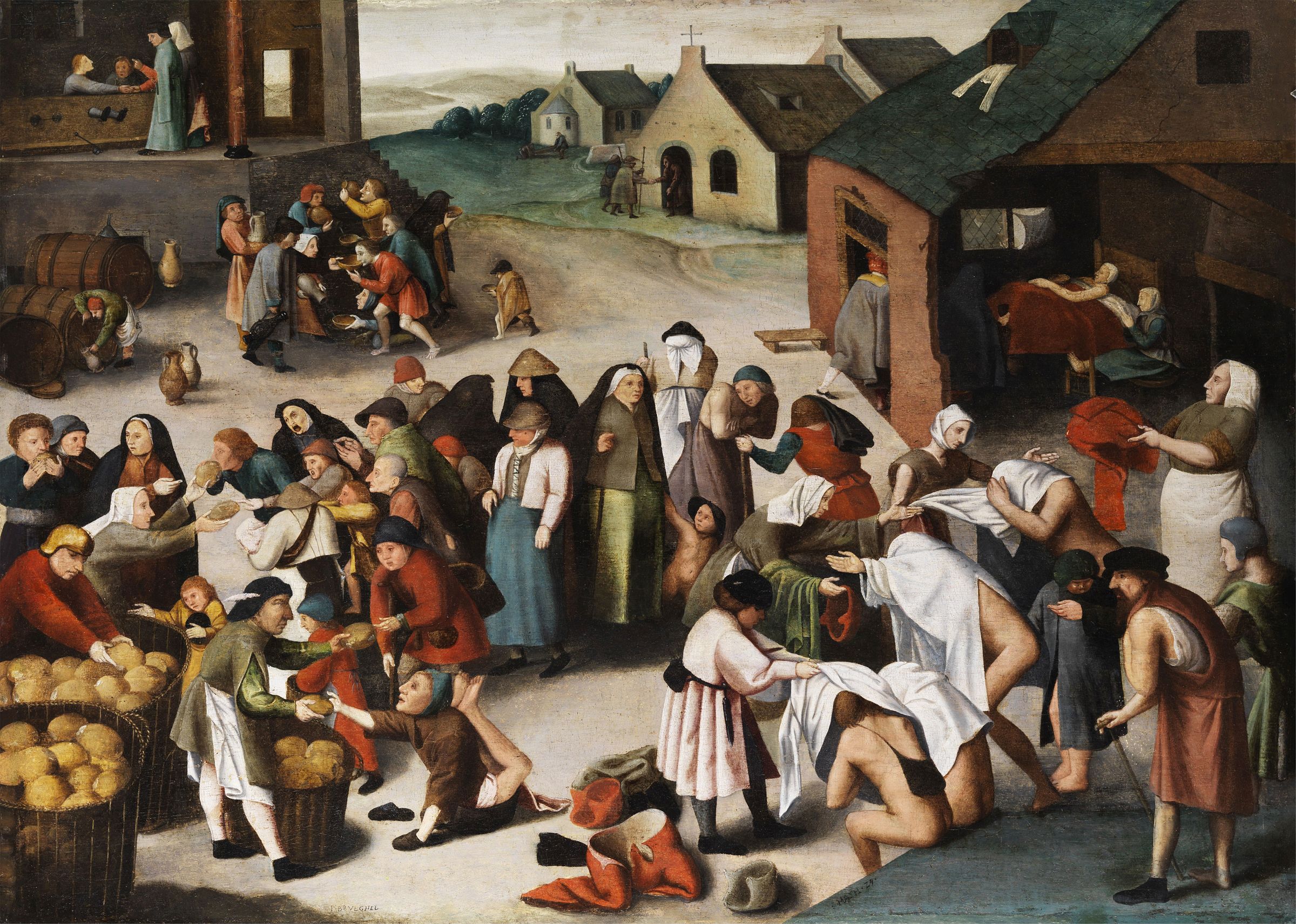
Image Credit: Pieter Bruegel (1564-1638). Seven Acts of Mercy. From Art in the Christian Tradition, a project of the Vanderbilt University Divinity Library, Nashville, TN. https://act.library.vanderbilt.edu/artworks/57786 [retrieved November 16, 2026]. Original source: https://commons.wikimedia.org/wiki/File:Brueghel-Umkreis_Werke_der_Barmherzigkeit.jpg.
The Reign of Christ – Proper 29 (34), Year A
22 November 2026
Ezekiel 34:11-16, 20-24
Psalm 100
Ephesians 1:15-23
Matthew 25:31-46
When I was in grade nine I did a three week practicum in a child care for children with cerebral palsy, and children with spina bifida, a birth defect in which the neural tube has remained open. I returned for another practicum in grade 12. This was before children with disabilities were mainstreamed.
It was a deeply rewarding experience. It was not the first time I met people with disabilities but the first time I met young children with disabilities. The experience was rewarding in part because of the supervision I received and the integration into the team of the child care, and because I came to love the children and learned instantly that while they had a disability, it did not occupy them as it does us. They were simply children like all other children with joys, frustrations, and a great sense of wonder and curiosity.
I remember a field trip to a large park, not far from the child care. To get there we used public transit. I can still see the reactions of the other passengers at the sight of four and five year olds in wheelchairs. I don’t think it would be wrong to say that there was a certain fascination. One didn’t want to stare but did not know how not to. One passenger was carrying a box of doughnuts, surely bought for a different purpose, but decided on the spot to gift them to the children via the adults who were accompanying them. It was the expression of a spontaneous love that did not know what to do.
The people reacted in this way because what they saw contradicted what we consider normative. And when we see people with severe disabilities we may also find ourselves in a moment of gratitude that it is not us in the wheelchair, or not our children, or grandchildren. Yet what this forgets is that children and adults with disabilities share the same humanity, have the same hopes and longings that we do. This well intentioned compassion inadvertently reduces the humanity of those we encounter, and I imagine it is part of the reason why we no longer have segregated schools and child cares. Children with disabilities are children, not victims.
Housing was a reoccurring theme during the last municipal election campaign. Not the cost of housing as much as who we want our neighbours to be or not to be. There was the deeply problematic debate over the potential renewal of the operating permit of Aster Place, a 40-unit modular housing entity for the unhoused. With diminished local media it has become difficult to stay on top of local issues and I do not claim to know everything about the debate. And I do not doubt that there may be problems around this and other homes. After all, this wouldn’t be the only place where one has problems. In our complex, twice within a twelve week period, the same resident managed to drive into the gate to our underground parking, apparently because they were distracted by their phone. And I remember the debate about homelessness and drug use when we lived in Abbotsford. It was a police officer who told me about soccer moms buying their drugs on the supermarket parking lot while their kids were in school. Where there are people, there will be problems. But there will also be humanity, and joy, and according to our parable, there will be God.
What I found difficult regarding the debate about Aster Place was that it was not about how to make community life better, how perhaps different rules, or a different operator could address problems, but that the debate was about removing the operating permit.1 As if having people living in the street would be preferable to having people living in supportive housing, and as if once the operating permit was cancelled all problems would magically disappear.
The police officer in Abbotsford told me about people like you and me buying drugs in the parking lots of suburban shopping centres. (Not sure where the dad’s get theirs).
Jesus’s final parable in the Gospel of Matthew tells of outsiders and our treatment of them. It is one of the best known parables and it is not told for the sake of any kind of description of the afterlife or of hell, but to aid us in our living today. The parable’s purpose is to both warn and encourage.
The people Jesus lists are those of the breadlines depicted by Fritz Eichenberg. They are hungry and thirsty; they are strangers, and naked, sick, and in prison. There is no word as to why they find themselves in their particular predicament, and they are not described as lost causes, nor as people to stay away from, or to drive from our communities. They simply are present in the way that Jesus quoted Deuteronomy when he said, You always have the poor with you … (Matthew 26:10), a verse that continues, I therefore command you, ‘Open your hand to the poor and needy neighbour in your land.’ (Deut 15:11)
The parable is not a story against social programs or against housing. But it is more than that, it suggests that social and housing programs are not enough, especially if that means that we farm out our charity for someone else to deliver, so we neither have to look the stranger in the eye, or find ourselves staring at them. The word charity comes from the Latin caritas which describes what is dear, the object of our love. So the word charity describes the love of our neighbour and it is hard to love from whom we avert our eye and whom we do not know. The sheep in the parable know their neighbours.
While they know their neighbours, everyone in the parable is unaware of the spiritual dimension of what they have done or have not done. But precisely that is the point. Jesus does not tell this parable to turn us into noble do-gooders who justify their own life by a few acts of charity. Jesus says that we meet none other than him in the hungry and thirsty, in the stranger and the naked, the sick and the prisoner. And we who so well understand those who said to Philip, the disciple, Sir, we wish to see Jesus (John 12:21), because we too long to see Jesus, we learn in this parable to see Jesus and to meet him.
And so the task is not just to love our neighbour but to recognize Jesus in our neighbour, which gives our neighbour infinite value, no matter how difficult they may be, for we all are difficult and I am not suggesting that caring for those at the margins is an easy thing.
Yet aside from the surprise to find Jesus in the last, least, lost, and the little, the parable turns our notion of charity on its head, for we exercise charity for the sake of the other, we seek to be benevolent, and we do not mind feeling good about ourselves when we do so. And of course, this is, although well intended, also condescending and patronizing.
But in this parable Jesus says that we care for the last, least, lost and little, not for their sake but for our sake, for in them we meet Jesus.
And that means that we do not look away and that we do not stare, and that even when we do not know what to do, for life is complicated, we know that every person bears the image of God, and that as we meet Jesus in the sacraments of Holy Baptism and Holy Communion, so we also meet Jesus in those who are in need and those who live at Aster Place. May our longing to see Jesus be greater than our desire for the poor and the stranger to be invisible so that our lives may be made richer and deeper by our encounter with them, by our encounter with Jesus who is Christ our King.
Amen.
Prayer of the Day
O God, our true life,
to serve you is freedom,
and to know you is unending joy.
We worship you,
we glorify you,
we give thanks to you for your great glory.
Abide with us,
reign in us,
and make this world into a fit habitation for your divine majesty,
through Jesus Christ, our Saviour and Lord,
who lives and reigns with you and the Holy Spirit, one God, now and forever.
Amen.
Let us pray for the whole people of God in Christ Jesus and for all people according to their needs.
Each petition ends with Hear us, O God, to which we reply, your mercy is great.
~ a brief silence ~
Christ our Lord, in the parable those called before your judgment seat are surprised to learn that their works of mercy were done unto you.
We meet you in Word and Sacrament, in the community of the Church, and in the least of these, for not only can you not be restrained to be in the places we consider holy, for you are all in all, but you have compassion on those who are suffering, forgotten, and left behind.
Give us such compassion that we would meet you where the world does not expect you. Hear us, O God. Your mercy is great.
We give thanks for those who have mercy on the hungry and thirsty, on strangers, and naked and vulnerable, on the sick, and those in prison. As those to your right did not know that when they turned to those in need they turned to you, we see that the act of mercy were habitual to them, expression of who they were.
May your Holy Spirit dwell in us that we too be people for whom the works of mercy become habitual. Hear us, O God. Your mercy is great.
We give thanks for those who came to Philip, asking to see Jesus. We too long to see Jesus. We give thanks for that deep longing.
We give thanks also that you want to be found, that you are present in Word and Sacrament, in the community of the Church, and especially in the last, the least, the lost and the forgotten. Let your presence – where we did not expect you – shape our life, and shape our politics. Hear us, O God. Your mercy is great.
We give thanks, O Lord, that even though we want love others for their sake that we can also love them for your sake, which makes it easier to love, for you are love. Hear us, O God. Your mercy is great.
We give thanks for Lexa, Lily, Jason, for their parents Nick and Kyleen, and for all the baptized. We give thanks that in the sacrament of baptism you restore us in your image, call us your beloved, and place us in a community where we grow in love toward you and all people. Hear us, O God. Your mercy is great.
We ask your healing presence for all who are ill in any way, especially those most dear to us …. and all we bring before you, spoken or silently … Hear us, O God. Your mercy is great.
We pray for the new government of our province and the opposition. Grant them wisdom, humility, and love, and let them seek to work for the benefit of all. Hear us, O God. Your mercy is great.
All these things and whatever else you see that we need, grant us, O God, for the sake of Christ who died and rose again, and now lives and reigns with you and the Holy Spirit, one God, now and forever. Amen.
1 Not to mention the 2025 cancellation of the supportive housing project for Cambie/Sexsmith.