

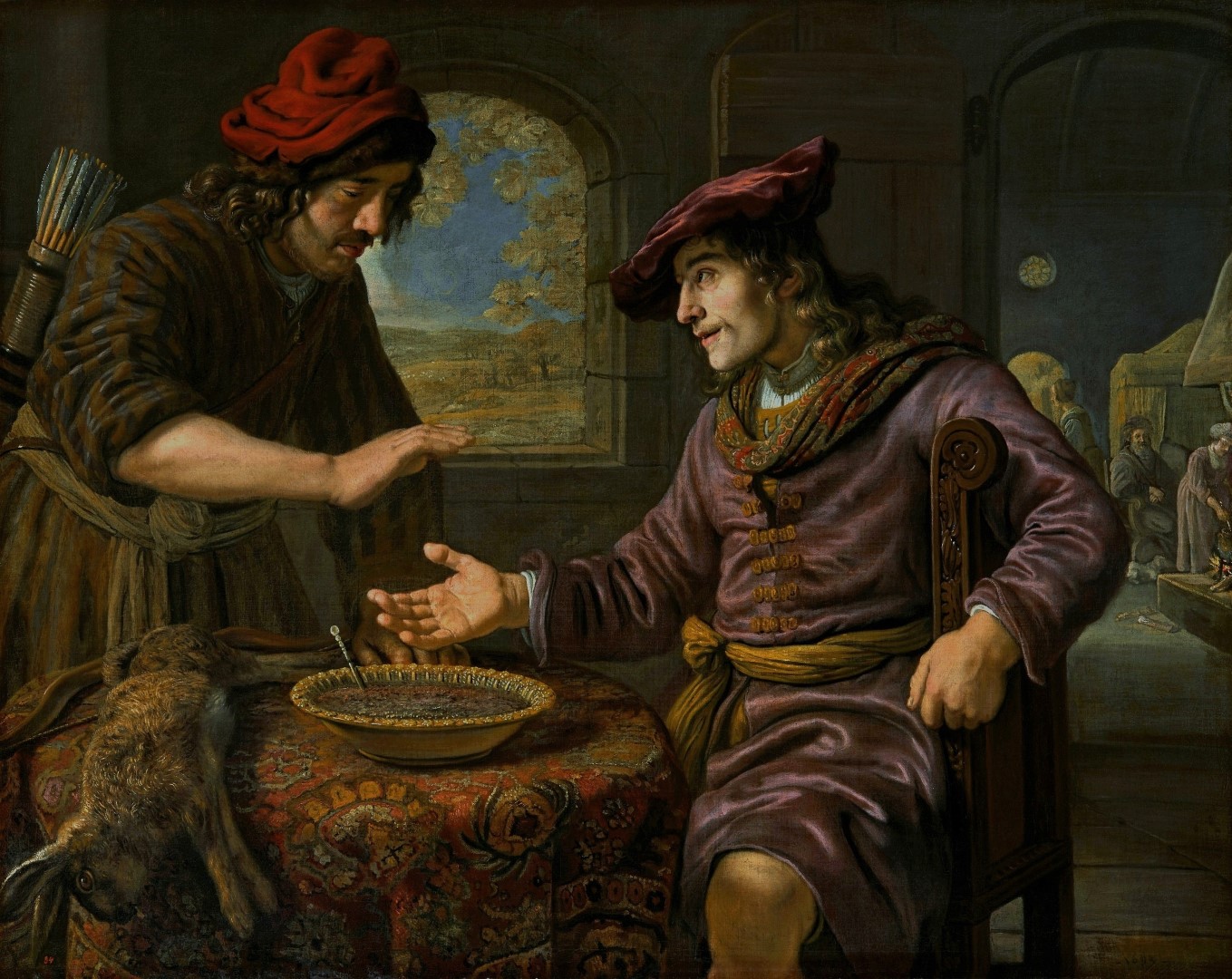
Image Credit: Esau and the Mess of Pottage (1653) by Jan Victors.
from Art in the Christian Tradition, a project of the Vanderbilt Divinity Library, Nashville, TN. https://diglib.library.vanderbilt.edu/act-imagelink.pl?RC=58885 [retrieved June 24, 2026]. Original source: https://commons.m.wikimedia.org/wiki/File:Victors_Esau_and_the_mess_of_pottage.jpg
Proper 10 (15), Year A
12 July 2026
Genesis 25:19-34
Psalm 119:105-112
Romans 8:1-11
Matthew 13:1-9, 18-23
Control (Genesis 25: 19-34, 32: 9-12 and Romans 8: 1-11)
Preacher: Ron Vonk
Two people died this year who were both my age. I was very close to one of these people. I only learned about the other person. Neither person was part of our church.
The first person who died lived his last year of life with his hands open to others. He had concern for his family members. He also had concern for his friends. Some of these friends were former prisoners who had turned their lives around. Some of these friends had financial troubles. He wanted to encourage all of these people. The man had the best medical care Canada offers but he spent as much time during his last year of life living out his concern for others as he spent on his own medical needs.
The second person who died also spent their time living out their concern for others. But they focused mainly on seeking medical attention not only in Canada but also in another part of the world.
Both people were Christians. Both people died much too young. Both had a concern for others. The one difference between them was the extraordinary efforts one of them took to seek medical help.
My purpose this morning is not to say that one person’s approach was right and the other person’s approach was wrong. But I do want to talk about these two different approaches to a major crisis in life. One person tried hard to control their crisis. The other person was more accepting of their situation. I want to talk about how we often try to control every situation in life. We even want to control situations which at this point in time only God controls.
Right up front I admit that I live my life trying to control whatever challenges life has for me. This morning I challenge my own need to control every situation. Our reading from Romans and Genesis this morning open up an alternative for me and maybe for someone else here this morning who continues to try to control every situation in life.
I begin with our reading from Romans 8. Romans chapter 8 opens with a wonderful announcement. There is now no condemnation. A new era of salvation has begun. We are delivered from the penalty of sin. Our relationship with God is secure. Our state of estrangement from God is over.
Why is our state of estrangement over? Our state of estrangement is over because of Christ’s death “for us.” Our state of estrangement is over simply because we are “in Christ Jesus.” His work is outside of our control.
In Romans 8 we get “before Christ” and “after Christ” pictures of our position before God. The “before Christ” picture is discussed in verses 5 to 8. Our “before Christ” picture is described in these words: “those who live according to the flesh, who set their minds on the things of the flesh.”
Living according to the flesh is not about the person who eats too much, living according to the flesh is not about a person being lazy or prideful. Living according to the flesh means a way of living in which a person’s life is shaped by, maybe even controlled by, the values and standards of a world in rebellion against God. Living according to the flesh is not simply a list of bad behaviors. It is a way of living that charts its path apart from God.
In order for us to understand what this way of life looks like, I want to consider Jacob and Esau in our first reading from Genesis. Our Genesis reading introduces us to these twin brothers. Their relationship with each other is full of conflict. Even in their mother Rebecca’s womb, the two babies were in conflict with each other. This morning we meet them as young men. Esau is a skillful hunter, a man of the open field who loves excitement. Jacob is a quiet man who stays close to home.
Jacob desperately wants something that belongs to Esau. We watch Jacob take that something from Esau. A conflict unfolds, a conflict that will keep the two brothers apart for 20 years. In this scene, Esau is hungry. Jacob is cooking up a stew – a red, stew usually with lots of meat that Esau cannot wait to eat. Esau is physically exhausted. Esau is not thinking straight.
In addition to cooking up his stew, Jacob is cooking up a scheme to take what is not his. Jacob wants Esau’s birthright – a right that in ancient culture belonged to the oldest son.
After Esau asks for some stew, Jacob says to Esau, “First sell me your birthright.” Since Esau is not prepared to wait for some stew, Esau foolishly says, “I am about to die (which is not true), of what use is the birthright to me.”
Jacob is not satisfied with Esau’s vague answer. Jacob is ruthless. Jacob says, “Swear to me first.” Jacob asks his brother to speak a sacred unbreakable word – a solemn oath that the one swearing cannot break.
In the end Esau does not even get the red, meaty stew he bargained for. He gets lentil stew without meat. The red coloring in the stew was not meat after all. Esau treats with flippancy something which in ancient culture was considered of great worth. Esau is controlled by things of the flesh.
And Jacob will live to regret his victory over his brother. Jacob later tries to return what he has taken. The Bible never talks about Jacob’s birthright again. In the end the birthright is not important. What is important is a good relationship with a brother.
Jacob is as irresponsible as his brother. Jacob wants success apart from God. Jacob makes a fool and an enemy out of his brother. The consequences of Jacob’s actions that day chase Jacob for decades. Jacob and Esau both live their lives with their minds on the things of the flesh.
Jacob and Esau exemplify the “before Christ” picture in Romans 8. We now move to the “after Christ” picture. We look at those who live according to the Spirit, who set their minds on the things of the Spirit.
We go to Romans 8 verse 9. “But you”, says Paul, “are in the Spirit, the Spirit of God dwells in you”. If you are a Christian, the Spirit of God dwells in you. Our status in Christ is secure (verse 10) even though we are still subject to physical decay and death, even though we still sin and even though we continue to be tempted to live according to the flesh. We may continue to try to control every part of our own lives.
Please notice that verse 10 opens with the words, “Christ is in you,” and verse 10 closes with the words, “the Spirit is life because of righteousness.” Christ and Spirit communicate to us the benefits of what God has done, “in Christ Jesus.” The “how does this work?” question is not answered. We simply know that God refuses to let our sin determine our relationship with God.
Our reading from Romans ends with the greatest liberation event of all time. Verse 11 says, “He who raised Christ Jesus from the dead will give life to your mortal bodies through his Spirit that dwells in you.” This is nothing less than liberation from the power of death. God will do for us what he did for Jesus. God will do for us what we could never do for ourselves. This is totally outside of our control.
No specific actions on our part are commanded in our reading from Romans. Our reading finishes with an emphasis on the word “give.” The Spirit of God “gives” life to our mortal bodies. I like the word “give.” This is all a gift from God.
At the same time, this new relationship has consequences. We are no longer obligated to the flesh. The flesh cannot please God. But like freed slaves who out of habit obey their old masters, we often follow the dictates of the flesh. That is why we need to join communities of Christians in worship. We are all in this together. We confess our sins, we hear words of forgiveness, we remember God’s gifts, we receive bread and wine as Christ is with us our worship and in our daily lives. One of God’s gifts is each other. We need this gift as well. God’s Spirit is in us as we worship together. God’s Spirit works in us as we worship together.
The final question is, ‘What does this Spirit shaped life look like?’ We go back to Genesis for examples of a Spirit shaped life. Verses 21 to 23 of Genesis 25 and Jacob’s prayer in Genesis 32 provide examples. In verses 21 to 23 we hear about Isaac and Rebekah and in Genesis 32 we hear about why the conflict between the two brothers ends.
The episode in Genesis 25 opens with barrenness. Jacob’s father Isaac is a child of promise. God kept his promise to give Isaac’s father Abraham a son. That son was Isaac. Rebekah, Jacob’s mother is a healthy young woman. When Rebekah married Isaac, her family blessed Rebekah with these words, “our sister may you increase to 1,000’s of ten thousand.” But Rebekah has no children. A miserable condition for a woman in ancient society who was promised a multitude of children.
When grandfather Abraham was in Isaac’s situation, Abraham found a surrogate mother. Isaac does not do what his father did. Instead, Isaac prays for 20 years. Finally, after 20 years of praying, Isaac’s prayers are answered. A Spirit shaped life is marked by prayer.
But this is not a “they lived happily ever after story,” just like our lives are not “they lived happily ever after stories.” The story of this family is filled with conflict. Conflict begins before the two sons are born. There is conflict between the two brothers. There is conflict between Mom and Dad. Each tries to control events to suit their own purposes. God is noticeably absent from much of the conflict.
Now we go to our final scene for this morning just before the two brothers reconcile. Jacob returns home after an absence of 20 years.
Just before the reconciliation, Jacob prays. Jacob expects his brother Esau to be angry. Esau is coming to meet Jacob with 400 men. They look like men preparing for war. Jacob has great fear. Jacob has great anxiety.
I invite you to listen to Jacob’s prayer. It is a four part prayer. I will go through each part.
Part 1 of Jacob’s prayer. “O God of my father Abraham and God of my father Isaac, O Lord who said to me, “Return to your county and your kindred, and I will do you good.” God promises to do Jacob good. Jacob holds God to God’s promise. Jacob is no longer a person in control of his situation. Instead, Jacob simply accepts that he is a part of the family of Abraham, a family that lives in a land of promise. Jacob simply accepts God’s promise. We accept God’s promises “in Christ.”
Part 2 of Jacob’s prayer. “I am not worthy of the least of all the steadfast love and all the faithfulness you have shown to your servant…” Jacob sees his own smallness. Jacob comes empty handed before God. Jacob is one child who, together with all God’s children, learns to live by God’s gracious, undeserved faithfulness to these children.
Part 3 of Jacob’s prayer. “Deliver me please, from the hand of Esau, for I am afraid of him…” Jacob asks God for safety. He asks God that his life and the lives of his family will be saved from the anger of his offended brother. Jacob understands that his life is no longer under his own control. Jacob needs God’s protection.
Finally, Part 4 of Jacob’s prayer: A reminder to God of God’s promises to do Jacob good, to make Jacob’s offspring as numerous as the sand of the sea, which cannot be counted….
God’s Spirit working within Jacob takes Jacob from a person who wants to secure his own future to a person of prayer and dependence on God. Jacob has learned to live by God’s gracious faithfulness. It is not a “they lived happily ever after story,” but it is the story of a person who gives control of his life over to God.
There are many situations in life we cannot control. We serve a God who has everything under control. God can be trusted. We move forward in confidence that life is under God’s control.
This is my prayer this morning:
May God’s Spirit dwell in us as we continue to live our lives under God’s control.
Amen.