

click to access archived live stream
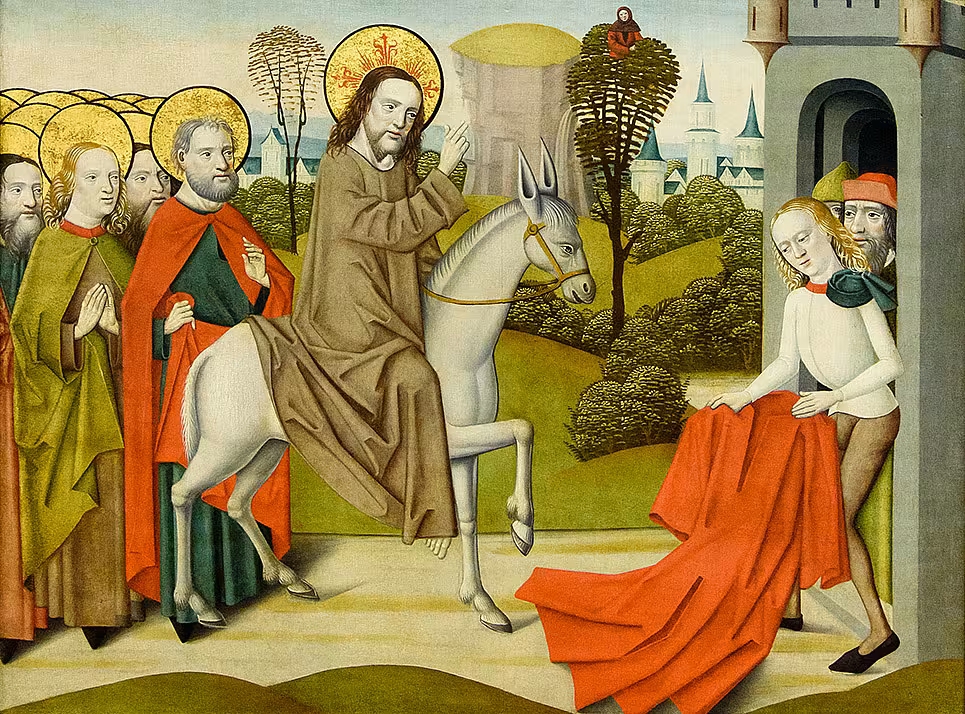
Image credit: Jesus’s Entry into Jerusalem (1470?), Ulmer Schule, Bayrisches Nationalmuseum
Palm Sunday, Year A
29 March 2026
Matthew 21:1-11
Exodus 14:21-22, 29, 31
Revelation 19:6-10
Matthew 26:6-13
Neither of my parents grew up in the church. A church in our neighbourhood had a preschool which my brother and I both attended for half-days. This became my parents’ connection to the church. At some point they decided to attend now and then. I do not know why. Maybe because they sought community, they did not have many friends. Maybe because they hoped that God would help them with problems of which they had many. Maybe because they sought God. Maybe all of the above.
Both of them had been baptized as children. It was in their thirties that they began attending, first occasionally, then more regularly and the church began to play a bigger role in their lives. My father had a conversion experience.
But if they had hoped that attending church would save their marriage, they must have been disappointed. My father moved out the year I moved out. That was in 1985. However, it was good for both of them. My uncles and aunts thought they never should have married.
My father remarried. His second marriage was happy and he became a better human being, which is what marriage is supposed to do. My mother remained single. She was lonely and would have liked to have known herself loved, but her personality disorder stood in the way of that.
My mother remained active in the church, although her circle of friends persistently grew smaller. When we spoke on the phone I would on occasion inquire about her church friends, and she would reply that she was no longer talking to the person I had asked about because, she said, “they did not let me get a word in.
My father’s social life greatly improved. He had married the sister of his best and only friend’s wife. He relocated and now was part of their social sphere.
But he had stopped going to church. When I once asked him about going to church he answered that he could not receive communion. He assumed, his faith having been shaped in a border-line fundamentalist church, that his divorce from my mother and his remarriage disqualified him from Holy Communion. He cited 1 Corinthian 11 where the Apostle Paul says that (…) all who eat and drink without discerning the body, eat and drink judgment against themselves. It was true that he had not been a good husband to our mother, he also had not been an attentive father, and so it would be understandable if he was trying to come to terms with that. But that is not what St Paul was talking about. Paul was addressing economic segregation in the church. Those who had food did not share with those who did not. Imagine a pot luck where some of us eat and some don’t. Failing to perceive that together we make up Christ’s body, rich and poor, Jew and Gentile, male and female, slave and free, that was the problem Paul was addressing. Paul was not suggesting that people be excluded from the Lord’s table, rather, Paul wanted to make sure everyone was included. These are the things we miss when we do not consider context.
Later, in my first parish, some older German folk made a similar argument against receiving communion every other Sunday. They thought it was too frequent and it was too frequent because they believed they were not worthy.
In case you wonder, on his deathbed my father received Holy Communion.
Our Processional Gospel about Jesus’ entry into Jerusalem is preceded by the healing of two blind men and followed by Jesus’ cleansing of the temple. (Matthew 20:29-34)
Jesus and the disciples are leaving Jericho and it is on their way out of Jericho that they encounter the two blind men. These two are probably used to being bypassed in the way that we may avoid panhandlers. But their concern is urgent and already being socially and economically marginalized they have nothing to lose and thus shout, Lord, have mercy on us, Son of David! The crowd tries to shut them up but undeterred they call again, this time louder than the first time, Have mercy on us, Lord, Son of David! Jesus hears them, stands still, and calls them to him. It may surprise us that Jesus asks them what they want of him. But Jesus engages them and gives them agency. That they address Jesus as “Lord” and “Son of David” shows us that the blind see what those with eyesight do not. Yet it was those who see who tried to shush them. Jesus, on the other hand, never refuses anyone who seeks him, it is the crowd or the disciples who do. Think of our other Gospel reading for this day: The disciples consider the anointing of Jesus by the woman a waste and one may think they think of her in the same way. Jesus, however, accepts her gift, the worship she bestows on him, and tells his disciples that acknowledging her lavish gift will be part of the life of the church. Jesus considers her worthy, as he had considered the two blind men worthy; and he considers us worthy, you and me.
And that sets the context for Jesus’ entry into Jerusalem. Only last week did the Gospel remind us that Jesus’ life would be in danger if he proceeded to Bethany, a small place just outside of the gates of Jerusalem. Upon hearing Jesus’ decision to go, Thomas had said to the others, Let us also go, that we may die with him. (John11)
This is not something Jesus did not know, for everything Jesus does is intentional.
Palm Sunday marks the beginning of Holy Week, the week in which Christ is betrayed, crucified, and raised from the dead. It is the week in which Jesus accomplishes our salvation.
The Bible does not give us a single way to understand how Christ’s death wins our salvation, it only proclaims to us that Christ crucified is the power of God and the wisdom of God. (1 Cor 1)
And so some understand Jesus’s death on the cross as humanity having offended God and Jesus bearing our punishment. This may be what the beautiful old hymn “Ah, Holy Jesus” is saying when it sings,
“Who was the guilty? Who has brought this upon thee? Alas, my treason, Jesus, hath undone thee.”
This is not wrong and there is reason to sing this, not only because the hymn is beautiful. Yet at the same time, it may suggest that God needed to be appeased by sacrifice. It also makes the death and resurrection of Jesus transactional: Jesus died so my sins are forgiven and I go to heaven.
It seems to me that Jesus’ ministry makes it impossible to see Jesus’ interaction with people and the world as transactional. Jesus asks the two blind men what it is that they seek, makes time for Nicodemus at night, and dips his bread into the bowl with Judas. Jesus is never ashamed of anyone, not of his disciples who often do not understand and who abandon, deny, or betray him. He is not ashamed of tax collectors or pharisees, not of foreigners, or of the unnamed woman who lavishly anoints Jesus as king. (It is true that Jesus says that it is for his burial, it is also true that kings were anointed with oil to their head and that this act of extravagance is a confession and an act of worship.)
The theologian Edwin van Driel writes that “Once creation wanders away from God, God decides that the One for whom all things were called into being, the One who is the (eschatological) goal of everything that exists, also will be the One through whom God draws back creation – ‘so that he might have first place in everything’ (Col 1:18)”1 Van Driel thus connects salvation to creation.
To put it another way: Think of the beginning, The Prologue, of the Gospel of John: Jesus was in the very beginning and all things came into being through Him. (John 1) Think of what St Paul says about Jesus, For from him and through him and to him are all things. (Rom. 11:36)
When you look at it this way a different story emerges thank one where God needs to be appeased by sacrifice. It is a story in which we were always loved by God, a story in which God created us in Jesus so that we could share in the life of the Trinity. That is heaven.
Sam Wells of St Martin in the Fields suggests that when we think that Jesus only came to repair the world that was never intended to be broken, then this is a story all about us in which Jesus is merely the plumber that comes to fix a leaky pipe.2 But if we think of the creation of the world as expression of God’s love that seeks to share its joy with us and creation, then this is no longer a story about a plumber. It is also no longer a story just about me but it is a story about community and communion. And there is nothing transactional in this story because it is all about relationship.
So when Jesus enters Jerusalem, Jesus does not do so to die, though he will die, but he enters the city to be with us, to be with creation, to be with those created in God’s image. And by drawing us into the life of the Trinity we are cleansed, made new, forgiven, and redeemed.
In God’s coming to be with us we see that God is not ashamed to be called our God, no matter who we are. (Hebrews 11:16) Jesus comes to be with us to draw us into the life of the Trinity, into communion with God and each other. And that dwelling with God begins not only after we die but it begins today.
Thanks be to God.
Amen.
1 Edwin Chr. van Driel, Incarnation and Israel: A Supralapsarian Account of Israel’s Chosenness, quoted in William T. Cavanaugh, The Uses of Idolatry, New York, NY: 2024 Oxford University Press, page 472
2 See So it Comes to This, a sermon preached at Duke Chapel on the 2nd of April 2023