

click to access archived live stream
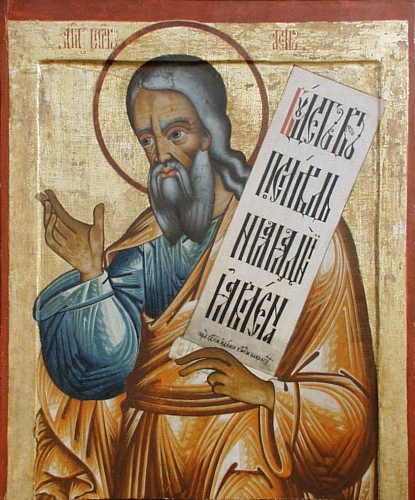
Image Credit: Russian icon of the Prophet Isaiah, 18th century (iconostasis of Transfiguration Church, Kizhi monastery, Karelia, Russia). Source: Wikipedia
Second Sunday after the Epiphany
18 January 2026
Isaiah 49:1-7
Psalm 40:1-11
1 Corinthians 1:1-9
John 1:29-42
Preacher: Ron Vonk
Ina and I bought a travel van about a year ago. Our hope was to use the van to see Canada from Vancouver to Prince Edward Island. We have not reached Prince Edward Island yet. In our first year we only got as far as Saskatoon.
Our van travels have had some highs and lows. As we travel, we talk more than we ever have. Much of the talk is about mundane things – where to stop for the night, bathroom breaks, scenic detours to choose. Some of our talk is kind talk – encouraging each other. Some of our talk is angry talk – words of frustration when we struggle connecting water, sewer, and electrical lines. It is all very complicated.
Some of our talk is despondent talk – the kind of talk we shared when our van motor died and we were left stranded on the side of a busy highway waiting for a tow truck. Our van is wonderful. But more wonderful has been the talks we have had with one another and talks we have had with far away friends who we have been able to visit.
And talk is what the unusual servant in Isaiah 49 offers us. In a few minutes I will suggest who this servant is. But first I invite us to listen to the servant’s talk and I invite us to listen to the talk of the people in the servant’s audience and the talk of God who addresses his servant. Much of the talk is despondent talk. But some of the talk is kind talk – encouraging talk.
We begin with the people in the servant’s audience. I am a Michael O’Brien fan. Michael O’Brien is a Canadian Catholic author who wrote a fictional account of the early life of the prophet Ezekiel. In O’Brien’s novel entitled “By the Rivers of Babylon,” the young Ezekiel describes the people who the servant in Isaiah 49 is addressing.
Here are young Ezekiel’s words: “We are many hundreds of captives, not the full populace of Jerusalem, but the wealthy and powerful…..All around me, a constant wailing of women’s voices arises from the crowd of prisoners and local inhabitants alike…..On the fourth day, we are passing through the valley Of Jezreel, its fields of blue flax flowers now burned, a harvest of ashes.”
Ezekiel asks the question, “Why do we travel north?” The answer – “We go north because we are being taken to Babylon.” Later in summary, the young Ezekiel says, “Deaf and blind, we go down into bondage in a foreign land, for deaf and blind we have been. The people in the servant’s audience are despondent people.
The section of Isaiah that includes Isaiah 49 is often called the book of the servant. The book of the servant opens with the fatal mistake of one servant, this servant being King Hezekiah, one of the last kings of Judah before the people’s travel to Babylon. Hezekiah had a visit from the Babylonians. In the visit from the Babylonians, Hezekiah showed the Babylonians his treasure house filled with silver, gold, expensive spices, precious oil, and his armory of weapons. Now the Babylonians have claimed all these treasures and the treasures of Jerusalem’s temple as their own. The captives and their overlords (mostly soldiers) now carry these treasures to Babylon.
Now in Isaiah 49 we meet another servant, a very different servant. This servant is not a king. And his first task is not to restore Israel or Judah but his first task is to bring Jacob back to God. Who is Jacob? And why is God’s servant’s first job to bring Jacob back to God?
Jacob was the grandson of Abraham, Israel’s founding father. The name Jacob means deceiver and Jacob lived up to his name. Jacob deceived his older brother Esau. Jacob stole his brother’s inheritance. Since Esau intended to kill Jacob, Jacob also went into his own kind of captivity. When Jacob returned from his captivity, Jacob needed to reconcile with his brother. Jacob tried to appease Esau by returning to Esau all the material wealth Jacob had stolen from Esau.
Just before his meeting with Esau, Jacob has a talk with God. Jacob prays these words “ I am unworthy ….Deliver me please from the hand of my brother….for I am afraid of him…..”
God did not answer Jacob directly. Instead at a time of night when Jacob was all alone, a strange man wrestled with Jacob until daybreak. They were evenly matched. Neither could defeat the other. At the end of the wrestling match, the stranger said, “Let me go.” To which Jacob replied, “I will not let you go unless you bless me.” In response, the stranger asked, “What is your name?” Jacob replied, “my name is Jacob – deceiver.” Then the stranger said, “You shall no longer be called Jacob, but Israel, for you have striven with God and with humans, and you have prevailed.
And from that moment Jacob carried the name that also carried with it the blessings and the responsibilities of the promises of God, blessings and responsibilities first given to Abraham. The blessings and responsibilities are placed on the deceiver Jacob who now moves into the future as servant Israel.
Isaiah 49 is a Jacob/Israel kind of moment. The people have been living as deceiver Jacob. Israel in Babylon is again afraid just like Jacob was afraid before reconciling with his brother Esau. Israel in Babylon is not capable of being what it means to be servant Israel.
Listen to some of God’s talk in an earlier chapter in the Book of the servant. (Isaiah 48:1-2) “Hear this, O house of Jacob, who are called by the name Israel …. who invoke the God of Israel, but not in truth or right. Israel is again called Jacob/deceiver.
Now we can hear from the unusual servant in Isaiah 49. We first hear about how God prepared the servant even before he was born. Here I quote from Eugene Peterson’s paraphrase of Isaiah 49. “God put me to work from the day I was born. The moment I entered the world he named me. He gave me speech that would cut and penetrate. He kept his hand on me to protect me. He made me his straight arrow and hid me in his quiver.”
God put a lot of effort into preparation of this servant. It sounds like the servant is being prepared for being a soldier. But all his weapons are used only as words. To have victory over an enemy a soldier needs a sharp sword. A soldier needs straight arrows that fly directly to their target. The arrows are hidden in a quiver, ready for their chosen targets. No effort has been spared in preparing this servant.
And finally comes the name that Jacob also carried with him. The servant’s name is Israel. God says that God will shine through this servant. The servant somehow displays the splendor of God. That is unusual. Normally God shows his splendor through what God does for his people. God shows his splendor through God’s actions. Here God claims that God will shine through the servant.
Who is this unusual servant, first called Israel, but then is given the job to bring Jacob back to God and set a reunion for Israel?
I have three suggestions. All three are relevant to understanding who the servant is. First, for the Israelites in Babylon and the Israelites left behind in Judah, Isaiah is this unique servant. Despondent Israelites heard Isaiah as God’s servant. They needed to hear Isaiah’s challenging words.
Second, most profoundly, Jesus, unlike Isaiah, meets all the requirements of God’s servant. Jesus alone fulfills all the responsibilities of Israel. It does not surprise us that if you go to the New Testament God uses the opening word “listen” in Isaiah 49 when God says to the disciples of Jesus, “This is my Son, the beloved, “listen” to Him! (Mark 9:7). Listen to Isaiah’s servant now means listen to Jesus. We must now listen to Jesus.
But sometimes the words in the Bible surprise us. To my surprise, the apostle Paul uses the words of Isaiah 49 and he applies the words of Isaiah 49 to himself and Barnabas (2 missionaries). God set up Paul and Barnabas as a light for the nations, the exact task given to the servant in Isaiah 49. The tasks assigned to the servant are now tasks assigned to Paul and Barnabas. Today, the words to the servant are God’s words to us. We are the servants of Isaiah 49 just like Paul and Barnabas were God’s servants.
Now, God’s servants (I am addressing us), listen to the words of the Lord’s servant in Isaiah 49 which are words similar to what we too may have spoken. We first hear despondent words. Again I quote from Eugene Peterson’s paraphrase. “I’ve worked for nothing. I’ve nothing to show for a life of hard work.” The servant in Isaiah remembers all the setbacks. The forced marches to Babylon. God’s angry words. The people’s despondent talk. The servant remembers God’s unanswered calls to God’s people. Things seem hopeless. The servant has worked for nothing.
But the servant does not end with despondent talk. Again let me quote the servant. “Nevertheless, I’ll let God have the last word. I’ll let him pronounce his verdict.”
The servant sees nothing out of all his effort, but it is not for him to decide. As a called servant he has been faithful in laboring and spending self. Now it is up to God to bring what results God will bring. The servant entrusts himself and all his efforts to God. The answer to despondent talk is resting faith. All servants, us included, must rest on God’s promises. We bring our despondent words to God.
And at this point in Isaiah 49 God talks. First, God affirms the servant. The servant tells us, “What an honor for me in God’s eyes! That God should be my strength! The first task for this servant was to use this Jacob/Israel moment to again bring Jacob back home to God. The first task is to use this Jacob/Israel moment to call Jacob to again be servant Israel. The task that seems to have defeated the servant is the very thing God prepared the servant to do. The servant must go on and completes the task. We must go on and complete God’s tasks for us.
But there is also a second task. God declares a bigger task. God says, “But that’s not a big enough job for my servant – just to recover the tribes of Jacob so they are Israel again. I’m setting you up as a light for the nations so that my salvation becomes global.”
In fulfilling the first task, the servant will also complete his second task. As the servant calls Jacob to again be Israel, God gives the servant as a light to the nations. Light is the opposite of darkness. Light is the opposite of disorder and chaos. With this light comes salvation. Salvation becomes global. Salvation means release from oppression, exploitation, and despair. We are given a word picture of the complete reversal of fortunes not only for Jacob/Israel, but also the complete reversal of fortunes for our modern world. God is resolved to bring life and well-being to all creation.
Many people in our world share despondent words with each other and with God. Their despondent talk is for far more serious reasons than the despondent talk Ina and I shared when our van motor died. Some of us have shared words of despondency because of serious illness, death of a loved one, news of family in other parts of the world suffering in a time of war. For many, the world is a place of suffering.
What writers like Isaiah do for us is set our despondency in a new context. The pain will still be there after hearing Isaiah’s talk. But by God’s grace Isaiah’s words help us to not only listen to our own talk but also to listen to God’s talk. God says to us, “Listen!” God calls us to remember his purposes. God invites us to rediscover in Him our source of power – power to fulfill God’s purposes in this very broken world.
God is resolved to bring life and well-being to all creation. The call to Isaiah as God’s servant is now God’s call to us.
May God continue to transform us so that we carry with us into our daily lives the blessings of God’s promises first made to Abraham. May God continue to transform us so that we work to fulfill God’s responsibilities now placed on us, God’s servants.
Amen.