

click to access archived live stream
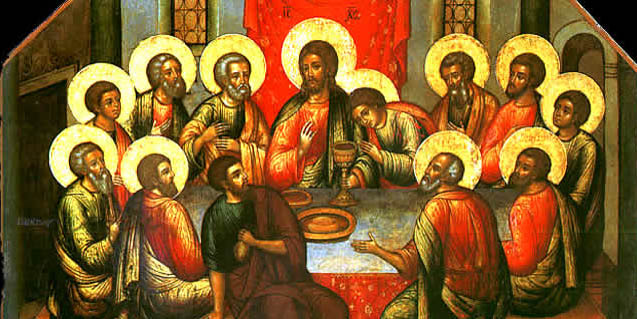
Image Credit: Simon Ushakov – Last Supper (1685)
Source: Wikipedia
Maundy Thursday
2 April 2026
Exodus 12:1-4, (5-10), 11-14
Psalm 116:1-2, 12-19
1 Corinthians 11:23-26
John 13:1-17, 31b-35
There is an old saying that says that character is to “do the right thing when no one is looking.”
I believe that this is true in that it relates to having a clear sense of who we are and who we are not. We will not eat the last piece of cake while everyone else is out, but remember that we belong to a community and remain loyal to it. We will remain faithful to the values that honour others and that implicitly also honour us, for putting others down puts us down, yet by honouring the image of God in our neighbour we retain the image of God in us.
But doing the right thing when no one is looking isn’t everything. It also means to do the right thing when in the company of those who may want us to go along with words or actions even when our faith would have us resist. When I was a child and I wanted something I would often pitch it to my parents by saying “Everyone else has it, too.” My mother would always reply, “but we are not everyone.”
This applies to the people who may have known better but failed to do better when they were in the company of Jeffrey Epstein, but it applies just the same to anyone who has not spoken up in the face of injustice. There too the argument may be, “but everyone else is doing it, too.” That, btw, is an argument I often hear regarding measures to combat climate change. The argument is not necessarily true but even if it were, it suggests that since no one else has a moral compass that I do not need to have one either.
And then yesterday I came across President Trump’s court prophet Paula White who literally compared the US President to Jesus because they were both “betrayed, arrested, and falsely accused.” As Antonio Spadaro wrote last August, “Trump invokes God not to submit to him but to replace him.”1
This, of course, is not about the American president, because if it were we could now self-righteously go home. But the question put to us is whether we – if put in such a situation – would act as court prophets who would only speak what the powerful want to hear, or whether we may uphold God’s justice in the way the prophets of the Old Testament did.
I remember the first time we went away and left the kids at home alone. Our eldest was 21, our youngest 15, and our middle child 18. I remember it but I do not remember it well because all was fine. We were living in Abbotsford then and went to spend a weekend in Vancouver. I am sure there was lots of prep and I am certain that we called them each day to make sure all was good. But they knew what to do, both in practical matters and how to interact with each other. They knew who they were.
This is what Jesus is doing here. The farewell speeches in the Gospel of John go from chapter 14 to 17 and in chapter 13 Jesus does two things:
He gifts himself to them in the Last Supper. He gifts his own life and being to them.
And he models for them how to live with each other. And so the words that follow in chapters 14 to 17 are grounded in the experience of the common meal at which Jesus is both host and gift, and in having had their master wash their feet. Jesus not only teaches the reversal of power relationships in the world but models it.
We live 2000 years later and have never known Jesus to be with us physically in the way that he was with the disciples, with friend and foe and everyone in between. Although, we too hold on to the physical presence of Jesus in Holy Communion, but also to the image of God in our neighbour, enemy, and even ourselves. We remember that acts of mercy done for the least of these are done unto Jesus, and so we hold to a physical presence of Jesus, even if different from the experience of the disciples.
In a way the disciples and we here today are like our kids left alone for a weekend; perhaps for us it is an extended weekend. It is important that Jesus is more than a memory but lives inside of us so that we can navigate the world, remembering who we are. And remembering who we are, we know that the Jesus who lives inside of us came to serve, therefore we too seek to serve.
For in a world that is changing as rapidly as ours is, we must remember who we are, we must remember that we belong to Jesus, and that means all our love, devotion, will, and focus belong to Jesus.
The sermon was followed by:
John L. Bell & Graham Maule, Jesus and Peter – Off-the record conversations, Chicago, IL: 1999 GIA: Table Talk, pages 106 – 115
1 Antonio Spadaro, Trump & the Grand Theater of the World, Commonweal 14 August 2026