

click to access archived live stream
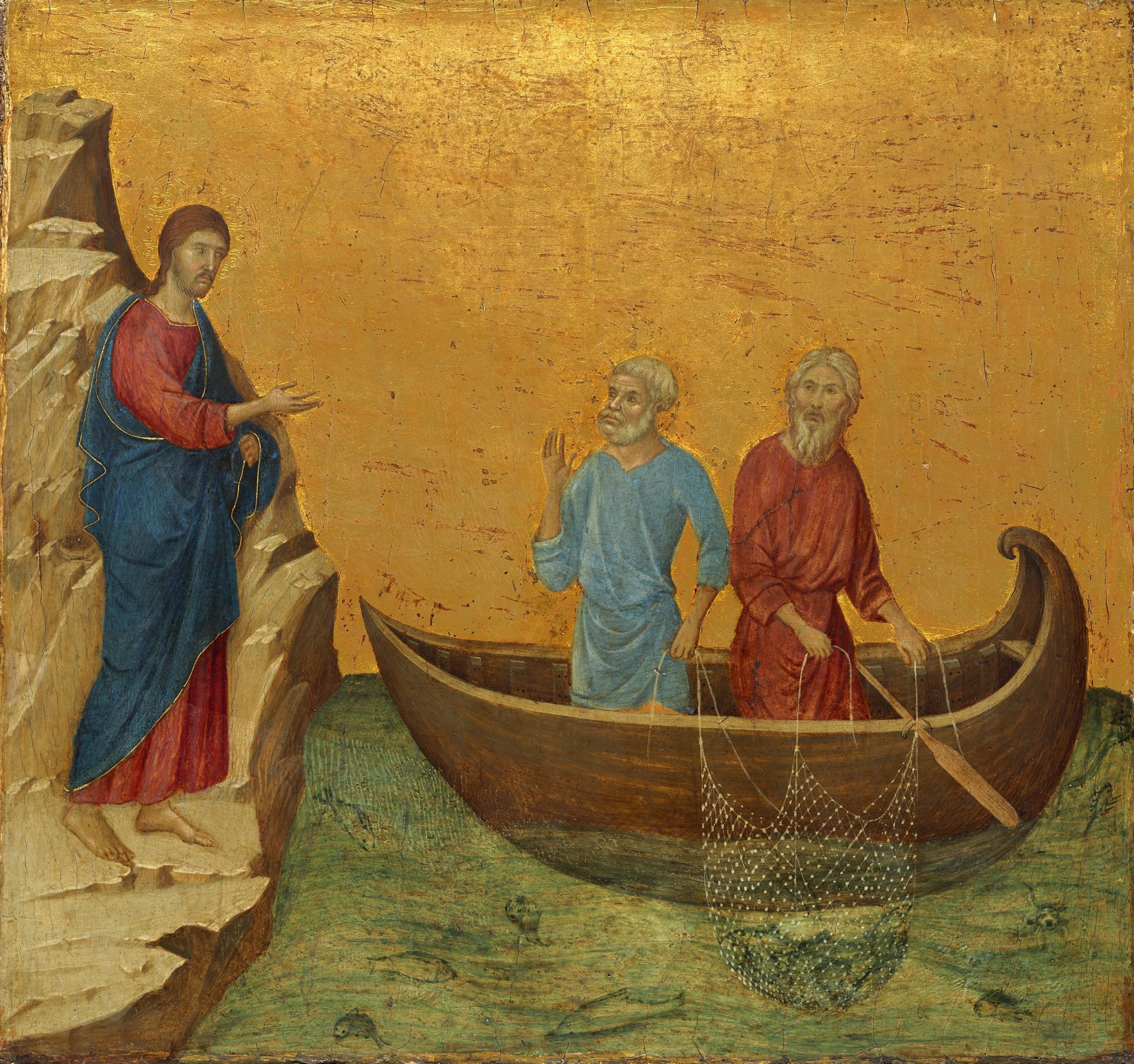
Image Credit: Christ Calling the Apostles Peter and Andrew by Duccio di Buonin-segna. Source: Wikipedia
Third Sunday after the Epiphany, Year A
25 January 2026
Isaiah 9:1-4
Psalm 27:1, 4-9
1 Corinthians 1:10-18
Matthew 4:12-23
Preacher: Rebecca Barnes
Hey you! Yes, you! I’m calling you!
Jesus calls two sets of brothers: Simon (who is later called Peter) and Andrew, and James and John. They leave their careers as fishermen to become fishers of men. I’m pretty sure you know the song – let’s sing it. Join along in the actions if you remember!
I will make you fishers of men, fishers of men, fishers of men. I will make you fishers of men, if you follow me. If you follow me. If you follow me. I will make you fishers of men if you follow me.
A friend of mine in Kingston was raised in the Church of Scotland. She remembers sitting on the steps of the kirk, confused as to why anyone would follow Jesus to become “vicious old men.”
When Simon, Andrew, James, and John dropped everything to answer Jesus’ call, did they realize they would be healing the sick, casting out demons, feeding people with loaves and fishes, and living as an itinerant band of followers of this radical man who challenged the authorities and eventually would be crucified? Did they know what they were getting into? Do we? It almost sounds like being a Christian is more than following Christ by simply showing up to church on a Sunday morning. And don’t worry – I’m not going to try to guilt you into doing anything else – at least not now…
We often describe somebody’s calling as their vocation. When you complete the requirements for your university degree, you do not “graduate”. The ceremony is called a convocation, which comes from the Latin term “convocare”, which means to call or come together. First, we are individually presented to the chancellor for our degree to be conferred upon us. An oath to accept credentials with the inherent rights, privileges, and responsibilities might be administered. Finally, the chancellor admits us to our degrees. Speeches are then given, reminding us that we are called to serve society with the education we have received and to keep learning and growing as we do so.
Human beings have mistakenly taught and believed that some vocations are better than others. Prior to the Reformation, the Roman Catholic church taught that there was a sharp distinction between the sacred and the secular. Society saw the church and monastic life as the ultimate expression of spirituality. Thus, certain callings were “holier” than others. A priest was in a better position to secure his place in heaven than a merchant, because the priest served God and the merchant served only himself. A monk or nun was closer to God because they achieved union through solitary prayer and meditation, not the farmer and wife who tilled the soil and raised a family. This idea of calling certain fits more closely to what we may think of for Simon, Andrew, James, and John.
This led to the idea, that still persists today, that we have to do certain tasks for God in order to be more holy. Humans have constructed all sorts of spiritual works, exercises, and pious observances in order to obtain merit with God. The Holy Spirit helped Luther see through all these human-made contrivances. In “Freedom of the Christian”, Luther writes: “Human beings, however, need none of these things for their righteousness and salvation. Therefore, they should be guided in all their works by this thought and contemplate this one thing alone, that they may serve and benefit others through all that they do, considering nothing except the need and advantage of their neighbour”. In other words, how are these human-designed spiritual disciplines “good works”? Who are you helping? God doesn’t need our good works, Luther proclaims, but your neighbour does!
In his reflections on the 147th Psalm, Martin Luther wrote: “Our works are God’s masks behind which the divine remains hidden, although the Lord does all things”. Our vocations are “masks of God”. God works through us, hidden in ordinary people and our daily tasks, to provide for and care for creation. This means that there is divine purpose in our seemingly mundane tasks – we serve our neighbours – making the ordinary sacred. Everyone serves everyone else through their vocations – whether that is in family, work, church, or state functions – and God orchestrates this interdependence. For example, we may see someone who works in a recycling sorting facility – or maybe, we don’t see them, because they work behind the scenes. However, behind that worker is a gracious Creator, faithfully providing a way to care for creation. Our work – however lowly or grand it may seem – has inherent dignity and value because it is God’s chosen way to care for creation through us! Vocation has to do with how God works through human beings.
The purpose of vocation is not to serve God, but to serve our neighbours.
This changes then, how we think about our vocations – it’s not about what we do or what we are supposed to do, though that does enter into it. Vocation becomes more about God’s action – what is God doing through my life – and on the flip side – what is God doing for me through other people?
When we start to really look, it’s amazing what we might see. As another writer put it, I am a card-carrying member of the Muppet generation. My parents have pictures of me, sitting in my baby bouncer, fascinated by Sesame Street
(at far too young an age). My favourite characters were “Nernie and But”. Dr Bunsen Honeydew and Beaker were early inspirations in my life to become a scientist and Crazy Harry influenced my love of pyrotechnics and explosions. The Muppet Show was a weekly ritual that my whole family watched. Behind all this wonderful insanity and silliness was Jim Henson. Though not a particularly religious man, Jim was raised in the Christian Scientist tradition and believed in the interconnectedness of all living things. He maintained a generalized “love everyone” view, likely based on his early exposure to Christian philosophies. He is remembered as a man who could effortlessly and elegantly balance between the sacred and the silly.
I think Jim’s connection to God and understanding of the connections between everything in creation shines through in many of his characters and the songs they sing. One of my favourites is The Rainbow Connection, written by Paul Williams and Kenneth Ascher. It was sung by Kermit the Frog in the Muppet Movie by Jim and asks philosophical questions about dreams and wonder. To me, it relates to a feeling of searching for vocation and yearning for meaning. It establishes Kermit the Frog’s lifelong dream of “making millions of people happy” – Kermit doesn’t want to make himself happy or famous – it’s not about serving himself, but serving others. Sing along with me if you recall the words:
Have you been half-asleep? And have you heard voices? I’ve heard them calling my name.
Is this the sweet sound that calls the young sailors? The voice might be one and the same.
I’ve heard it too many times to ignore it. It’s something that I’m supposed to be.
Someday, we’ll find it, the rainbow connection, the lovers, the dreamers, and me.
In this verse, I hear Kermit trying to process the voice he hears and try to figure out what that means for him – we might interpret this as the Holy Spirit, prompting him to leave the swamp so he can live out his vocation – serving others by making other people happy. Perhaps a similar voice has prompted you to action at some point? Were you even aware that you heard it?
Some people, like the brothers in our gospel reading today, get THE calling – to be the head of a huge ministry, to be a relief worker in a war-torn land, to be a medical worker in a battle zone, some sort of leader that will get them both fame and fortune. But the fact is, most of us don’t. We muddle along in our lives, trying to discern where God wants us to go and what God wants us to do. With everything that is going on in the world today, we might feel frustrated that we do not have the capacity to be at the protests, even the ones that are local, like the one that happened at UBC a few days ago against residential school denialism. But here’s the good news: we’re already where God wants us and doing what God needs us to do.
At the end of the Muppet Movie, we see the entire cast of the Muppets singing Rainbow Connection as they are bathed in the colours of the rainbow – what a wonderful visual metaphor for the interconnection that weaves us together when we think about our vocation as serving others and in turn, being served – and – I think most importantly – that we do not do any of this on our own – you cannot have a rainbow with just one or two colours.
Sometimes, you need to be what I refer to as “the second shepherd to the left”. You don’t have to be close to the action or in the thick of things – but focusing on what you CAN do – keeping yourself and others informed, praying, and encouraging self-care (and hopefully remembering to practice it yourself!) is important. Sometimes you might feel like the colour in the rainbow that everyone forgets – indigo – but without indigo, the rainbow is incomplete.
So then, remember that in whatever task you are called to, however insignificant it may seem, the Holy Spirit is guiding you into the places, positions, and purposes where you are needed, orchestrating what may seem like a glorious mess of scattered light into a beautifully connected rainbow.
When we begin to look at our lives through the eyes of faith, it changes how we see our tasks. It’s not about grandiose gestures or sacrifices or religiosity. Instead of seeing a task as a way of earning a living or just something we “have to do”, perhaps we could view it as a way to love and serve our neighbours. We may even catch a glimpse of God hiding in the most unexpected places, ordinary life becoming transfigured with the presence of God.
Amen.