

click to access archived live stream
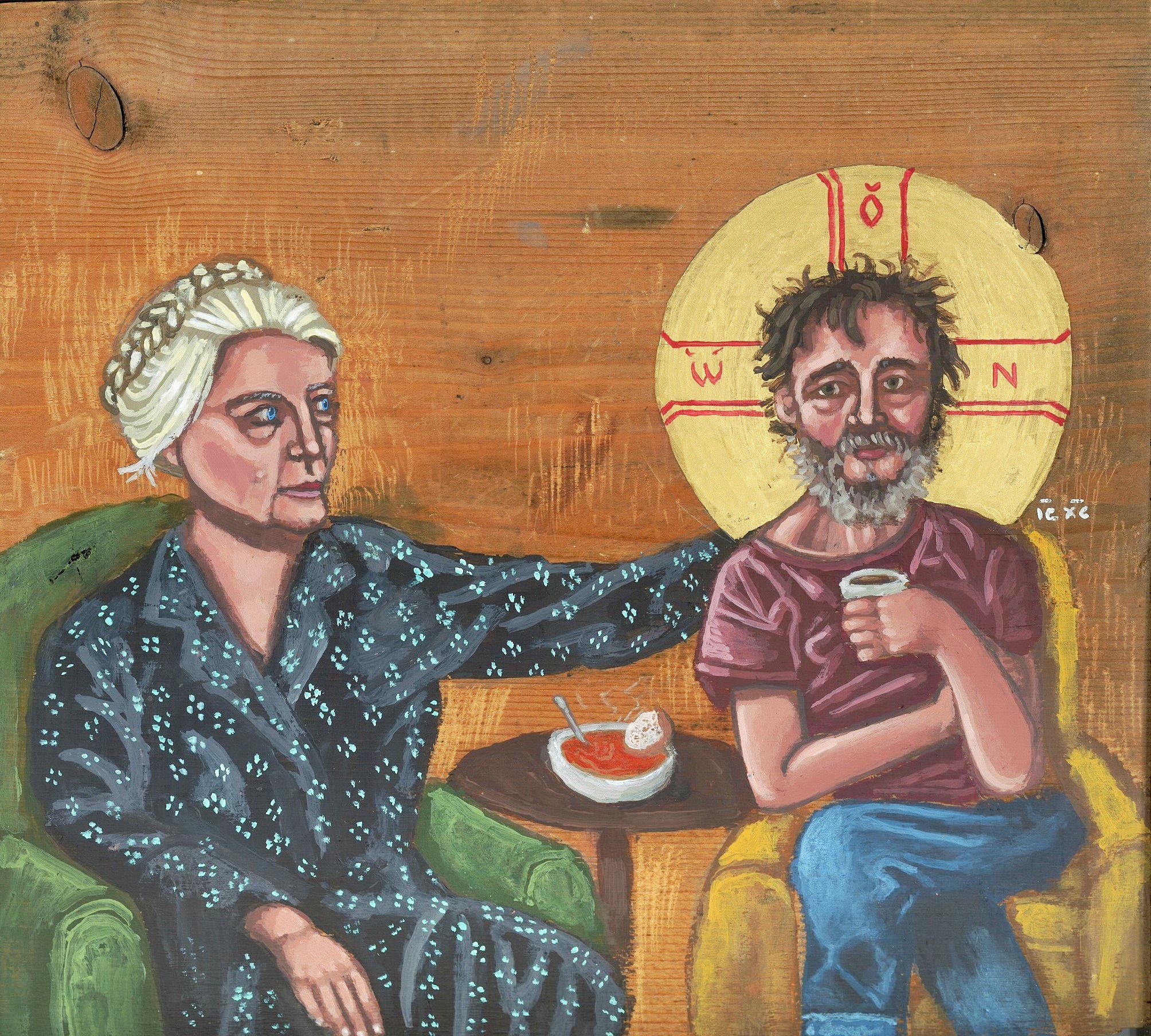
Image Credit: Dorothy Day with Homeless Christ, Kelly Latimore. Original source: Kelly Latimore Icons, https://kellylatimoreicons.com/
The artist has granted permission for the non-commercial use of this image with attribution. The artist must be contacted for other uses.
From Art in the Christian Tradition, a project of the Vanderbilt Divinity Library, Nashville, TN. [retrieved February 3, 2026]
Fourth Sunday after the Epiphany, Year A
1 February 2026
Micah 6:1-8
Psalm 15
1 Corinthians 1:18-31
Matthew 5:1-12
I have been fascinated by a fracturing church, although I will say that this year’s service for the Week of Prayer for Christian Unity gave me hope as both Anglican churches were present, which means that they were able to worship together, even if only this once.
Of course, this is not about Anglicans and it is not about pointing fingers. Lutherans have had their own fractures. I don’t think anybody on either side of the same-sex issue can say that we navigated this issue particularly well.
In my mind the fracturing has continued at least in the language we employ, which is also an indication of how we shield ourselves against the other.
The word I am thinking of is’ progressive’. Parts of the church have been calling themselves progressive Christians. I have mentioned previously that to me this sounds schismatic, for the implication is that progressive Christians are better Christians, or perhaps the real Christians. Then on the other hand you have those who say they are the keepers of true doctrine which suggests that others are not. My criticism of this kind of language isn’t to suggest that we all agree with each other, or that bad theology, or even heresy didn’t exist. But for a church that claims to represent Jesus, a little more humility would be welcome.
But there is another problem with the word progressive. It naively buys into the idea that things are only getting better and that consequently our salvation lies in progress. This progress is driven by human ingenuity, and usually is technological, and while technology has indeed improved the lives of many greatly, it has also given us DDT, the atomic bomb, and moved us toward the climate catastrophe. The point is that such view of progress sees ourselves as our own best resource, therefore it is devoid of humility, and it has little room to see our salvation as coming from God, specifically from the cross of Christ.
Of course, the technological paradigm is embraced universally, yet those who designate themselves as conservative are not necessarily in possession of more humility.
Progressives tend to be naive about human sin, conservatives limit grace to the personal and fail to see the social dimension of grace, fail to see that systems can be changed, which is what we ask when we pray “your kingdom come, on earth as it is in heaven.”
In other words, neither perspective has much room for God.
The addressees of Paul’s first letter to the church at Corinth were very much like us. They thought they had things figured out. If one spoke well, had honed one’s rhetoric, explained things well, was convincing and persuasive, then that was the way to go, for this was intelligent and educated. Those were the Greeks.
The others were those who were expecting another Moses, another David, another Elijah, a saviour who would free Israel from its oppressor, from Rome’s occupation. That vision too was wholly caught within the power plays of the world. A greater power was needed to accomplish this, after all David had his army and Elijah not only called fire down from heaven but also killed the prophets of Baal.
Both concepts had no room for God and no room for the cross. Neither could imagine that God would do a new thing in Jesus, a new thing that was consistent with who God had always been.
The church is familiar with Paul’s words. … but we proclaim Christ crucified, a stumbling block to Jews and foolishness to gentiles, 24but to those who are the called, both Jews and Greeks, Christ the power of God and the wisdom of God.
Often, the cross has has become shorthand for God’s forgiveness. Jesus died so that we would be forgiven. Only that we wouldn’t call it wisdom, more likely grace, but now we have received God’s grace we’d like to go back please to the way we run the world, which means human ingenuity and power, grace not so much. The cross has no attraction for us. We admire people like Dorothy Day but we wouldn’t really seek the company of the homeless Christ we see on our bulletins, and we are mostly in denial about our own weaknesses, though our weaknesses and crosses are uniquely predisposed to be the place to encounter God.
Last year I picked up Amy Kenny’s book, “My Body is not a Prayer Request – Disability Justice in the Church.” Kenny tells of how well-meaning people speak to her condescendingly. She calls them prayerful perpetrators because they assume that somehow, on account of her disability, she is not a whole person. She says that religious people want disability to stop making them uncomfortable. “Insert God here to make ableism seem holy.”1
Kenny retells the story of the man born blind from John 9 to remind us that when the disciples expressed what the culture believed, namely that disability was a sign of deficiency and of sin, Jesus answered, Neither this man nor his parents sinned; he was born blind so that God’s works might be revealed in him. (John 9:3) While Kenny does not say so, we can interpret this as assuming that the man born blind was not deficient but particularly blessed. A little earlier Kenny writes, “To assume that my disability needs to be erased in order for me to live an abundant life is disturbing not only because of what it says about me but also because of what it reveals about people’s notions of God. I bear the image of the Alpha and the Omega. My disabled body is a temple of the Holy Spirit. I have the mind of Christ. There is no caveat to those promises.”2
I suppose that people have always had trouble with paradox. And so it is not surprising that we have difficulty seeing the cross as the place where God dwells. It is easier to embrace progress or the tried and true. It is also easier to skip straight to the resurrection and see the cross as nothing but a vehicle for the forgiveness of sins. The forgiveness of sin through Jesus’ death on the cross is then understood only as transactional and therefore finished so that we no longer need to think about the cross.
If we pay attention to the first verse of our reading, For the message about the cross is foolishness to those who are perishing, but to us who are being saved it is the power of God, we see that we are being saved, that our being saved is not yet finished, and that God is still involved with us. Our saving then is ongoing and may just be the place to embrace the mystery of the cross, which includes the blessings of the beatitudes, which also run counter to our inclinations, not least because Jesus blesses people we deem cursed.
That God is still involved with us is a gift, even for people like us who have little room for God because we would prefer to run the world on our own terms, on our own conceptions of reality, as progressives or as conservatives. But Paul says that we are being saved and so the cross is not just a past event but it is the present power of God.
Much of this is a paradox. But the Gospel is not generic wisdom, it is not the wisdom of the wise, it is not advice from the self-help section, it is not about the tried and true, and it is not about plausibility. It is the power of God, and it is for saving, for a kind of saving that involves our whole lives, and the way that it happens is that it transforms us. And along the way we find that God is present even in the places we would rather not be, and God’s presence transforms and redeems, which is why Amy Kenny can assert that she bears the image of the Alpha and the Omega, that her disabled body is a temple of the Holy Spirit, and that she has the mind of Christ.”
Yes, the cross is a paradox.
The Prayer of St Francis ends with a paradox, one we know to be true:
“For it is in giving that we receive,
it is in pardoning that we are pardoned,
and it is in dying that we are born to eternal life.”
Amen.
1 Amy Kenny, My Body is not a Prayer Request – Disability Justice in the Church, Grand Rapids, MI: 2022 Brazos Press, page 8
2 Ibid page 4