

click to access archived live stream
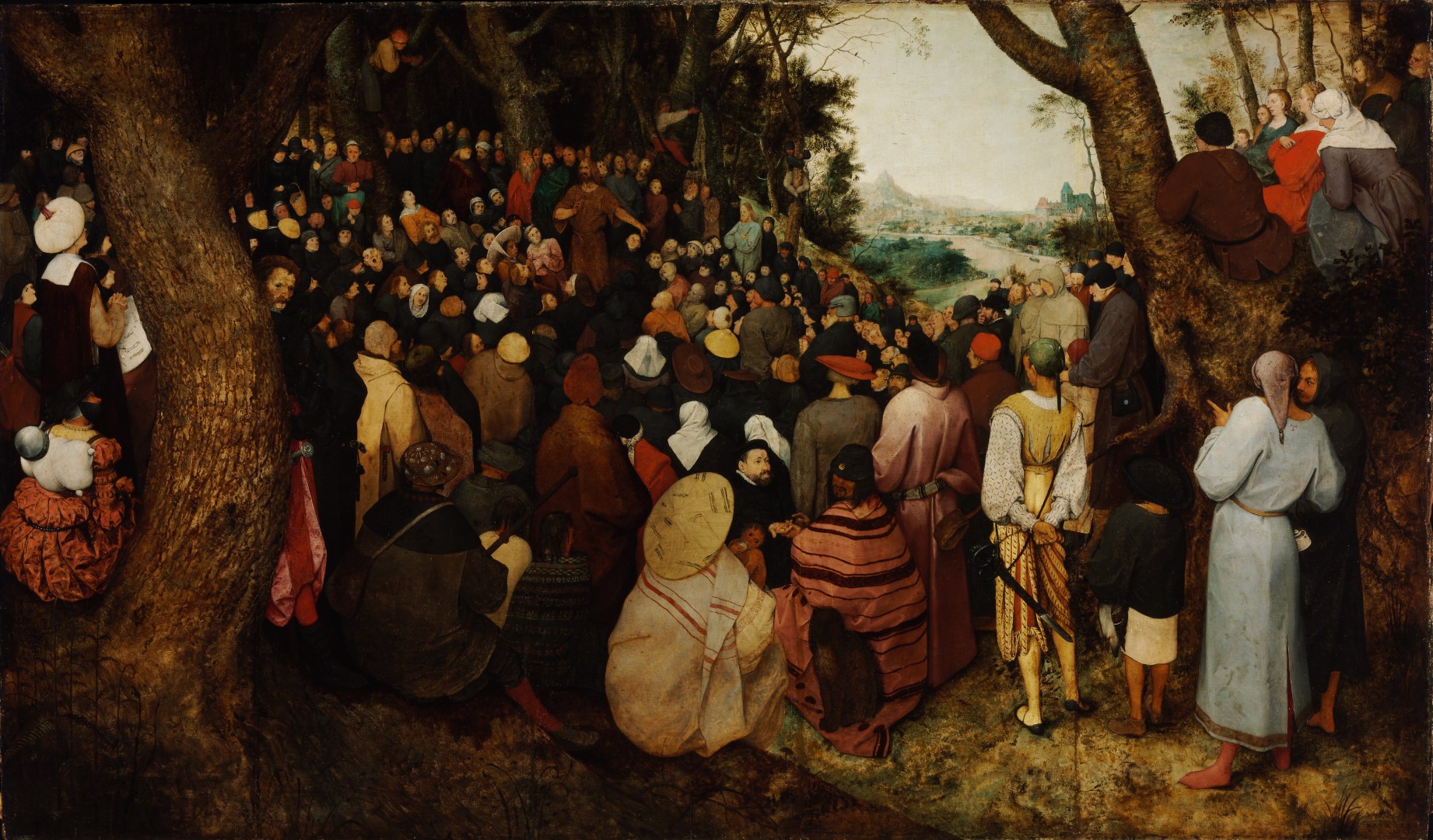
Image credit: The Preaching of St. John the Baptist by Pieter Bruegel the Elder, 1566. Source: Wikipedia
Second Sunday of Advent, Year A
7 December 2025
Isaiah 11:1-10
Psalm 72:1-7, 18-19
Romans 15:4-13
Matthew 3:1-12
If you know any Roman Catholics or were raised in the Roman Catholic Church, you know about the sacrament of reconciliation or simply confession. I grew up in the Lutheran church and so my reflections need to be taken with a grain of salt.
One of the marks of being Catholic was that one had to go to confession at least once a year. When I was growing up, confessional booths were somewhere along the side of the nave of a church. In a church I visited in the 80ies the confessional booth had given way to a room for pastoral conversation.
And yet those who grew up with that practice recall that they didn’t always know what to say when they came to confession. Perhaps because of a lack of instruction they may have said that they had teased their brother or sister. This then made the act of confession appear trivial, not because there was nothing to confess but because without contrition the act of confession became an empty ritual. And then there is our modern disposition that believes that we answer to God alone and owe nothing to anyone, thereby denying our accountability to one another. These may be among the reasons confession is practised less and less.1
Lutherans mostly engage in corporate confession and forgiveness, although we do have an order for individual confession and forgiveness as well. I have used it on very few occasions.
Our order of corporate confession tries to articulate not just what we did but also that we live in ways that are contrary to God’s good will. And while the rite is important – and sets the tone as we begin our worship –, I wonder whether its anonymity may keep us too from going deeper.
When I had been in Canada only a few years there was a case of a German speaking man who had immigrated to Canada after WW II and after many years in Canada was accused of war crimes. When he had immigrated he had failed to disclose his past involvement with the Nazi regime. I vividly remember a news clip in which a reporter spoke to fellow church members of the man outside the Lutheran church he attended. Church members said that it was so long ago and one should let bygones be bygones, and that we should forgive and forget. At first this may sound vaguely Christian but one quickly realizes that we only ever make such statements to avoid accountability. And demanding that our victims forgive without us ever showing contrition, victimizes our victims a second time.
John the Baptist begins his ministry with the call to repentance. “Repent, for the kingdom of heaven has come near.” Matthew tells us that Jerusalem and all of Judea went out into the wilderness to be baptized by John with a baptism of repentance.
Our common understanding of repentance, involves contrition and a change of our ways. It can also be described as a change of heart, a turning around and going in the opposite direction.
The writer Amy Fryholm reminds us that the Greek word metanoia, translated as repentance, has two roots. Meta means to “go beyond,” and noia is a form of the Greek word nous, which is often translated as “mind.” So, John’s call to metanoia should perhaps be translated as “going beyond our mind,” or as “transcending oneself.”2 Paul’s exhortation to the Romans comes to mind, Do not be conformed to this world, but be transformed by the renewing of your minds. (Rom 12:2) If we understand repentance in this way, then repentance is an invitation to be more than we are (to be more, not less), or to be who Jesus Christ freed us to be.
We see the scene of Jerusalem, all Judea, and the whole countryside going out to John depicted in our bulletin image, translated into the Flemish countryside of the 16th century. Matthew tells us that even the religious leaders come to be baptized, perhaps hedging their bets. John addresses them abruptly and directly as a brood of vipers. Yet more important is his warning against presumption: [D]o not presume to say to yourselves, ‘We have Abraham as our ancestor,’ for I tell you, God is able from these stones to raise up children to Abraham. (Matthew 3:9)
It is true that all of the people who come to John can claim Abraham as their ancestor. And claiming Abraham (and Sarah) as their ancestor(s) is not without import, for it is with them that God made covenant, the God who makes covenant, the God of Abraham, and Isaac, and Jacob.
However, claiming Abraham in order to avoid the hard work of repentance, of accountability, and becoming the people God has enabled us to be, is a problem.
If you have ever wondered why John seems so strange, not just the being in the wilderness but particularly his food and clothing, it is to evoke memories of the prophet Elijah (2 Kings 1:7–8). We are in the New Testament but John is the last prophet of the Old Testament. And what do we know about the prophets of the Old Testament? In a world of many deities and idols their concern was for faithfulness to the God of Israel, and one could not be faithful to God without acting with justice. Jesus’s own preaching stands in continuity with this. In Matthew 13 he references the prophet Hosea when he says, “I desire mercy, not sacrifice.”3 (v.13) Theologian and activist Ched Myers points out that in St Paul’s exhortation to the Ephesians the verb for metanoia or repentance is used to command the sharing with the needy. Repentance has economic implications.
So perhaps we would experience confession as more profound if it had more profound implications: 28Thieves must give up stealing; rather let them labour and work honestly with their own hands, so as to have something to share with the needy. (Eph 4) In a world in which wealth is routinely distributed upward and not downward we may have an idea of who the thieves are.4 The conclusion is that redistribution happens already, just that it’s benefiting the rich and not the poor. John, the prophets, and Jesus require redistribution in the opposite direction so that the poor, that widows, orphans, and foreigners can live in dignity.
And so when John appears at the Jordan, he is not demanding pious devotion or sentimentality, nor giving your life to Jesus, unless giving your life to Jesus means that you live like you believe that the reign of God has come near in Jesus, and that such nearness of the reign of God means that we repent in such a way as that we go beyond ourselves.
I would like to believe that all the outlandish things we hear these days are made possible by the internet and by filter bubbles, and that they wouldn’t exist if it were not for the internet. And while I am not ready to exonerate the internet, I have noticed a disturbing shift in the conversation about reconciliation with the indigenous peoples of this land. As I have observed them, they centre around a denial of the deaths of indigenous children in Residential Schools, even though we have the names of the children who never returned home after they were forcibly removed from their families; and there are those who want to close the book on reconciliation.
At best, this goes along the lines of “let bygones be bygones”, or “my generation didn’t do it, therefore we are not responsible”; in worse cases it claims reverse discrimination, “it is unjust that the weight of history rests on our shoulders.” Others are happy to blame the churches as if the churches had operated in a vacuum, or one is so keen to speak on behalf of indigenous people that it is clear that we do not want our indigenous neighbours to have a voice in this conversation.
This became apparent again following the ruling of the Supreme Court of British Columbia on the Cowichan land claim in Richmond. Some used the case to instill fear in the populace, as if suddenly we would lose our property, privilege, or power.
You know, it’s not the first nations’ fault that the crown did not sign treaties in British Columbia. It is also not the first nations’ fault that elsewhere treaties were not upheld by the crown.5
The fear John the Baptist invoked was not the fear of our neighbour and not the fear of the other but the fear of God’s judgment so that we would turn from our sinful ways and live. John did not preach that we should let bygones be bygones, nor that we could disown our history, nor that we were not accountable to one another. John preached repentance for the sake of reconciliation.
When our children were young we taught them that they must own their intentional and unintentional sins and we taught them to make amends with their siblings or friends. And we taught the party that had been wronged to accept the apology. Often times they would answer, “It’s OK.” That, of course, was the wrong answer because whatever it was, it was not OK, for to say OK was to resist the naming of the sin. Indigenous people will live with the consequences of colonization for decades to come, perhaps for a century or more. We too live with the consequences of colonization. We have benefited and continue to benefit. Followers of Jesus cannot engage in fear mongering, in victim blaming, nor in calls to end the conversation with those we have harmed.
John calls us to repent. Repentance is not an abstract concept but is a real thing that, when exercised, gives shape to our lives. Repentance if undertaken with sincerity bears fruit. (Matthew 3:8)
Repentance allows us to be more than we are, it allows us to be who God created us to be, for the kingdom of heaven has come near.
Amen.
1 See Bernard Prusak on James M. O’Toole’s The Ghost Sacrament, Commonweal, 3 December 2025
2 Amy Frykholm, A Voice in the Wilderness, 30 November 2025
3 See Hosea 6:6: For I desire steadfast love and not sacrifice, the knowledge of God rather than burnt-offerings.
4 See Ched Myers, Healing Affluenza and Resisting Plutocracy – Luke’s Jesus and Sabbath Economics, Minneapolis, MN: 2025 Fortress Press, page 58 and page 259 (footnote 27)
5 Not to mention that where treaties were signed, they were signed by two unequal parties.