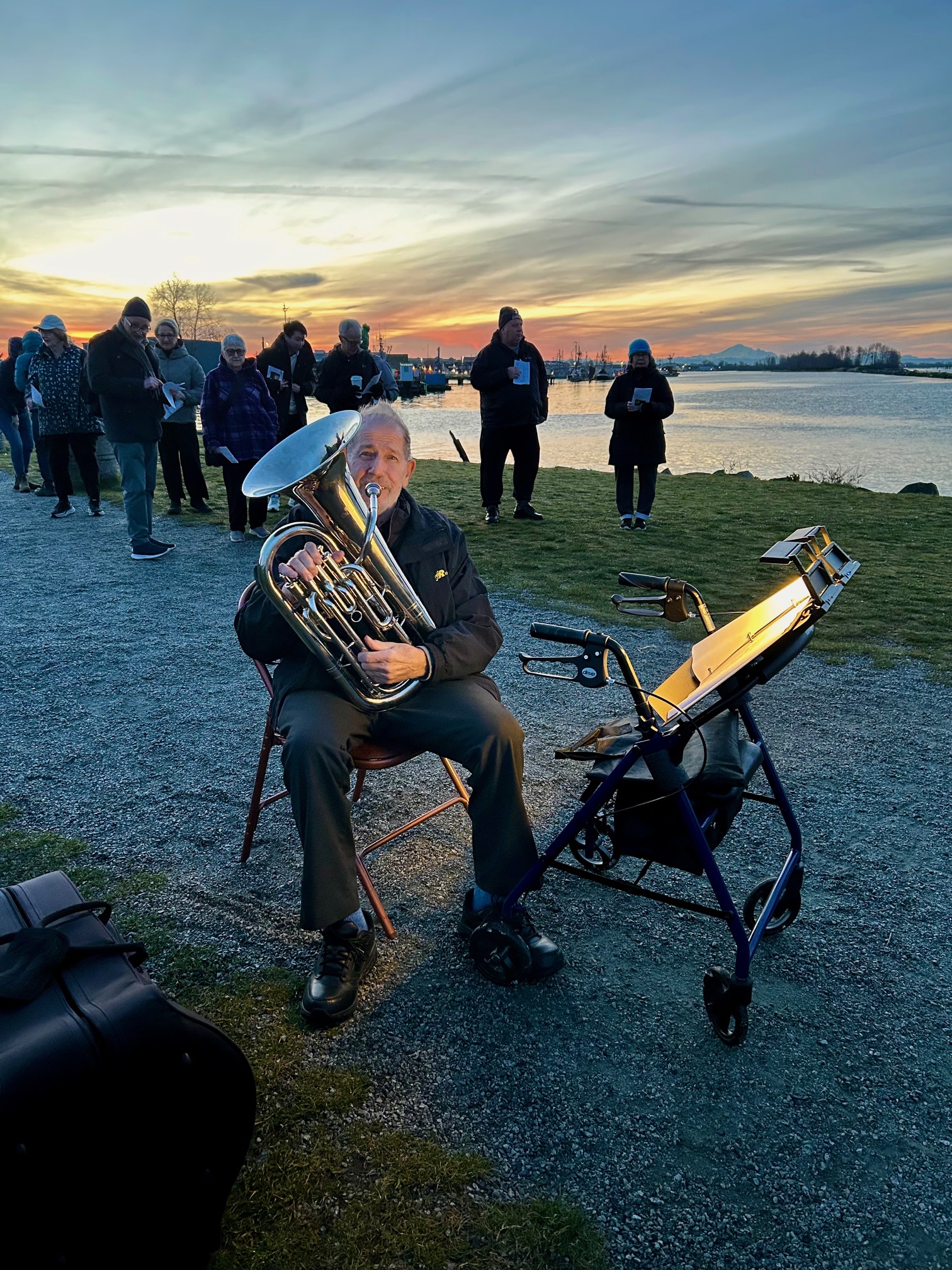


Ecumenical Easter Sunrise Service, 5 April 2026
Fishermen’s Memorial, Garry Point Park, Steveston
Psalm 118:1-2, 14-24
Matthew 28:1-10
If you are from Our Saviour, you may have heard this story before:
One of my favourite Easter hymns is the plain chant hymn “Christ is Arisen”. It is believed to originate sometime in the 12th century.
I admit that I like plain chant, not only because I am rhythmically challenged, but because to me it is somewhat ethereal, there is a holiness emanating from it, another world. I may feel this way because it so obviously is from a different era. When my wife and I were first married we lived in Germany. There are plenty of old churches, and in many of the old churches we visited as tourists I would chant this song. You can imagine the acoustics inside of those old walls.
Because I consider it so beautiful I chose it as a first hymn on Easter Sunday in my first parish. It turned out I was the only one who liked it, and that was, it was explained to me, because it was not exuberant enough to be a suitable Easter hymn.
I still love the hymn and at least I still sing it.
We are here this morning while it is still dark. That echoes John’s telling of the resurrection of Jesus: Early on the first day of the week, while it was still dark, Mary Magdalene came to the tomb … Similarly, Matthew tells us that [a]fter the Sabbath, as the first day of the week was dawning, Mary Magdalene and the other Mary went to see the tomb.
It is dawning now, we can see the sun is coming up behind the mountains to the East, but it is dark and we don’t know yet what kind of day it is going to be. Now, we may have seen the stars and know the weather forecast, and most importantly, we know the story, but that it was still dark, that day was only dawning I take not only literally but also metaphorically, which I imagine is what the evangelists had in mind. For the women did not yet know that the grave was empty and that Jesus had risen. They did not yet live in the light of the resurrection, did not yet live in the light of Christ. They mourned their friend and teacher Jesus.
The function of liturgy and lectionary is to help us enter the story so that the biblical story becomes our story, our narrative, and the conclusions of the story become our conclusions.
If we attended a Maundy Thursday or Holy Thursday service, we likely heard Psalm 22 read. It is the Psalm Jesus prayed on the cross. It is a psalm of lament and begins with the exclamation My God, my God, why have you forsaken me? It may puzzle us that Jesus, the second person of the Trinity would express Godforsakenness, after all Jesus is God. But Jesus was also human and a devout Jew who prayed the psalms. And the psalms are prayers that bring before God our joy and suffering, our lament and anger, and all our human emotions. The psalms praise God or plead with God.
I am not sure if I have ever felt godforsaken, though there are times when I knew God to be closer and times when God seemed farther. But when I look at the world I might worry that it may be godforsaken, though I know that it is not, for Jesus is God with us and Jesus came to draw the world into the love of God and the communion of the Holy Trinity. But let’s just say that I have known despair and sometimes it’s hard to let go of despair.
However, that is not where Psalm 22 ends. In verse 21 the prayer of the psalm changes from the dread of one’s enemies and the despair of loneliness to the rescue God has worked. And then in verse 22 we read,
I will tell of your name to my brothers and sisters;
in the midst of the congregation I will praise you.
When Mary Magdalene and the other Mary come to the grave their hearts are weighed down with grief. They are unable to articulate hope for the future. But the grave is empty and an angel greets them and commissions them. They are promised that they shall see the risen Lord in Galilee. The story could end here but it does not. As they are running in fear and with great joy to tell the other disciples, Jesus appears to them on the way. It looks like they outran Jesus. Jesus greets them in a very ordinary way. What the NRSV renders as “greetings” is better translated as “Good Morning!” (The Message) or simply as “Hi”. (Frederick Dale Bruner)
It is a greeting of familiarity and friendship. And then Jesus tells them essentially the same as the angel had, except that Jesus says more, “Do not be afraid; go and tell my brothers and sisters to go to Galilee; there they will see me.”
In the agony of the cross Jesus had prayed Psalm 22. But the psalm changes from lament to praise,
I will tell of your name to my brothers and sisters;
in the midst of the congregation I will praise you.
It seems that in Jesus’s speaking about his brothers and sisters there is an intentional connection to the praise of Psalm 22. In speaking in this way not only Jesus is raised but the scattered community is raised as well. Resurrection it turns out is not an individual experience but is about community and about salvation for the world.
So, if we feel worried at times, or have trouble speaking of hope, here is our reason for hope, our hope is in Christ Jesus, the first-born of the dead. That old Easter hymn I mentioned at the beginning does not substitute mere happiness for resurrection joy, but it ends in the proclamation of not only Jesus’s resurrection but of ours too. Amen. Alleluia.