

click to access archived live stream (video displays as "Second Sunday of Christmas" but is "Epiphany"
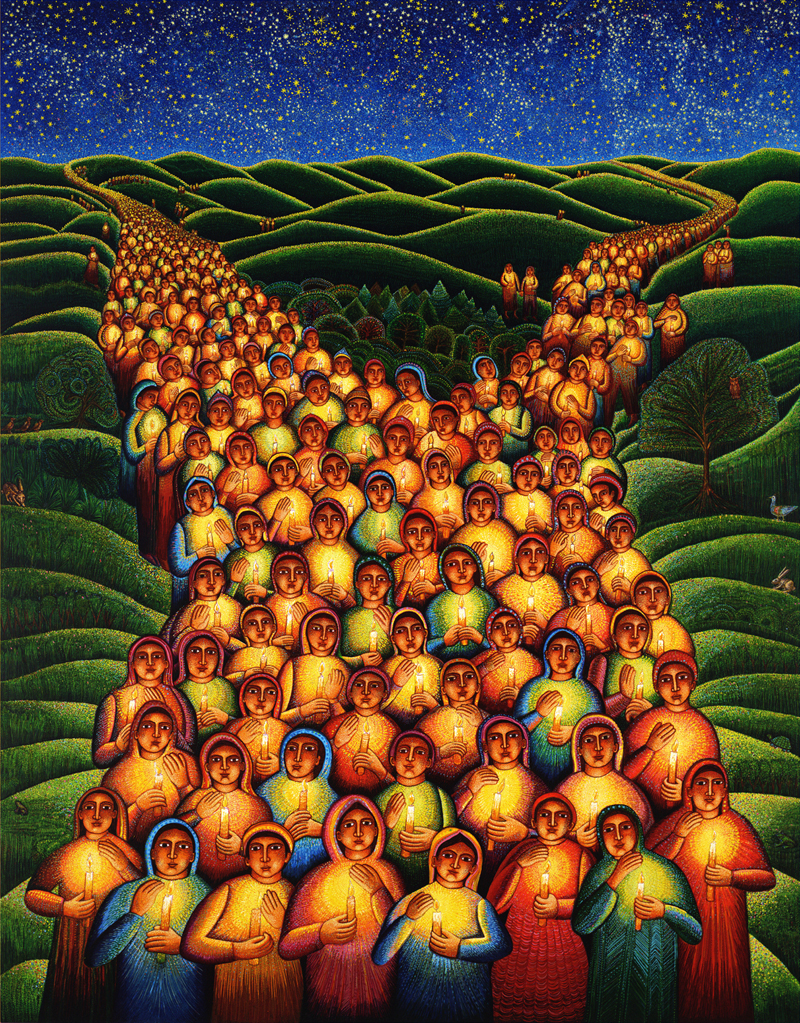
Image Credit: John August Swanson, Festival of Lights. The artist has granted permission for the non-commercial use of this image with attribution. From Art in the Christian Tradition, a project of the Vanderbilt Divinity Library, Nashville, TN.
Epiphany of the Lord
6 January 2026 (moved to 4 January, a Sunday)
Isaiah 60:1-6
Psalm 72:1-7, 10-14
Ephesians 3:1-12
Matthew 2:1-12
When our daughter Margot was in high school her math or her computer science teacher told her that ‘she should go into computers because there she could make a lot of money.’ I have told this story before and tell it because it shows a paradigm. It illustrates one of the things that is wrong with the world.
The Christian understanding of vocation is that our life belongs to God. Therefore, what guides our decisions are questions about how we can serve God with our work as with the rest of our lives. That does not mean that we should all be pastors, nor does it mean that we should be poor, but it means that it is the values of the Gospel that are to guide our decisions, for we belong to God. This is not restrictive but life-giving for it helps us not to live for ourselves.
I use the word vocation because Jesus has called us to follow. There was a time when we would speak of vocations when it came to choosing a career path. Now we speak mostly of a job or a profession. But the word vocation reflects the idea that our life is lived in response to something other than ourselves, that we are part of a community. So when the goal of education becomes to earn a lot of money, then we no longer understand our lives to be part of a social fabric.
Education is not about financial returns, nor merely the infusion of knowledge, but education is about character formation. And having character means to be able to function in a social environment and to be able to make ethical decisions. And ethical decisions may require us to forgo personal benefit for the sake of the community of which we are part.
When we moved to Abbotsford we noticed a push in the school system for the so-called three Rs, reading, writing, and arithmetic. And while the phrase apparently goes back to St Augustine’s Confessions, and even though I have at times observed deplorable language and mathematical skills, reducing education to the three Rs would reduce education to skills training without regard to character formation. Skills get you a job but not a life.
Today the three Rs have morphed into STEM: Science, technology, engineering, and mathematics.
In 1948 the Catholic philosopher Josef Pieper wrote of the decline of the liberal arts, the subjects we now often call languages, literature, music, and the social sciences.1 Pieper wrote before the background of a Germany in rubble but also before the history of an Immanuel Kant who regarded human learning as exclusively discursive, as reasoning, and as activity or work. The sociologist Max Weber put it this way, “We work not only to live but we live in order to work.”2
And this is how we ended up in a world in which efficiency is everything. But is love of neighbour efficient, is art or music efficient, are friendship and love efficient, is paying attention to the Word of God in the community of the Church, is listening to the Holy Spirit efficient? You see, all the things that make life beautiful and worthwhile cannot be measured in terms of efficiency.
In 2021 I attended a seminar on “Poetry, Science, and the Imagination”3 that highlighted how poetry and the sciences both seek to find language for the unknown and to imagine reality in new ways.
Beginning with the understanding that humans are created in God’s image, the theoretical physicist Tom McLeish asked how being created in God’s image manifests itself. McLeish names three things: God is three in one, so God is communal. Therefore, we at our best instantiate relation and love.
McLeish then asked, if God rhetorically speaks the world into existence, maybe we are called to recreate in image that same cosmos. That is, he says, what science is. He then adds art and poetry because we recreate our image of the world in those ways too. But we don’t just create a world. If we’re made in the image of God, then we build a relationship with it.
Seeing how McLeish fluently connects science, theology, and poetry you will not be surprised that a little earlier he had called the creation of pathways that make one choose between the humanities and arts on one hand or the sciences on the other a form of educational child abuse.4
Let me elaborate a little, though in the seminar McLeish did not. I think what he means primarily is that if we make childen and their parents choose between one or the other, then we deprive them of seeing the whole picture, of understanding the connections, and of being able to build the relationships with the world that come from living as those who are created in God’s image.
I would add a second thought. An education that strictly aims at marketable skills, which today seem to relate primarily to STEM, appears to me to be an education primarily in how to get things done, not why they should be done. The liberal arts on the other hand complement the sciences by teaching the classical virtues: prudence, justice, temperance, fortitude, faith, hope, and charity, virtues that help us make ethical decisions. Without practice of the classical virtues one may just decide to invade another country and kidnap its president, simply because one can.
This Sunday we celebrate the Epiphany of Our Lord. The glory of the Lord is revealed to the world. It is significant that Matthew’s Gospel begins with the worship of the magi and ends with the commandment to make disciples of all nations. Even though Matthew frequently quotes the Old Testament, the Gospel of Matthew is universal in its orientation. The Good News of Jesus is not for Sven and Ole alone.
And so we heard the story of the scholars who come to worship the child. The story is connected to the flight to Egypt and to Herod’s murder of the children of Bethlehem. It is a story that tells of the abuse of power and of refugees and migrants.
But in today’s reading we learn of the magi’s arrival in Jerusalem and of them mistaking Herod’s palace for the address of the new-born king. The magi were scholars. They knew how to interpret cosmic events. They knew celestial navigation. They were the intellectual elite of their day. And yet, when they arrived at Herod’s palace, they arrived at the wrong address. Herod could not help them, for he knew neither science nor theology. But he called the chief priests and scribes, the religious authorities who had knowledge through revelation, and they knew that the place the scholars were looking for was Bethlehem. And so the magi move on to Bethlehem, they find the child, and worship him.
Josef Pieper who lamented the decline of the liberal arts and the fact that intellectual inquiry had become understood solely as work, did so because intellectual inquiry solely in the service of productivity and efficiency has no room for revelation.
He wrote that if recognition and understanding5 are work and only work, then the one who learns, learns nothing but the fruit of his or her own subjective work, i.e. nothing in his understanding is owed to something outside of him or herself.6
Contrary to this purely immanent understanding of the world are not only the Bible but also ancient Greek philosophy. Heraclitus knew all human understanding contains an element of pure receiving. Heraclitus called it ‘listening for the essence of things.’7
I assume that most of us here do not regard science and faith to be in conflict with each other. But did we imagine that they can inform each other, and that both are subject to some kind of revelation, of receiving something we did not already have or know? Did we know that the magi were scholars and yet open to revelation? Are we open to revelation, to standing in God’s presence in awe, even here in the world.
Madeleine L’Engle who inspired the seminar in which theoretical physicist Tom McLeish was a guest, wrote, “The discoveries made since the heart of the Adam was opened, have changed our view of the universe and of creation. The universe is far greater and grander and less predictable than anyone realized. And one reaction to this is to turn our back on the glory and settle for a small tribal God who forbids questions of any kind. Another reaction is to feel so small and valueless in comparison to the enormity of the universe, that it becomes impossible to believe in a God who can be bothered with us tiny finite creatures, or,” she concludes, “we can rejoice in a God who is beyond our comprehension, but who comprehends us and cares about us.”8
This is the God revealed in Jesus.
Thanks be to God.
Amen.
1 Josef Pieper, Muße und Kult, 5th edition 1958, Kösel: München. Published in English as Leisure – The Basis for Culture,
2 Ibid page 22, Weber was quoting Lutheran pietist Nikolaus Graf von Zinzendorf
3 A pandemic online seminar held by Image Journal
4 Transcript in the possession of the preacher.
5 German: Erkennen (noun)
6 Muße und Kult, page 29. “Wenn Erkennen Arbeit ist, ausschließlich Arbeit, dann erringt der Erkennende, in dem er erkennt, die Frucht seiner selbsteigenen, subjektiven Aktivität und nichts sonst; es ist also in der Erkenntnis nichts, das nicht der eigenmenschlichen Anstrengung verdankt wäre; es ist nichts Empfangenes darin.”
7 Ibid page 25
8 Quoted in L’Engle Seminars: Poetry, Science, and the Imagination – Only Connect with Tom McLeish (transcript) originally presented on Wednesday, 3 March 2021. Transcript in the possession of the preacher.