

click to access archived live stream
Sermon by Ron Vonk
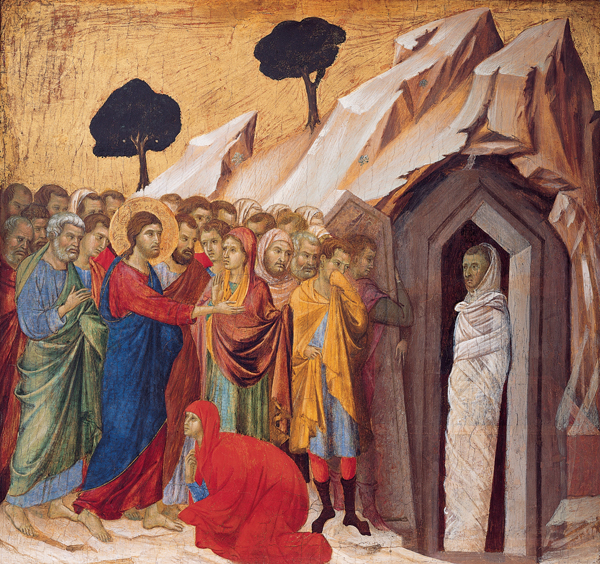
Image Credit: ‘The Raising of Lazarus’, by Duccio di Buoninsegna, Kimbell Art Museum
Fifth Sunday in Lent, Year A
22 March 2026
Ezekiel 37:1-14
Psalm 130
Romans 8:6-11
John 11:1-45
I have had two prolonged periods of depression and anxiety. My second episode with depression and anxiety came in the year before COVID lockdowns. During that year Ina and I attended Shepherd of the Valley in Langley where Kristen is the pastor.
Every couple of months Kristen has a time of prayer for healing, a time in which she anoints people with the sign of the cross and then she prays a short prayer for each person. When I attended Shepherd of the Valley every time Kristen had a time of prayer for healing, I came forward. After Kristen’s prayer I went back to my seat feeling just as depressed and anxious as before. I continued in the dark time of my life.
Yet each prayer for healing opened the door to hope. I did not even realize it at the time that my journey to hope had begun. Kristen’s prayers marked the beginning of that journey.
We are now reaching the end of the season for the preparation for Easter. Next Sunday is Palm Sunday. Lent is a period of reflection and repentance. Lent is a time when we cry out in despair. Lent is a time to reflect on the dark times in our lives when we felt that God was absent. Lent is a time to reflect on the dark time that our world is presently facing.
I am fascinated how all 3 scripture readings we read this morning as well as the Psalm we chanted, are messages of hope for the dark time of life. These passages are also messages of hope for us. This morning I will give a brief summary of each scripture passage, beginning with Ezekiel’s Valley of Dry Bones.
The prophet Ezekiel faces an audience that is disillusioned, cynical, bitter and angry. God has failed his people. God’s covenant with Israel is broken. The Davidic king is dead. The temple is destroyed. The people are living as captives in Babylon. Marduk, the god of the Babylonians is in charge.
This morning we enter a valley of dry bones with Ezekiel. This is not Ezekiel’s first journey into this valley. Last time Ezekiel visited this valley vultures and crows were circling overhead. Clouds of buzzing flies filled the air. Dogs were rummaging through a heap of torn clothing and partly devoured human bodies. The smell was sickening.
Now time has moved on. All that is left is a valley of very dry bones. These are the corpses of Jewish captives denied a proper burial. This is death in all its horror. This is death in all its finality. There is no hope in this valley.
Yet, in this most unexpected place hope is revived. In this most unexpected place God speaks to Ezekiel. God asks a ridiculous question, “Mortal, can these bones live?” To our surprise, the prophet does not give the obvious answer. Ezekiel does not say, “These bones cannot live. These people are long dead.” Instead, Ezekiel gives a cautious answer, “O Lord God, you know [if these bones can live]”.
Then Ezekiel is told by God to prophecy to the dry bones. As Ezekiel speaks, the unexpected happens. God revives the bones. Life does not return immediately. First, there is the rattling noise of bones coming together. Then the process of decomposition reverses. Tendons wrap themselves around the bones. Skin covers them. But once the skin covers the bones the process comes to an end. Everything stops.
There is no breath in the bodies. They are still dead. Before breath returns the prophet must speak again. Ezekiel again speaks God’s words, “Come … O breathe upon the slain, that they may live.” A new creation event must happen. In order for these bodies to be living bodies God must breathe into the bodies the breath of life as God did with Adam in the opening chapters of Genesis. Only God can do this. But the prophet must also speak. The prophet speaks God’s commands.
It is critical that we speak God’s words, words that we read in the Bible, words that we recite in our liturgies, words that we sing and hear during communion. I pray that those words become deeply embedded in each of our minds.
Now I invite us to join these discouraged Jews who have lived the past 20 or more years under cruel Babylonian oppression. Hear God’s promises to them spoken through Ezekiel. There are three promises. Promise #1. I am going to open your graves. God is going to rob these graves of his precious people. What a great promise for us as well! Promise #2. I will bring you back to the land of Israel. These people are going home. We are going home! Finally, Promise #3. I will put my Spirt, my breath, in you and you shall live. God’s Spirit revives God’s people.
Remember, nothing has changed for these people yet. They are still in captivity. They are still discouraged. This is only the beginning of their journey to hope.
After reading from Ezekiel, we read from Romans 8. In Romans we heard God speak to us through the apostle Paul. In Romans chapter 7 just before our scripture reading this morning, Paul cries out, “Wretched man that I am! Who will rescue me from this body of death?” Then Paul answers his own question, “Thanks be to God through Jesus Christ our Lord!”
Paul anticipates a liberation day greater than the one anticipated by Ezekiel. Ezekiel’s liberation day is a liberation day for the Jewish people. Paul’s liberation day is for all people. This liberation day is the most astounding liberation day of all time. God is going to rob graves. All his precious people are going home. God puts His Spirit on God’s people. God revives God’s people.
In Romans 8 Paul talks about 2 kinds of people. The first kind of people are people whose minds are hostile to God. Such minds cannot please God. These people are living in a way that is shaped and controlled by the values and standards of a world in rebellion against God. Instead of a journey to hope these people continue on their journey to death. A journey that we have all been on. A journey that Paul was on before his conversion to Christ on the Damascus road. A journey the religious leaders in John chapter 11 are on as they plan to put Jesus to death.
Paul’s readers are on a different journey. Their minds are on the Spirit. A mind on the Spirit produces life and peace. The Spirit of God motivates them. Physical death is still coming for these people. Many of them are still Roman slaves to sometimes cruel Roman masters. I like the way Eugene Peterson translates this part of Romans 8: “even though you still experience all the limitations of sin – you yourself experience life on God’s terms.”
What makes life difficult for these Roman Christians is that they too are only on a journey to hope that has just begun. They must trust that God has given them life instead of death. They must trust that God gives them peace instead of conflict. God has given them the gift of life. They receive this gift of life, this breath from God in the same way I did at Shepherd of the Valley when Kristen prayed for me and I went back to my seat depressed and anxious.
Finally, in our gospel reading this morning Jesus faces an audience that is disillusioned, bitter, maybe even angry. Jesus was not present when Lazarus died. Lazarus died four days ago. Martha and Mary each say to Jesus, “Lord, if you had been here, my brother would not have died. Some of the friends of the sisters say, “Could not he who opened the eyes of the blind man have kept this man from dying?”
And just like in the Valley of Dry Bones, God robs another grave. But first we hear words from Jesus that sound like the words in Romans 8. Jesus says, “I am the resurrection and the life. Those who believe in me, even though they die, will live, and everyone who lives and believes in me will never die.” This is what a mind on the Spirit is all about. The Spirit directs us to the words of Jesus. The Spirit directs us to the words of life.
But again there are dark moments in our gospel reading. There is still death. And just like us in the company of death, Jesus is greatly disturbed. Jesus weeps.
But Jesus is not just weeping for Lazarus as Jesus walks to the graveyard. Jesus weeps because we have so little understanding of what Jesus intends to do in the face of death. We have minds often more on the flesh than on the Spirit. Death does not have the last word. In the face of even this tragedy these people will soon be empowered by the Holy Spirit to begin their journey to hope.
As God asked Ezekiel to prophesy the unexpected to dry bones, Jesus says the unexpected. Jesus says, “Take away the stone.” Unlike Ezekiel, Martha does not give a cautious answer. Martha says the obvious, “Lord, already there is a stench because he has been dead 4 days”. This is crazy.
And this is the last voice we hear in our gospel reading other than the voice of Jesus. Only Jesus speaks from now on. We have heard the voice of Martha for the last time.
Martha and Mary dare not speak as they obey. First Jesus prays. Then Jesus commands death, “Lazarus, come out!” Another grave is robbed of its precious contents. Lazarus comes out. The people obey the final words of Jesus, “Unbind him and let him go.” The journey to hope continues for Mary, Martha and their friends who were in the graveyard that day.
Now the surprising twist at the end of this story. We expect joyful shouts. Yet no one shouts for joy. The people go back to their own places still in darkness. Their journey to hope has begun but they are still in the darkness.
And if we had read beyond our gospel reading this morning we would have heard from others who were not at the graveyard that day. These others feel threatened by this person who robs graves. The raising of Lazarus begins the plan to crucify Jesus. These people’s minds are on the flesh. Their concern is to maintain their own positions of power. This story on the giving of life leads to the story of the death of Jesus. Of course death does not have the last word. What remains to come is not only the death of Jesus but his resurrection and the ongoing giving of life. The journey to hope has just begun.
Before the service ends this morning we will again sing Journey to Hope. I remind us of some of the words in this second last song in our liturgy: “With thankful hearts we praise your name, Filled, refreshed, restored again. Love ignites us in its flame with hope anew. You turn to us with gift of grace, Transform us as we leave this place. Create in us a holy place for you.”
May God’s Spirit dwell in us as we continue our journeys to hope this week.
Amen.