

click to access archived live stream
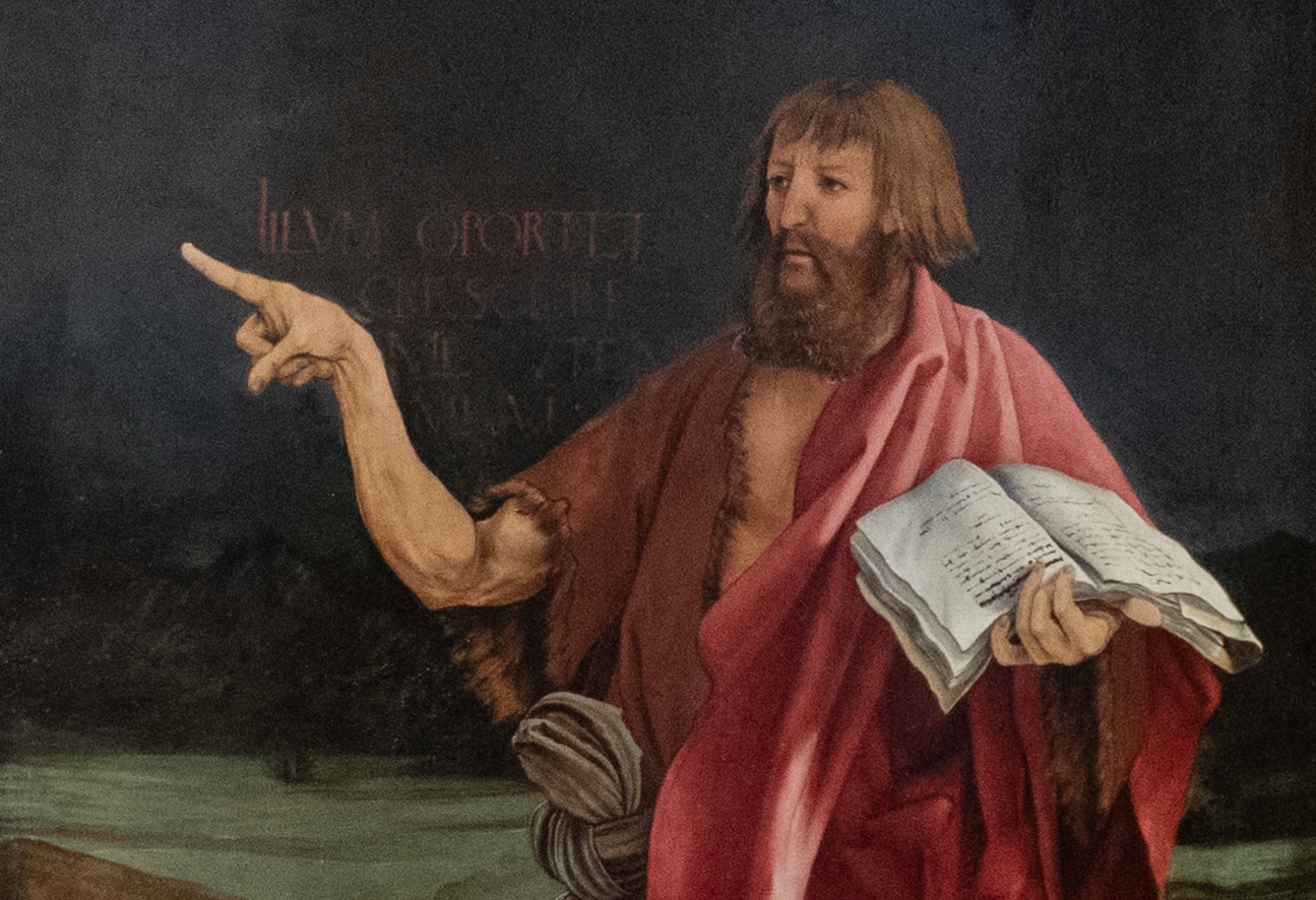
Image credit: John the Baptist pointing to Christ. Isenheim Altar by Mathias Grünewald, 1512-1516. Source: Wikipedia
Third Sunday of Advent, Year A
14 December 2025
Isaiah 35:1-10
Luke 1:46b-55
James 5:7-10
Matthew 11:2-11
When I was on my internship in North Battleford I led worship and preached every other Sunday, except for the last three months when I was on every Sunday because my supervisor had taken ill. Part of my responsibility was to choose the hymns for the services I led. I had not been in Canada for long, which meant that I really was not familiar with any hymns other than the hymns I had grown up with. Not being a sight reader, I chose hymns I was familiar with, which generally meant that they were at least a couple of hundred years old and had been translated from the German. It didn’t take very long before someone asked if we always had to sing those dirges.
The question made me expand my repertoire more quickly than I may have otherwise. Yet, I must admit that I liked the old hymns, and not only because I had grown up with them.
We’re in Advent but there is an old play for Easter Morning, called by its Latin name, the Quem Quaeritis trope. We have done it. At the beginning of worship the congregation assembles in the narthex and assumes the position of the women who come to the grave early on Easter morning, while it is still dark. They expect to find a corpse but are instead greeted by an angel who says to them, “Whom do you seek, oh followers of Jesus of Nazareth?” When the congregation answers that they seek Jesus who was crucified, the angel proclaims that Jesus has been raised as he had said and that Jesus is no longer among the dead. And while the message is a joyful one, we know that for those who are grieving, us included, the resurrection is not always easy to believe. And I don’t imagine this was different for the first disciples. And in this little play the congregation assumes the place of the grieving and incredulous disciples.
This takes me back to the dirges of my internship, beautiful as they were. There is an old plainchant piece for Easter, Christ is Arisen (ELW 372). The melody dates back to the 12th century and even though we sung it following the Quem Quaeritis trope at the time when the Gregorian Chant of the Benedictine Monks of Santo Domingo de Silos had gone double platinum,1 the congregation was disappointed with this choice. They had expected an expression of unadultered resurrection joy that allowed no second-guessing, not joy that was subdued.
All of this comes to mind because Advent is a subdued season. It’s not when we watch Christmas movies or go to the mall, or invoke this season of good cheer. Yet in Advent we wait in the dark, and the world in which we live is one of uncertainty. And there are among us those for whom the expectation of happiness is difficult, often because they grieve, or are alone, or suffer from Seasonal Affective Disorder, or all of the above.
Last week we encountered John the Baptist in the wilderness of Judea where crowds were coming to hear him. This week we find John in prison. Those who read the Gospel from beginning to end know that immediately preceding today’s passage Jesus had taught about discipleship, about being sent like sheep into the midst of wolves, and about the likelihood that his followers be dragged before the authorities because of loyalty to him and their witness to the reign of God. But John did not hear these words and so it is from prison that John sends his disciples to ask Jesus, Are you the one who is to come, or are we to wait for another? (v.3) Finding himself in prison was not how John had expected the coming messianic reign.
This is not the same as singing dirges during Sunday worship or plainchant at Easter but both share a cognitive dissonance. John did not expect to be in prison. John expected the end of colonial rule and the restoration of Israel. It is clear to John that things aren’t the way they are supposed to be. And for us to truly celebrate God’s coming into the world we must acknowledge that things aren’t the way they are supposed to be. In Luke’s Gospel the heavenly host declares God’s praise, singing,
Glory to God in the highest heaven,
and on earth peace among those whom he favours! (Luke 2:13-14)
But there is war in Europe, the Middle East, and in Africa, and there is strife in places closer to home.
And so the task for this season is not to close our eyes to the conflicts that rage in this world but to understand how we can hold together both, God’s peace in Christ, and a world yet to be redeemed.
The Advent hymns I sung as a child were able to affirm both: That God had redeemed the world in Christ, and that we were still waiting for the world to be fully redeemed.
I am fond of “Saviour of the Nations, Come” (ELW 263), a hymn from the fourth century, translated by Martin Luther. I am also fond of “O Saviour, Rend the Heavens Wide” (LBW 38), a hymn from the 17th century written in the context of the Thirty Years War, referencing Isaiah 64. Verse 3 sings, “Sin’s dreadful doom upon us lies; Grim death looms fierce before our eyes. Oh, come, lead us with mighty hand from exile to the promised land.” They are hymns of deep longing that are not afraid to name the human predicament. I love these hymns because we cannot have fulfillment without longing. And yet longing knows that the world is broken, and that our lives may be broken, things we are not supposed to admit. Yet the reward of admitting such brokenness is that those who do are able to experience the deep joy of Christ’s coming. As Jesus said earlier, Those who are well have no need of a physician, but those who are sick. (Matthew 9:12)
Perhaps my favourite Advent hymn is Jochen Klepper’s “The Night is Far Advancing”. It was written in 1938 Nazi Germany. The author was born in 1903 and is a Lutheran pastor’s son. Suffering from asthma since his childhood, following his theological studies he chooses not to seek ordination but becomes a writer. In 1931 he marries the Jewish widow Johanna Stein. This leads to estrangement from his anti-semitic father. In 1933 he loses his position with a Berlin radio station due to being a member of the social-democratic party. In 1935 Klepper loses his job working for a print publication because of his marriage to a Jewish woman. In 1937 he is banned from publishing altogether. Klepper’s wife Johanna had brought two daughter into the marriage. Brigitte is the eldest and they had managed to send her to England just before Germany’s invasion of Poland. Unable to bring the second child to safety in 1942 and with the annulment of their marriage and the deportation of mother and daughter looming in their immediate future, the family commits suicide in the night of the 10th of December 1942. Klepper’s last diary entry reads: “In the afternoon: Negotiations with the security service. We will now die – that too is in God’s hands – Together we have chosen death. Above us in these last hours is the image of the blessing Christ, who seeks us and suffers for us. In his face our life will end.”
Here is the hymn I mentioned in a translation by Fred Pratt Green:
The night is nearly over
The daylight nearly here:
With praises let us welcome
God’s bright and morning star.
Who suffered long in darkness
Join in the joyful strain:
The morning star is shining
On all your fear and pain.
We hear the family’s own experience.
The fifth and last verse sings:
God wants to live in darkness
yet has made it bright2
As though he would reward it
He guides the world aright.
He who created all things
Does not forsake the lost;
Who trusts the Son as Saviour
Has freedom at the last.
That “God seeks to live in darkness yet has made it bright” expresses the paradox in which we live. It was in his own dark night that Klepper saw God’s light, saw the morning star (Rev 22:16).
John the Baptist is the one who allows us to articulate the paradox within which we live, the denial of which would cripple both faith and reality, for a faith that has no room for suffering is unable to touch our lives, and a suffering that sees only darkness and no light is only despair.
The season of Advent remembers that God has come into our darkness to redeem us. It reminds us of the paradox that it is in darkness that we see and find God’s redemptive love.
“God wants to live in darkness
yet has made it bright.”
Amen.
1 Flashback: Spanish Monks Ignite Gregorian ‘Chant’-Mania – The Benedictine Monks of Santo Domingo de Silos released their double-platinum juggernaut 25 years ago, Rolling Stone Magazine, 15 March 2019
2 Fred Pratt Green writes, “So he can make it bright.” “Yet has made it bright” is a more accurate translation.