

click to access archived live stream
First Sunday after Christmas Day, Year A
28 December 2025
Isaiah 63:7-9
Psalm 148
Hebrews 2:10-18
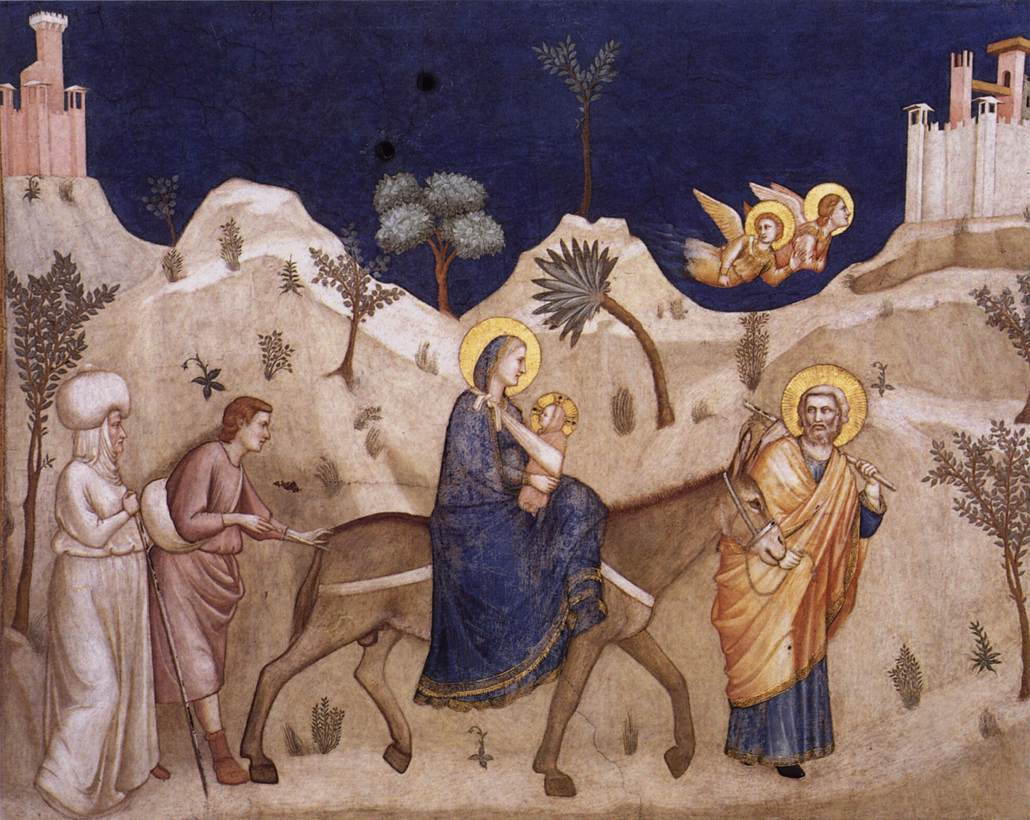
Matthew 2:13-23
We lived in Winnipeg many years ago, though in our memory it seems like it was yesterday, because it was only yesterday when our children were little.
We lived in a small old house, only a few houses away from the Assiniboine River and from the park where in the winter we would go sledding. Our house was only three kilometres from the church which made my commute short but also allowed me on most days to leave the car for Jackie and the kids. Even though we were not far from the church, the neighbourhoods were very different. The population around the church was more transient, there were crack houses, and prostitution. There was much need.
Our house was small and I would often work late at the church. At night I would travel by car. And often when I was at the church, someone would ring the doorbell seeking some kind of assistance. I eventually learned not to answer the door late at night. A wise choice but not the one that God made when Jesus was born in Bethlehem, for the incarnation celebrates not a departure but God’s coming into the world, into a dangerous world.
The Trappist monk Thomas Merton once wrote,
Into this world, this demented inn
in which there is absolutely no room for him at all,
Christ comes uninvited.
But because he cannot be at home in it,
because he is out of place in it,
and yet he must be in it,
His place is with the others for whom
there is no room.
His place is with those who do not belong,
who are rejected by power, because
they are regarded as weak,
those who are discredited,
who are denied status of persons,
who are tortured, bombed and exterminated.
With those for whom there is no room,
Christ is present in this world.
When I learned not to answer the door late at night, it was because I understood that I was vulnerable and that it was important for my young family that I came home unharmed. I don’t regret that I acted with some care. Yet my hesitancy stands in contrast to God’s coming into the world as a small vulnerable child born in a barn in an occupied part of the empire to a young unwed couple.
The Gospel of John speaks of God tenting among us. John writes, “And the Word became flesh and lived among us …” (John 1:14) Literally John writes that God “tabernacled” among us as God used to dwell with the Israelites in the tent of meeting. It is a dwelling in vulnerability, for to live in a tent is to live vulnerably. I think of homeless encampments. Imagine that was your only home. One of the better children’s sermons on the first chapter of John brings a tent into the sanctuary and sets it up right here to show how God came to dwell with us.
In contrast to God’s coming into the world in vulnerability stands that much of Christian hope has focused on leaving this world. This hope to leave the world is always expressed with qualifications, like “not yet”, or “when am ready.” Embedded in such qualifications is not only the desire to “go to heaven”, as per our usual parlance, but to do so on our own terms.
Of course, the longing to go to heaven is about our longing for redemption and our longing to be with God, yet there is also an element of escape.1 And escape is a common element of our lives, to escape the daily grind, or boredom, or the state of the world. Diversions abound. Some of us have had reason to want to escape, and perhaps people in other places, and perhaps others in general more than we do. For me at least, the question arises if Medical Assistance in Dying, or Medical Termination, is not simply the immanent adaptation of a transcendent hope.
In contrast, Christmas is not about leaving this world but about God coming into this world.
Sam Wells of St Martin in the Fields says that it was always God’s plan to be with us in Christ and that the purpose of creation was to fulfill this plan. The Bible chronicles God’s faithfulness and God’s never-ending desire to be with us. As we learned last Sunday, God comes to us despite our failures, to the exiled in Babylon as well as the returnees, and to the Church.
God’s plan is a plan that unfolds in God’s life with God’s people. It is a plan we may only understand as we get a larger view of it, but in the end it is a plan that involves all people.
Christmas then, the Feast of the Incarnation, of God taking on flesh and ‘becoming like his brothers and sisters in every respect’ (Heb 2:17) is the invitation to move from a perspective of wanting to depart the world to embracing God’s presence in the world.
While it is not always easy for us to discern God’s presence, though there are those who happily would instruct us in practising God’s presence (for it requires practice), the shift from seeking to depart to embracing the God who is present is that which makes it possible to live a life of discipleship that seeks to love neighbour and enemy, and enters commitments, mirroring the commitment God made in creation, covenant making, and in the incarnation of Jesus.
Of course, one day we will depart this place but that does not mean that God is only in heaven.
At the beginning of our section from Hebrews we learn that the purpose of the incarnation was ‘to bring many children to glory.’ Glory can have multiple meanings, and for a marginalized church it may mean that despite of how the world sees us, the church has honour before God. Yet such honour cannot exist without the presence of God, for it is the presence of God that lends such honour, and the presence of God is what we celebrate at Christmas.
One theologian says about our reading, “In Hebrews, the present gift of the ‘real presence’ of Christ is less a ‘cultic’ sacramental reality than an invitation to enter into the service of the world in need of healing. The great appeal at the end of Hebrews reads, ‘Let us then go to him outside the camp and bear the abuse he endured (13:13). Heaven is experienced proleptically in the service of neighbour. ‘Sanctification’ in Hebrews, then, is not setting the ‘holy’ apart from that which is ‘profane,’ but eliminating the boundary line between the two notions.2
Heaven is experienced in the service of neighbour and sanctification eliminates the boundary between holy and profane. That means, neither God nor heaven are far, for God is here. God became incarnate in Jesus.
One of the Christmas stories I encountered many years ago is Leo Tolstoy’s “Where Love Is, God is Also”.3 It is the story of the cobbler Martin Avdyeitch, and takes place in Tsarist Russia. The cobbler is widowed and all of his children but one had died in infancy. When his youngest child, Kapitoshka, falls ill and also dies he is left without hope. It is at this time that an old man from Martin’s home village stops by on his way from the monastery. Martin opens his heart and tells him of his sorrow.
“I only wish I was dead. That is all I pray God for. I am a man without anything to hope for now.”
The visitor whom he knows from his home village directs Martin’s attention to God. “We must live for God, Martin. He gives you life, and for His sake you must live. When you begin to live for Him, you will not grieve over anything, and all will seem easy to you.”
Martin keeps silent for a moment, then he asks, “But how can one live for God?”
The old man directs Martin to the Gospels and as he begins to read, Martin’s love for God grows. One night he hears a voice. The voice appears to be that of Jesus and Jesus asks him to look out into the street tomorrow, promising his own coming.
By paying attention and being present to his fellow human beings the cobbler acts in Christ-like ways. It is a good day and a fulfilled day, yet in his prayers at the end of the day he remembers that Jesus had promised to come yet he had not seen him. It is here that those he had welcomed that day speak in the name of Jesus and the cobbler learns that Jesus had indeed come to him.
Tolstoy ends the story by quoting from Matthew 25, What you have done to the least of these, you have done unto me.
It is a story that turns the cobbler’s desire from wanting to leave this place to looking for Jesus and welcoming Jesus here. This is not a denial of transcendence but it is transcendence in immanence. God has come to us. God is here.
It is Christmas and we give thanks that God has come into the world. May we have eyes to see and ears to hear.
Amen.
1 Karl Marx has famously called religion “the opiate for the masses”, observing that in his time the hope of heaven was used to maintain a deplorable status quo in this life.
2 Erik Heen, Working Preacher, Commentary on Hebrews 2:10-18