

click to access archived live stream
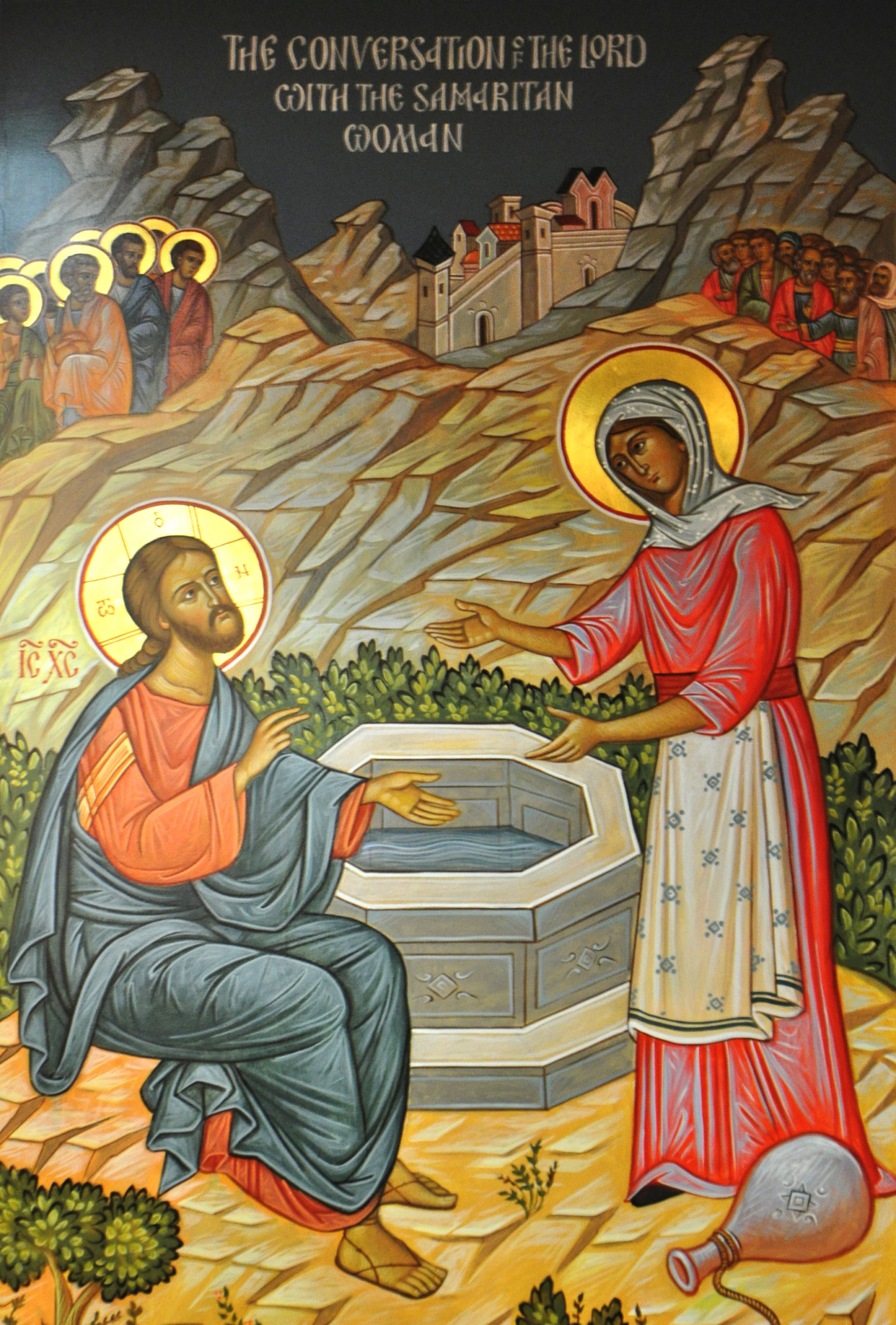
Image Credit: Christ and the Samaritan Woman 1998-2005, Holy Trinity Orthodox Church, Parma, OH
From Art in the Christian Tradition, a project of the Vanderbilt Divinity Library, Nashville, TN. https://diglib.library.vanderbilt.edu/act-imagelink.pl?RC=57300 [retrieved March 5, 2026]. Original source: https://www.flickr.com/photos/frted/8186047331 (Ted).
Third Sunday in Lent, Year A
8 March 2026
Exodus 17:1-7
Psalm 95
Romans 5:1-11
John 4:1-42
You may have noticed that I have added four verses to an already long Gospel reading. These verses are important. Geography in the gospels is not necessarily about geography but often serves another purpose. The conversation with Nicodemus in chapter three had taken place in Judea, the location of Jerusalem. Now Jesus moves back to Galilee. This does not seem an important detail, especially for those of us who have not visited the Holy Land and aren’t exactly sure of biblical geography anyway. And yet it is important, for the evangelist John tells us that Jesus had to go through Samaria.
The thing is that Jesus did not have to go through Samaria. In fact, people would avoid travelling through Samaria, like some people have been avoiding travel to the United States. So when John tells us that Jesus had to go through Samaria he is not talking about geography but he is speaking about the path Jesus deliberately chose. Only a few verses earlier Jesus had said that God loves the world. By going through Samaria Jesus shows what it means that God loves the world.
In 2013 I attended a conference on peace making. One of the speakers, a scholar of the old church at Wheaton College and of Greek descent, spoke of the narrative he was given as a recruit in the Greek military. Because of educational deferment he was older than the other recruits – all of them conscripted. He was 31 while others were 17, which he suggested had something to do with the fact that he picked up things that his younger fellow soldiers did not. The narrative they were given was that the Turks, their national enemy, wanted their homes, their families, and wanted the land in which they live.1 The story Jews and Samaritans told about each other was different but no more flattering.
Under David and Solomon Israel was one territory, and under David it had reached its largest expanse. Ancient Israel was always a small power and rose under David largely due to a power vacuum in the region. This lasted only until Assyria to the East rose to become the next superpower and intent on turning its neighbours into vassals. After the death of Solomon there was a conflict about the heir to the throne which resulted in the northern tribes (remember this was a tribal confederation) breaking off, calling themselves Israel, leaving the south as Judah. In 720 BC the Northern Kingdom – Israel – was conquered by Assyria, and like the Soviets and many other empires, Assyria sought to destroy national identity through resettlement and assimilation. And that’s how we arrive at what we glean in the story. The Book of Ezra even describes the population of Samaria as adversaries. (Ezra 4:2)
Fast forward to the time of Jesus: Because of the assimilation policy of the Assyrians many other cults had entered Samaria, and so the question about fidelity to YHWH was legitimate. 2 Kings 17 says about the population of Samaria, So these nations worshipped the Lord, but also served their carved images; to this day their children and their children’s children continue to do as their ancestors did. (2 Kings 17:41)
The way the story of the woman at the well is often interpreted in a way that identifies the woman as a sinner and her sins are understoor to be of a sexual nature. Yet Ezra and 2 Kings frame the story differently. In this reading the woman represents the Samaritan people.
Remembering the Assyrian policy of displacement and assimilation we learn from 2 Kings 17 that the Assyrians had settled people from five different nations in Samaria. (2 Kings 17:24) When Jesus speaks of the woman’s five husbands he speaks of Samaria’s intermarriage with foreign peoples and the acceptance thereby of their false gods. In this context we must remember that God’s people are to love the stranger. (Deut 10) The warnings against intermarriage are strictly about right worship and against idolatry.
Idolatry is worship of false gods, worship of something that is not God. This may seem very remote to us modern people because we don’t worship graven images, and consequently we may think that idolatry is not something we have to worry about.
But remember that St Augustine said, that our hearts are restless until they rest in God. Or in other words, human beings are worshipping creatures, the difference lies in what we worship. This does not mean that Christians necessarily worship rightly. While we were created for communion with God, we are also imperfect human beings who are easily distracted. Some of us worship the Bible instead of the God the Bible reveals to us. All of us are to some extent participating in the idolatry of consumerism which not only is based on great inequalities, think of sweat shops and child labour, but is also based on the illusion that the earth’s resources are infinite. The nature of consumerism is that it offers us a sense of fulfillment that quickly wanes and make us want the next thing. The Canadian philosopher George Grant said that modern life has become the joyless pursuit of joy. 2
Power is another false idol. It is the idea that the world would be a better place if only I could be in charge. The next best thing is to have a group of people in charge who think like I do. Not that we don’t need people in charge but they are not to be rulers but servants. You know that I am fond of quoting Jesus’s reply to James and John who seek to sit at Jesus’s right and left, ‘You know that among the Gentiles those whom they recognize as their rulers lord it over them, and their great ones are tyrants over them. 43But it is not so among you; but whoever wishes to become great among you must be your servant, 44and whoever wishes to be first among you must be slave of all. 45For the Son of Man came not to be served but to serve, and to give his life a ransom for many.’ (Mark 10) That is the reason that to this day we call people who serve in government ministers, which is Latin for servants.
It is instructive for us to think of our own idolatries.
In his encounter with the woman Jesus speaks of five husbands, and that the one she is living with now is not her husband. The first five were the nations listed in 2 Kings 17. The sixth is Rome. And Rome demanded absolute loyalty.
That this may be a much better way to understand the story is enforced by the fact that the Samaritan woman answers not with a reference to any actual husbands but with reference to cultic practices of worship, practices influenced by the presence of religious practices from outside of Judaism.3 However, where to worship is of no concern to Jesus, right worship is. This is because Jesus is the new temple. And by doing so Jesus transcends the political conflict between Judah and Samaria, and transcends nation states and empires. We must worship God in spirit and in truth, and that hour is coming and is now, says Jesus.
A couple more details from this wonderful story: We do not know the woman’s name. But in v. 21 Jesus calls her simply woman, which is exactly what he calls his own mother at the wedding at Cana (chapter 2) and under the cross (chapter 19). Therefore, the woman, or Samaria, carries an identical dignity to Jesus’s own mother.
In v. 26 Jesus replies to the woman’s remark about the coming Messiah, I am he. (v26) It is the only time in the entire Gospel of John that Jesus identifies himself as the Messiah.
What we learn here is that Jesus redeems Samaria from its false allegiances and its idolatries. And as the woman stands in for Samaria, so Samaria is a stand-in for the world God loves. Consequently, the freeing from false loyalties, and false worship, and the invitation to worship in spirit and in truth are given to the whole world, insiders and outsiders. When a little while later Jesus speaks to the disciples in the familiar images of agriculture and particularly harvesting, Jesus is alluding to the disciples’ own mission, to the church’s mission to not exclude the outcast and to be a community that transcends the nation state and the loyalties it demands.
As people who are pulled in many different directions, of whom many different loyalties are required, and who consequently engage in various idolatries that we have difficulty naming because they are so natural to us, Jesus invites us to drink from the spring of water gushing up to eternal life. That happens in worship where Word and Sacrament sustain us and help us worship rightly, not only on Sundays but every day and in all of our living. Our worship is key to living rightly for idolatry is more than a religious ritual.
Amen.
1 George Kalantzis and Stephen Fowl, Challenges to Christians Practicing the Peace of Christ in the Nation, 13 July 2013
2 In the foreward to Neo-Vedanta and Modernity by Bithika Mukerji
3 This helpful understanding of John 4 in its larger biblical context is owed to the work of Wes Howard Brook in his commentary Becoming Children of God – John’s Gospel and Radical Discipleship, Maryknoll, NY: 1994 Orbis Books