

click to access archived live stream
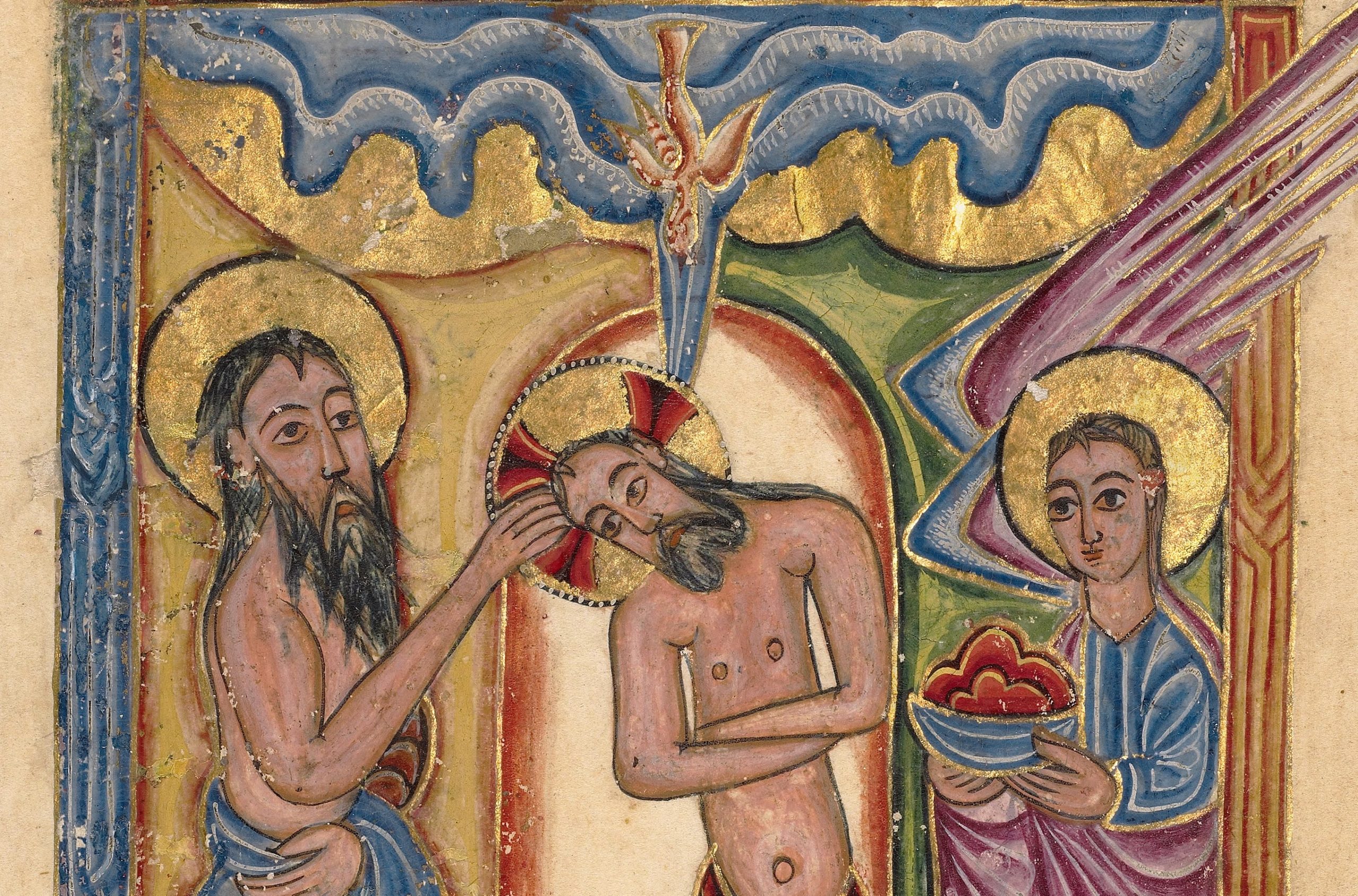
Image Credit: Mesrop of Khizan, active 1605-1651. Baptism of Christ, in the public domain.
Baptism of the Lord, Year A
11 January 2026
Isaiah 42:1-9
Psalm 29
Acts 10:34-43
Matthew 3:13-17
We have not had as many baptisms as we would like, though I fondly remember Sia’s baptism last August.
When I was first ordained, one of the things I found awkward when meeting with young parents, was explaining what baptism says about the forgiveness of sin. This was in part because we baptize infants and the expected objection is that a child so small could not possibly have any sins to be forgiven. After all, we speak of the innocence of children. Now, I admit that I can’t remember that ever having constituted some kind of argument but the fact that we think of children as innocent does suggest a certain cognitive dissonance with the introductory statement of the baptismal liturgy:
“God delivers us from sin and death and raises us to new life in Jesus Christ.”
The theological argument is that we are born children of Adam and that our Baptism into Christ makes us children of God. A psychological argument may be that small children are incapable of thinking of anything but their own needs, a necessity for their survival, yet one of the marks of maturing is learning to consider the needs of others, after all, we live in a community with family, friends, neighbours, colleagues, and strangers.
Since baptism is a sacrament for the forgiveness of sin, for modern people like us the understanding of this is made difficult by the fact that the word sin has almost vanished from our vocabulary.
The Catholic philosopher Josef Pieper (whom I referenced last week) tells of the German writer Ernst Jünger who called Hitler’s order to kill prisoners of war one of Hitler’s worst blunders. I will not speak about Jünger here (he died in 1998), but Pieper points out that “it would have been much more (…) accurate to speak of a crime, of a monstrous deed, an outrageous violation of justice. Yet even here,” Pieper notes, “we would still hesitate to speak of a serious sin, …”1
Now, we begin our worship with the confession and the forgiveness of our sins, and in our personal prayer at the beginning of a day we ask God to keep us from sin. In our prayer at the end of the day we ask God to forgive where we have sinned, yet rarely is sin part of our every day language. The language of sin has been relegated to religious contexts, as if we could compartmentalize faith and day-to-day life.
But this is in line with religion having been relegated to the realm of the private. In our world it is OK to be religious as long as it does not interfere with the ways of the world. But what is the point of our faith if it has no bearing on anything of significance? We do well to remember that Jesus was considered a problem and was executed for the fact that he showed that God cares about all of life, about all of the world, he did not consider our life with God a private matter, and in this Jesus challenged our notions of power.
I think that Christians have largely absorbed and accepted the demand to make our faith a private matter, except perhaps where the demands of our faith are in alignment with the world and we therefore can go unnoticed, or perhaps be commended for being progressive, even though we are religious people. I know that I have at times sought to be noticed in ways that do not identify my faith with fundamentalist Christianity. Yet that seems too little, for it somehow is more concerned about being found acceptable than to be found faithful.
The theologian William Cavanaugh in his book The Myth of Religious Violence makes the argument that while religion can be violent, and religious people can be and have been violent, religion itself is no more violent than any secular ideology. Furthermore, for any time before the enlightenment it is difficult to separate religion from secular society, so which would one attribute violence to, if nothing separates religion and society?
We know that the horrific atrocities of the 20th century were not committed in the name of religion but in the name of ideology and the nation state.
Cavanaugh writes, “The myth of religious violence promotes a dichotomy between us in the secular West who are rational and peacemaking, and them, the hordes of violent religious fanatics in the Muslim world. Their violence is religious, and therefore irrational and divisive. Our violence, on the other hand, is rational, peacemaking, and necessary. Regrettably, we find ourselves forced to bomb them into the higher rationality.”2
In the history of colonization the same concept has been used to legitimize the subjugation of indigenous peoples.
What we are then diagnosing is the marginalization not only of religion but of theological thinking among Christians who think less in the ways of the Gospel and more through rationalizations offered to us by the world. This is why we have trouble with the Sermon on the Mount.
This is not to be confused for the tears shed for the waning influence of Christian churches. We can’t do much about the waning influence of the church but we can do something about the how we think about the world and whether our faith has any bearing on it.
Doing something about our separation of faith and world, about the privatization of our faith, means to take our baptism seriously. The sacrament of Holy Baptism is a profound event. It is to transfer from one kind of a story to another.3 The story we inhabited before our baptism was the life of being the children of Adam, children of the Fall. The life we inhabit as the baptized is the new creation (2 Cor 5:17), the siblings of the firstborn of all creation (Col 1:15). This is not a moral statement but it is an ontological statement, for we now live in Christ and not only on Sundays not only in religious matters.
Speaking of sin in ways other than our diet marks us as people of faith and perhaps we are reluctant to use the language of sin worried that doing so may diminish us in the eyes of others. Or perhaps we think of sin as diminishment in principle because we do not like to think of ourselves as people who sin. Yet, it seems to me that there is something positive about the language of sin. Jesus says that those who are well have no need of a physician (Luke 5:31), yet we know that we have need of Jesus. And so we see that the language of sin is relational language. Sin is relational language because it assumes responsibility, it assumes that we are in relationship with God and therefore answer to God and to each other. The language of sin speaks of accountability. And while Christians come out on different sides of an issue, they do so – I pray – trying their best to live in faithfulness to Jesus. They are not guided by “their own morality”4 but are guided by God’s commitment to us which evokes in us the desire to be faithful to God. In contrast, those who only answer to themselves are alone.
That those who have not sinned are not in need of a physician is sign that the language of sin is not about diminishment but about healing, restoration, and community.
Witnessing the baptism of Jesus by John, even from afar, we cannot help but notice that it is a public affair, and that both John and Jesus conduct their ministry publicly. We who are baptized into Christ’s death and resurrection were not baptized into a private faith but into a relational faith. The way we think and speak about our faith may help us live out the relationship God has established in our baptism. May the Holy Spirit, given to us in our baptism, dwell in us richly that it be so.
Amen.
1 Josef Pieper, The Concept of Sin, South Bend, In: 2001 St Augustine’s Press, page 8
2 William T. Cavanaugh, Does Religion Cause Violence? Behind the common question lies a morass of unclear thinking. Harvard Divinity Bulletin Spring/Summer 2007. See also his monograph, The Myth of Religious Violence: Secular Ideology and the Roots of Modern Conflict, 2009 Oxford University Press
3 Sam Wells, How then Shall we Live – Christian Engagement with Contemporary Issues, Norwich, UK: 2016 Canterbury Press, page 101