

click to access archived live stream
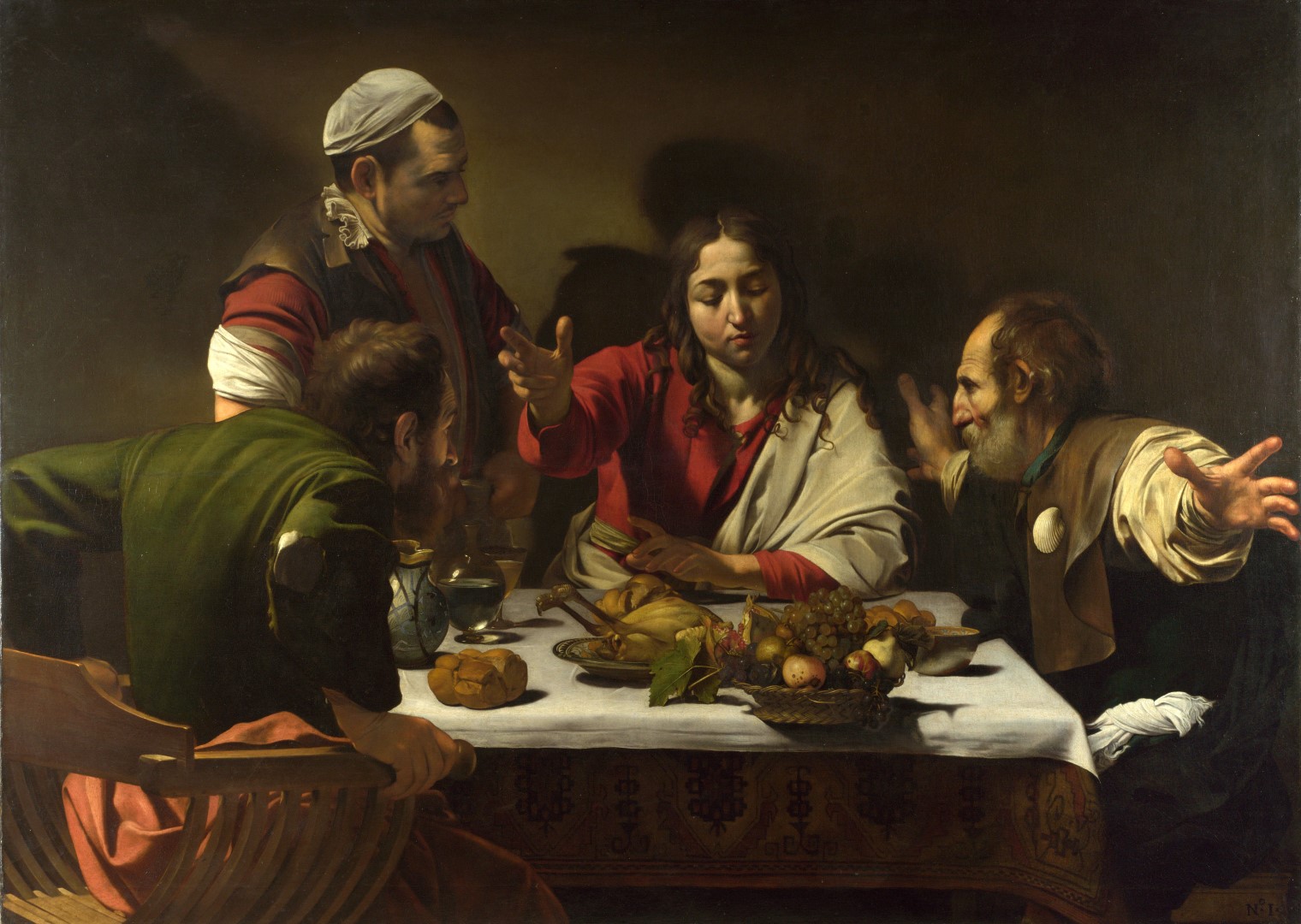
Image Credit: Supper at Emmaus, Caravaggio (1602-3), National Gallery (London). Source: Wikipedia
Third Sunday of Easter, Year A
19 April 2026
Acts 2:14a, 36-41
Psalm 116:1-4, 12-19
1 Peter 1:17-23
Luke 24:13-35
I have always loved this story, for it is a story with a happy end. A happy end that does not make the crucifixion undone, but that in Christ’s resurrection transcends death.
And yet the starting point of the story is one of deep disappointment.
Jackie and I have a garden plot in a community garden. And a couple of weeks ago soil was delivered and I went to take a few wheelbarrows of soil to our garden bed. We do not know a lot of the other gardeners because we all come at different times, and our plot borders only three others. But a number of us were filling wheelbarrows and I noticed one fellow wearing a Winnipeg Jets cap. Having lived in Winnipeg for eight years and with two of our children born there, we still have affection for Winnipeg. Making small talk, I said, “Nice hat,” to which the fellow gardener replied that there wasn’t much to cheer for with the Canucks.
In 2016 I attended a soccer game of my home town team on the night of my arrival. I went with an old friend from my seminary days. Immediately in front of us sat a man who was chain smoking. He asked how we could possibly cope with the suspense of the game without reaching for a cigarette. When “our” team scored he hugged everyone within reach, a little beer got spilled, too. For me, this was a cross-cultural experience. I like sports but it is not my life. The game was close and I was glad our team didn’t lose. What would a loss have done to our friendly neighbour?
Imagining this brings us a little closer to the Emmaus story. Cleopas and his companion are travelling away from Jerusalem, and more importantly, they are travelling away from the other disciples. Grief is a time when people come together, when we make casseroles for our neighbours, when we mow their lawn, and when we say, “call me if you need anything.”
But grief can also drive people apart because we draw different conclusions from the things that happened, or what we believe we or others should or should not have done. And so a shared experience becomes a cause of division.
Cleopas and his companion are profoundly disillusioned. They have left the company of the disciples. While their disillusionment is caused by the execution of Jesus, about whom they had believed that he was to redeem Israel, perhaps in the aftermath of Jesus’s death they are also disillusioned with the community itself, the way we may be disillusioned with the church.
And as they are leaving the others, they are also leaving behind their life as disciples of Jesus. It is as if they have decided or feel the Roman empire has decided for them, that this chapter of their lives is closed. Yet, the wound is raw and they are unable to speak about anything else. Their grief has just begun. As Jesus, unbeknownst to them, joins them, he inquires about their conversation. With his question he puts his finger in the wound but he asks about the one thing their life continues to revolve around, even now, and despite the fact that they are literally walking away. He knows why they are distraught and he wants them to say it.
Fast forward to the village where they urge Jesus to stay with them, where they recognize Jesus in the breaking of the bread. In a very tangible way their experience points to our own experience of meeting Jesus in the breaking of the bread in the sacrament of the altar. It reminds us that when the Church speaks of the incarnation, it speaks not merely of God’s birth at Bethlehem, but of God coming to dwell with us, of the Church being Christ’s body, and of Christ living in us, as one of our hymns so beautifully sings, “God comes to make the common holy”.1
In last weeks Gospel, Jesus blesses those who have not seen and yet have come to believe. In a way, despite Jesus’s joining them on the road, this story hints at what believing without seeing looks like. It is not blind faith in the way that faith sometimes is caricatured, but it is faith that sees Jesus without seeing him in the way the disciples did. It is not coincidental that just as their eyes are opened, Jesus vanishes from their sight.
As they recognize Jesus and exclaim, Were not our hearts burning within us while he was talking to us on the road, while he was opening the scriptures to us?, they get up and return to Jerusalem, to the rest of the disciples, and in spite of the late hour. Their rejoining cannot wait.
And so, having been consoled and encouraged by their encounter with Jesus, they resume the risky business of discipleship. And it was risky.
But they resume their life as disciples not only because they met Jesus but also because Jesus had interpreted the scriptures for them: 25Then he said to them, “Oh, how foolish you are and how slow of heart to believe all that the prophets have declared! 26Was it not necessary that the Messiah should suffer these things and then enter into his glory?” 27Then beginning with Moses and all the prophets, he interpreted to them the things about himself in all the scriptures.
The theologian Ched Myers says that this is the first recorded Bible study in the life of an Easter church that hasn’t even been birthed yet (…).2
And about this Bible study Myers says, “The prophets tell us to defend the poor, but we lionize the rich. The prophets tell us that horses and chariots cannot save us, but we are transfixed by the apparent omnipotence of modern military technology. The prophets tell us to forgo idolatry, but we compulsively fetishize the work of our own hands.”
And to the necessity of the death of Jesus (Was it not necessary that the Messiah should suffer these things and then enter into his glory?, v.26), Myers says, “The prophet’s death is not necessary, given the character of God; it is, however, inevitable, given the character of the State. No one who pays attention to history can dispute the truth of this assertion.”
And in this necessity of which Jesus speaks, to which the prophets and history witness, and to which Jesus’s own death bears witness, Jesus leads the disciples to understand that those who follow Jesus do not to kill for the reign of God but that they may die for it.
And so it turns out that the beauty of the story of the Emmaus Road is about discipleship, about the new life in Christ that unfolds in the witness of the Church. The body of Christ is the bread Jesus breaks and it is also Christ’s Church.
Cleopas and his companion whose hope had been extinguished, have been brought back to life. They who had lost all hope had their hope renewed. They who who had walked away return to the life and the witness of the community of the Church, accepting the joys and the dangers this entails. Discipleship and vocation are not easy but they are a gift.
Amen.
1 Lord, You Give the Great Commission, Evangelical Lutheran Worship ♫579
2 Ched Myers, Easter Faith and Empire: Recovering the Prophetic Tradition on the Emmaus Road, in: in Getting on Message: Challenging the Christian Right form the Heart of the Gospel. Edited by Peter Laarman (Boston: Beacon Press, 2006).