

click to access archived live stream
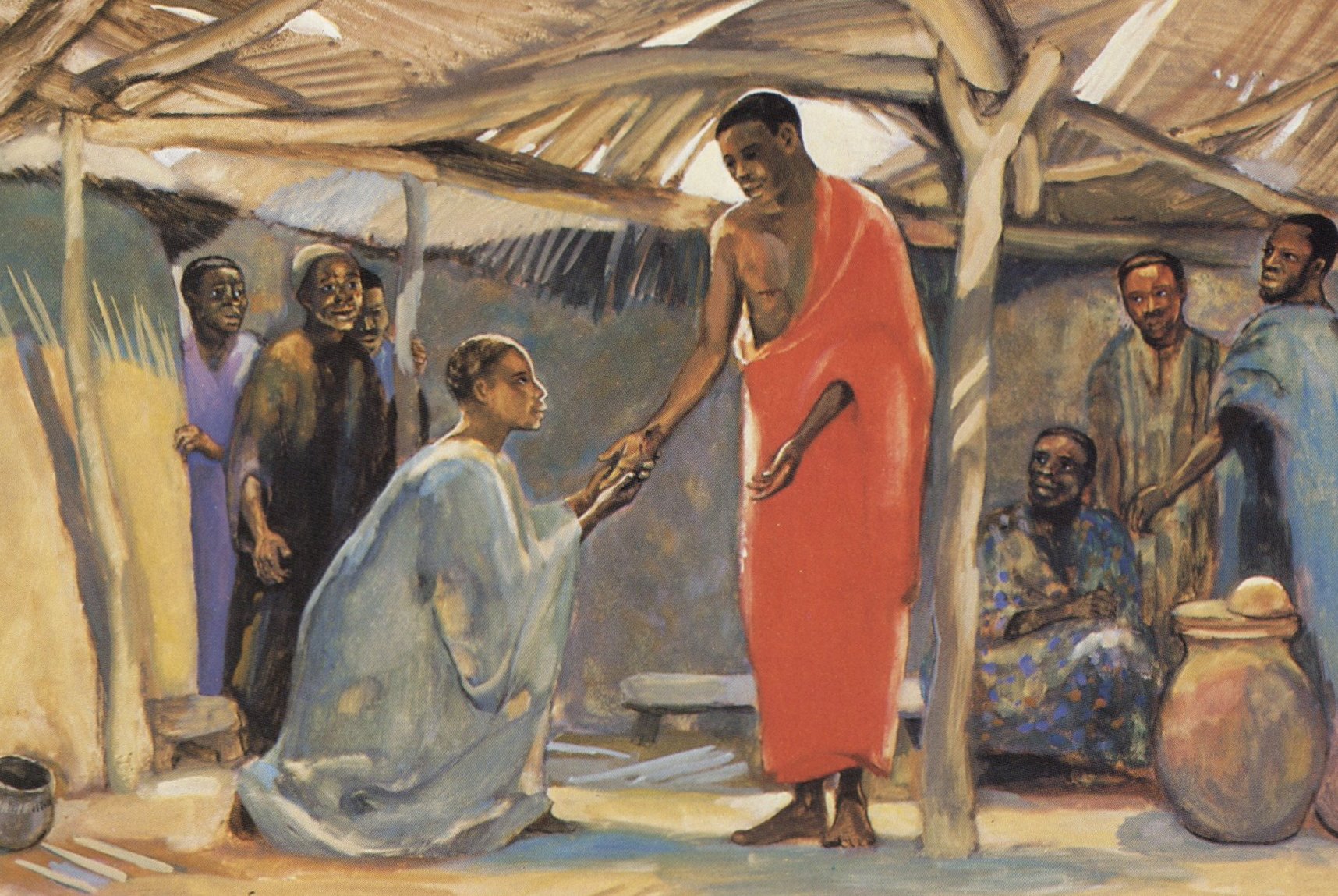
Image Credit: Jesus Mafa (Cameroon). Jesus appears to Thomas. Permitted for non-commercial use. (http://www.librairie-emmanuel.fr)
Second Sunday of Easter
12 April 2026
Acts 2:14a, 22-32
Psalm 16
1 Peter 1:3-9
John 20:19-31
When WW I began, my maternal grandfather was sailing with the German merchant marine somewhere near India, perhaps in the Arabian Sea. The British commandeered their ship, interned the crew, and my grandfather sat out WW I in India. When I was little he spoke about those years as the best years of his life. It suggests that the British treated him well, and in all the years I knew my grandfather, there was always a jar of chutney in his fridge.
I believe he returned to Germany in 1919. Germany was defeated, was paying reparations, and having a first serious experiment with democracy. When things started to get better the global depression hit, politics became more extreme, including street fights between opposing factions, and before long Adolf Hitler became chancellor of Germany.
I do not know how either of my grandparents voted in 1932, the year the Nazis emerged as the strongest political party, nor do I know how they voted in 1933. My maternal grandfather was 80 when I came along and he did not talk about those years. I suppose people chose not to talk about those years, least of all with a little boy.
I do know that my grandfather had not joined the Nazi movement or party, in fact neither grandfather had. But in 1944 when it was apparent that Germany was losing the war, the Nazis mobilized boys as young as 16 and men as old as 60. I learned that this was when my grandfather bought a party membership. He turned 60 on the day Hitler instituted the new conscription rules, and as my mother told me later, her father was afraid to be drafted. And by joining the party he sought to be less conspicuous to the regime. He likely would not have expected to survive.
It is my opinion that he need not have worried. He was an engineer working for the local brewery and in the midst of the horror of the war the Nazis needed to keep the beer flowing for people to be able to forget their misery, even if only temporarily.
I am telling this story without judgment for not only do I not know the whole story, I also do not know what I would have done. Of course, joining with genocidal criminals was not a good idea, even if at that point Germany was losing the war.
What I believe I do know is that my grandfather made that decision out of fear. Fear made him blind to moral discernment and to other possibilities. Fear paralyzed him as it paralyzes anyone.
In our reading from John’s Gospel Jesus comes to the disciples who – even though Mary Magdalene had told them of her encounter with the risen Lord – are hiding behind locked doors. Given that Jesus had been executed as an enemy of the state, it is understandable that they would fear to suffer the same fate, and so they are behind locked doors. That same fear was the reason Peter had denied Jesus.
This story of Jesus coming to the disciples and returning a week later has long been understood to be about Thomas’ unbelief, assuming that Thomas was seeking the same kind of scientific evidence we moderns may ask: “I only believe what I can see.”
But that forgets that the rest of the disciples had the same experience Thomas asked for. They had seen Jesus and his wounds when he had first come to them while Thomas was away. Jesus gives them his peace and shows them his hands and side.
Perhaps Jesus did so so they would not think he was a ghost, or to show that he was the same whom they knew and loved. And that may be part of the story. But perhaps there is more to the story, perhaps the evangelist is reminding us of what Jesus had said to the disciples earlier, namely that God has given all things into Jesus’s hands (3:35; 13:3) and that those given to Jesus by the Father cannot be snatched out of the hand of the Father with whom Jesus is one. (10:28) And so here Jesus comes to them and shows them his hands. Did they remember his words to them?
If this is the reason Jesus shows them his hands and his side, this is about more than providing evidence for them to give intellectual assent to the resurrection, for we know, blessed are those who have not seen yet have come to believe. (v. 29) And the people who have not seen are us and everyone in the generations following the first disciples.
To know that we belong to Jesus and that no one can snatch us out of the Father’s hand is what the disciples need to know if they are to be the Church, for to be the Church was dangerous and can be dangerous, and to face that danger they needed trust. When Jesus says, Peace be with you, Jesus is reminding them them of his presence. When Jesus breathes on them, he fills them with new life as on the day of creation, or as Genesis puts it they “became a living being.” (Genesis 2:7) Jesus is the one who was dead but is alive and comes to those who are dead in their fear and he returns them to the living.
Jackie and I have been married for 35 years. We were young and we had no idea what we were doing. I mean, we knew that we were getting married, but what that might mean, or how our life might unfold, we did not know. When we got engaged I may have been more nervous than on our wedding day because I knew that I was making a commitment for many more years than I had been alive.
If we had so little understanding, then why did we get married? We got married because we trusted one another, and in that trust in each other we trusted God. Yet there was no road map and no guarantees. There was only trust.
It is helpful for us not to think of the faith of Thomas and the rest of them only as them believing something to be true, as a faith in propositions, like the stuff we may have learned in confirmation class, but to think of Jesus’s visit, his gifting them with his peace and his breathing new life into them, as making it possible for the disciples to trust in him so that they can go and be the Church. Or as someone has said, that the peace the world cannot give “is the peace that comes from the knowledge that, in spite of all the hurt and harm the world can and does inflict, God’s compassion and care embodied in Jesus stands again in their midst, the crucifixion notwithstanding.”1
A friend from the Ekklesia Project is an immigration lawyer in San Francisco. She writes about the disciples behind locked doors, “… locked doors remain a hauntingly familiar image in our present context of state-sanctioned terror against our immigrant communities. (…) The relentless cruelty unleashed against my frightened immigrant clients can de-center me from the Resurrection. Yet, this week’s gospel text reminds us that in the middle of injustice, our Wounded and Risen Jesus stands among us and proclaims, ‘Peace be with you.’”2
I do not know what my grandfather trusted in, maybe just luck, or that this too would pass. But luck or the knowledge that regimes do not last forever is not the same as trust. Only trust frees you from fear.
When Jesus returns a week later and all are there, including Thomas, Jesus again brings his peace. It is the same peace he had brought earlier when he had said to them, Peace be with you. As the Father has sent me, so I send you.
Perhaps we are too familiar with the passage to notice that this isn’t just about Jesus’s peace calming our nerves but that Jesus in fact transfers the divine authority that was entrusted to him to the community. It is this that allowed Dietrich Bonhoeffer and all other Christian truthtellers to witness to the Gospel even at the cost of their life. Last Thursday 81 years ago Bonhoeffer was hanged at the concentration camp Flossenbürg. He was 39 years old.
When at last Thomas says to Jesus, My Lord and my God, this is not a pious phrase, and it is not about a personal Jesus but it is a repudiation of the emperor.3 Domitian (81 – 96 AD) was the Roman emperor when John was writing his Gospel and history references Domitian as “dominus et deus noster”, as our lord and god. Thomas disavows the emperor and worships Jesus instead. Trust has taken the place where fear had once been.
May we have such trust. May the Church have such trust.
Amen.
1 Gennifer Benjamin Brooks in Working Preacher’s Commentary on John 20:19-31, 16 April 2023
2 Amy Lee, Resurrection Peace, Second Sunday of Easter, Year A
3 US troops could disobey questionable orders, Catholic archbishop says – Reuters 26 January 2026