

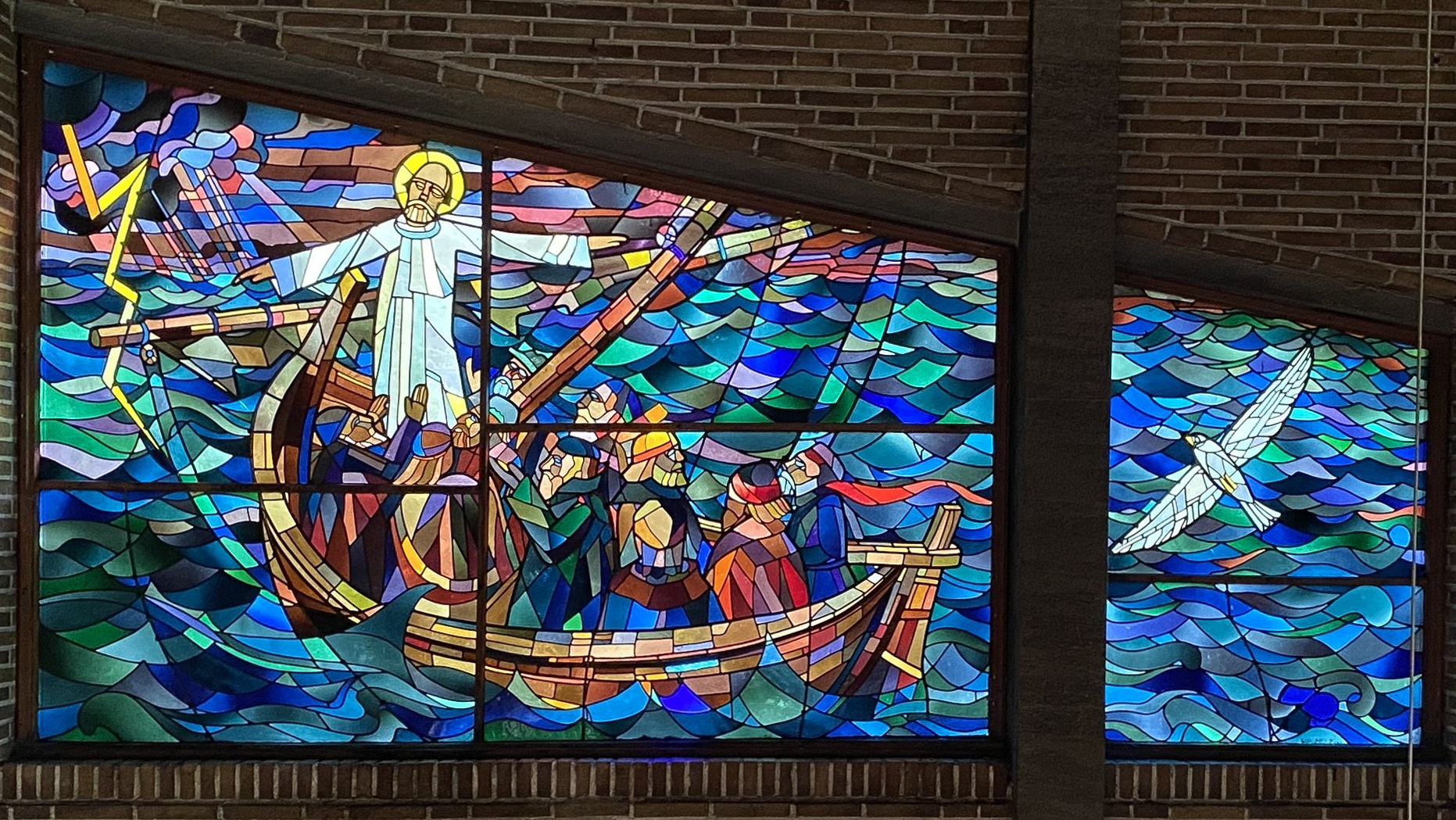
click to access archived live stream
Joint Lenten Service at St Anne’s Steveston, 18 March 2026
Mark 8 (daily lectionary)
11The Pharisees came and began to argue with him, asking him for a sign from heaven, to test him. 12And he sighed deeply in his spirit and said, ‘Why does this generation ask for a sign? Truly I tell you, no sign will be given to this generation.’ 13And he left them, and getting into the boat again, he went across to the other side.
14Now the disciples had forgotten to bring any bread; and they had only one loaf with them in the boat. 15And he cautioned them, saying, ‘Watch out—beware of the yeast of the Pharisees and the yeast of Herod.’ 16They said to one another, ‘It is because we have no bread.’ 17And becoming aware of it, Jesus said to them, ‘Why are you talking about having no bread? Do you still not perceive or understand? Are your hearts hardened? 18Do you have eyes, and fail to see? Do you have ears, and fail to hear? And do you not remember? 19When I broke the five loaves for the five thousand, how many baskets full of broken pieces did you collect?’ They said to him, ‘Twelve.’ 20‘And the seven for the four thousand, how many baskets full of broken pieces did you collect?’ And they said to him, ‘Seven.’ 21Then he said to them, ‘Do you not yet understand?’
22They came to Bethsaida. Some peopled brought a blind man to him and begged him to touch him. 23He took the blind man by the hand and led him out of the village; and when he had put saliva on his eyes and laid his hands on him, he asked him, ‘Can you see anything?’ 24And the man looked up and said, ‘I can see people, but they look like trees, walking.’ 25Then Jesus laid his hands on his eyes again; and he looked intently and his sight was restored, and he saw everything clearly. 26Then he sent him away to his home, saying, ‘Do not even go into the village.’
We lived in Abbotsford before we came to Richmond. Living in Abbotsford I would occasionally go to the local Christian book store. One time, while browsing, I overheard a conversation between two young mothers about the church they respectively were attending. Both churches were big churches and both women had moved between big churches, and their move appeared to be because of what big churches offer, which at times can make a small church pastor jealous, because for some things you need critical mass. Yet because their move to another church appeared motivated what a large church can offer it did not appear to be a commitment to a community or to a ministry.
I will admit, that – although I was never drawn to mega churches – before I was ordained I too did a bit of church-shopping.
Our Gospel from the daily lectionary marks the turning point in Jesus’ ministry. From here on Jesus moves toward Jerusalem. And so it is an appropriate reading for the fourth week of Lent. Following the Confession of Peter, a little later in chapter 8, Jesus explains that discipleship involves denying oneself, taking up one’s cross, and following Jesus. In an insertion in chapter six Mark had told us about the fate of John the Baptist and also told us that Jesus was identified with John the Baptist. Herod, upon hearing about Jesus, had said, ‘John, whom I beheaded, has been raised.’ (6:16) This hinted at the road Jesus was taking, and the destiny of those who followed him.
This is different from church shopping, and it certainly stands in contrast to wanting to be part of a “successful church.”
This helps us understand what is going on in our passage. Jesus had been healing on the Sabbath, challenging purity laws, and interacting with gentiles. As Jesus crosses the lake, so Jesus crosses boundaries. And not surprisingly today’s passage begins with a conflict between the religious establishment and Jesus. Jesus sighs deeply and takes his disciples across the lake.
As they sail to the other side Jesus warns them of the yeast of the pharisees and the yeast of Herod. We know that yeast spreads through the whole dough. The yeast of the pharisees and of Herod is the propaganda of the ruling elite that seeks to rob us of an alternative imagination. Once we become convinced that things are not only the way they are but that it is impossible for them to be any other way, we acquiesce to the status quo. And if you live in a mono-culture, which is what yeast creates, then you will not even notice but become blind. It seems to me that this is a real risk not only for the people of Jesus’ time but also for us, for the more media we consume, the fewer books we read, and the less we interact with people who are different from us, the more likely it is that we will be overwhelmed by the yeast of the status quo without even realizing it.
It is no wonder that Jesus says to them, ‘Why are you talking about having no bread? Do you still not perceive or understand? Are your hearts hardened? 18Do you have eyes, and fail to see? Do you have ears, and fail to hear? And do you not remember? The disciples did not understand and do not understand metaphors.
That Mark has two feeding stories is no coincident and not a duplication of the same story with variation, rather it is an affirmation of the one loaf, of the one body of the Church.
We know that social hierarchies are invented and maintained to prevent people from coming together, to prevent the one loaf.
And so when Jesus reminds the disciples of loaves and baskets, this, in fact, is about one loaf, one body. The five loaves and the 12 baskets left over represent the Jewish world, that is the five books of Moses and the 12 tribes of Israel. The seven loaves and the seven baskets left over from the feeding of the 4000 represent the inclusion of the gentiles.1 And this reflects the conflict about who is in and who is out. And so, even though the disciples did not understand, it is fitting that they have only one loaf, for the followers of Jesus are one body.
At the beginning of our passage Jesus had been challenged to perform a sign. But Jesus is no more interested in proving himself now than when the devil tested him in the wilderness. Jesus knows who he is. But Jesus wants his disciples to know who they are.
And while Jesus does not quote Micah here, his ministry is an embodiment of Micah’s understanding of right worship:
6 ‘With what shall I come before the Lord,
and bow myself before God on high?
Shall I come before him with burnt-offerings,
with calves a year old?
7 Will the Lord be pleased with thousands of rams,
with tens of thousands of rivers of oil?
Shall I give my firstborn for my transgression,
the fruit of my body for the sin of my soul?’
8 He has told you, O mortal, what is good;
and what does the Lord require of you
but to do justice, and to love kindness,
and to walk humbly with your God? (Micah 6)
Those are the signs that matter. And they are signs to be performed by the community, by the one body, by the Church.
But the disciples won’t understand this until later and we too are slow of heart and will. To mind comes an editorial from the Globe and Mail last week in which the authors explain why Canada’s new sovereignty and prosperity agenda needs to engage emerging and developing economies.2 They did not speak about justice but they could have.
Or I think of George Orwell who wrote that all left-wing parties in highly industrialized countries are a sham because we all live by “robbing Asiatic coolies, and those of us who are ‘enlightened’ all maintain that those coolies be set free; but our standard of living, and hence our ‘enlightenment’, demands that the robbery shall continue.”3
The same contradictions can be identified about our declarations about our planet and our actual way of living.
It seems odd that our passage ends with the story of the healing of a blind man, a different man than we encountered last week. Mark tells us this story as Jesus turns his face toward Jerusalem, and it is a story of hope.
Earlier Jesus had exclaimed, “Do you still not perceive or understand? Are your hearts hardened? 18Do you have eyes, and fail to see? Do you have ears, and fail to hear? And do you not remember?”
Here Jesus shows that even the disciples can be given sight, even we can be given sight, just as Jesus had given hearing to the deaf man in chapter seven.
Our calling is not an easy one, and often we lack understanding, memory, and imagination. But Jesus is the healer of our every ill and he will heal us still.
Amen.
1 “The number 5 (5 loaves and 5000 men), the number 12 (12 baskets) and the Hebrew name for basket (kophinos) belong to the Jewish circle; the number 7 (seven loaves and seven baskets), the number 4 (4000 men or people), and the Greek name for basket (sphyris) belong more specifically to the Greek … One loaf in the boat is all that is needed! Separate bread (eucharistic?) is not needed for Jewish … and non-Jewish followers of Jesus [1981:52, 54].” Norman Beck quoted in Ched Myers, Binding the Strong Man – A Political Reading of Mark’s Story of Jesus, Maryknoll, NY: 1988 Orbis, page 226
2 Jennifer Welsh and Margaret Biggs: Why Carney’s sovereignty and prosperity agenda needs to engage emerging and developing economies, The Globe and Mail, 12 March 2026. Jennifer Welsh is the director of the Max Bell School of Public Policy at McGill University and a member of the Expert Group on Canada and the Future of Development Cooperation. Margaret Biggs is the Matthews Fellow in Global Public Policy at Queen’s University and a member of the Expert Group on Canada and the Future of Development Cooperation.
3 Quoted by Wendell Berry in the essay Word and Flesh, in What are People For – Essays, Berkeley, CA: 1990/2010 Counterpoint, page 201