

click to access archived live stream
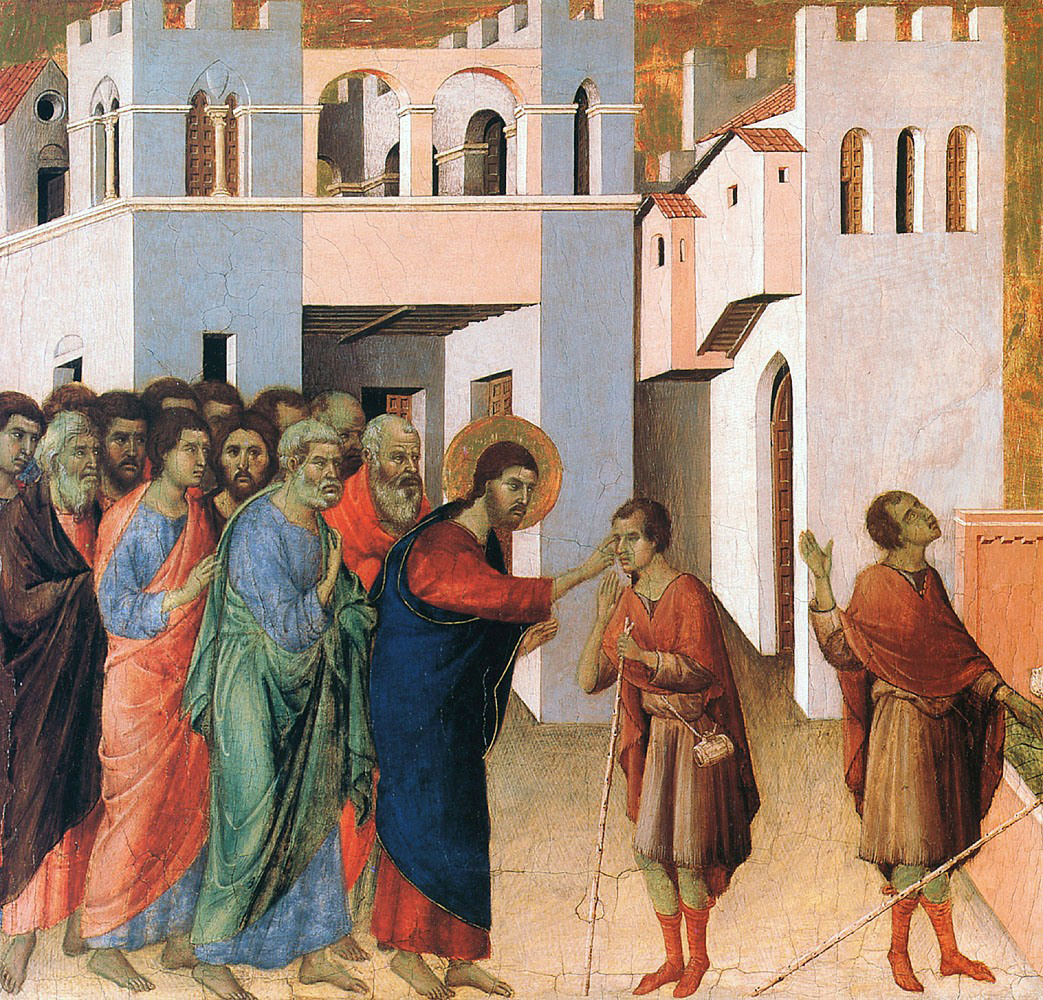
Image Credit: Duccio di Buoninsegna ca. 1255 – 1319, The Healing of a Blind Man.
Fourth Sunday in Lent, Year A
15 March 2026
1 Samuel 16:1-13
Psalm 23
Ephesians 5:8-14
John 9:1-41
The first recorded pogrom against Jewish people occurred in the year 38 in Alexandria, Egypt. The political circumstances were somewhat complicated but the result was the torture and murder of Jews and foreigners by the thousands.
The biblical book of Esther predates the pogroms of Alexandria by about 400 years and tells a similar story. The story is set in the Persian empire. Haman is viceroy to King Ahasuerus and holds a grudge against Mordecai, Queen Esther’s cousin, because Mordecai refuses to bow to Haman on account of being a Jew. Haman perceives this to be an injury to his honour and plans to kill not just Mordecai but all Jews. Queen Esther finds the King’s ear and the plot is foiled. You likely know the story.
The festival that celebrates the foiling of the Haman’s conspiracy and the survival of the Jewish people is the festival of Purim which Jews celebrated just a couple of weeks ago. As a Jewish acquaintance said to me, “This is like many Jewish commemorations: They tried to kill us but we lived.”
Antisemitic incidents are on the rise in Canada and elsewhere. That antisemitism is too often defined as objection to the politics of the State of Israel undermines the accuracy of statistics but does not erase antisemitism, hate, or violence.
While we know that antisemitism has a long history, we do not know why it exists. And the problem with explaining its existence is that it would appear to give reasons as if there could be reasons for hate. The closest thing to an explanation of the phenomenon, without giving it legitimacy, may be to observe that Jews are a distinct community and anyone who appears different offends those who seek uniformity.
I remember Muammar, a boy of Turkish descent with limited language skills, joining our class in middle school. Finding his way was made more difficult by the fact that the school year was well under way. He was made fun of behind his back and to his face for his lack of language skills and for the fact that he smelled different. He smelled different because he ate different foods, probably much more interesting than the standard German fare. Most of us failed to see that he was just a kid like the rest of us. A child who sought community and who sought to be liked. But what we saw was difference and some of us used this difference to make us feel good about ourselves.
The story of the Man Born Blind reflects the experience of exclusion from the community that early Christians experienced when they began to follow Jesus. Following Jesus did not make their life easier but harder, which is pretty much what Jesus promises. Never does Jesus say that following him will make our life easier. In the story before us it seems clear that the Man born Blind would have had fewer troubles had he remained blind.
Yet what strikes me in the story this time is that no one rejoices at the restoration of the sight of the man who had been blind. No one is happy for him. This begins with the disciples’ apparent inability to show compassion or empathy for this man when they first encounter him. Instead they make him the object of a theological case study and ask whether he or his parents had sinned. The evangelist John lets us see the absurdity of their question by allowing us to follow it to a possible conclusion: How does one sin while floating in embryonic fluid? Yet the disciples never see the person. They only see his disability which they take to be the result of inferiority. Following this, the story turns into an interrogation of the man and we begin to get a glimpse of who in the story is blind.
As the story unfolds, we see not only exclusion of someone from the community who – as person with a disability – would have been at the margin of the community already, but we also see our own skepticism and mistrust toward difference and change. This is because we too judge others and we are reluctant to let them move outside of the places we have designated for them.
Many years ago our family worshipped at St Gregory of Nyssa Episcopal Church in San Francisco. I do not remember the whole sermon, but I remember that the priest began his sermon by saying that people say about him that he is a good judge of character. He then explained that he is a good judge of character because he is good at judging people.
I felt convicted, for I can be judgmental toward others, based solely on superficial impressions. No, I am not judgmental toward anyone who comes to see me or toward people I have a relationship with, just most everyone else. And although, I grew up in a home in which we constantly compared ourselves to others, I suspect that I am not alone in judging people.
And what’s important here is that it’s not just the others – whoever the others are – who judge, because the good guys – whoever the good guys are – do the same. It is a common human tendency that makes us all blind.
Think of how difficult it is to remember someone’s name when you meet them for the first time. It is difficult because when we meet someone for the first time, we are preoccupied with how we ourselves are perceived. We are so focused on the impression we may give that we forget to pay attention to the other. Admittedly, this discrimination against the other is neglect rather than attention, but it is born of the same anxiety. For we judge others because we constantly compare ourselves to others. And I suspect that the conversation about human sexuality was so difficult not only because it was a place in which we could appear as the defenders of what is true, regardless of which side we were on, but also because sexuality is such a strong force which we are not entirely sure of ourselves. And so by imposing judgment we dealt with our own anxiety. Consequently, in a time as confusing as ours, judgment made us feel better about ourselves.
While my own judging of others aims to erase my own insecurity, personally it is grounded also in the fact that my brother and I received little affirmation while growing up. One of my memories is of my mother complaining regularly that other parents bragged about their children. It must have made her feel inferior because she did not understand that that’s what parents, grandparents, and aunts and uncles do. They do so not because their children are better than someone else’s children but because they love them. Our mother missed who we were, and the disciples and pharisees in our story missed who the Man Born Blind was. Jesus alone saw him, understood him, and entered into relationship with him. When we judge others we miss who they are.
The writer Henri Nouwen once asked whether we can free ourselves from the need to judge others.
His answer was that this is indeed possible when we remember and claim that we are God’s beloved children, and being God’s beloved becomes our primary frame of reference. But, he wrote, “[a]s long as we continue to live as if we are what we do, what we have, and what other people think about us, we will remain filled with judgments, opinions, evaluations, and condemnations. We will remain addicted to the need to put people and things in their ‘right’ place.” Yet when we let go of the idea that our worth is based on our accomplishments or the regard others accord us, we become able let go of our need to judge.
Of course, not judging others does not mean to give up moral discernment, it only means that my worth is not pegged on being better than someone else, but to know that my worth is found in being a beloved child of God, as is my neighbour’s worth, and even my enemy’s. This no one can take away, not my own failures, nor my own decline, not even death. What does the Man Born Blind say when asked whether he is the man who used to beg? He says, “I am.” “I am” is what Jesus says in John’s Gospel.1 I am the light of the world, says Jesus. (v.5) By being in Jesus we are, we have being, we are given life everlasting, and God’s works are revealed in us. (v.3)
Amen.
1 the Bread of Life (John 6:35), the Light of the World (John 8:12), the Door (John 10:9), the Good Shepherd (John 10:11,14), the Resurrection and the Life (John 11:25), the Way and the Truth and the Life (John 14:6), the Vine (John 15:1,5).