

click to access archived live stream
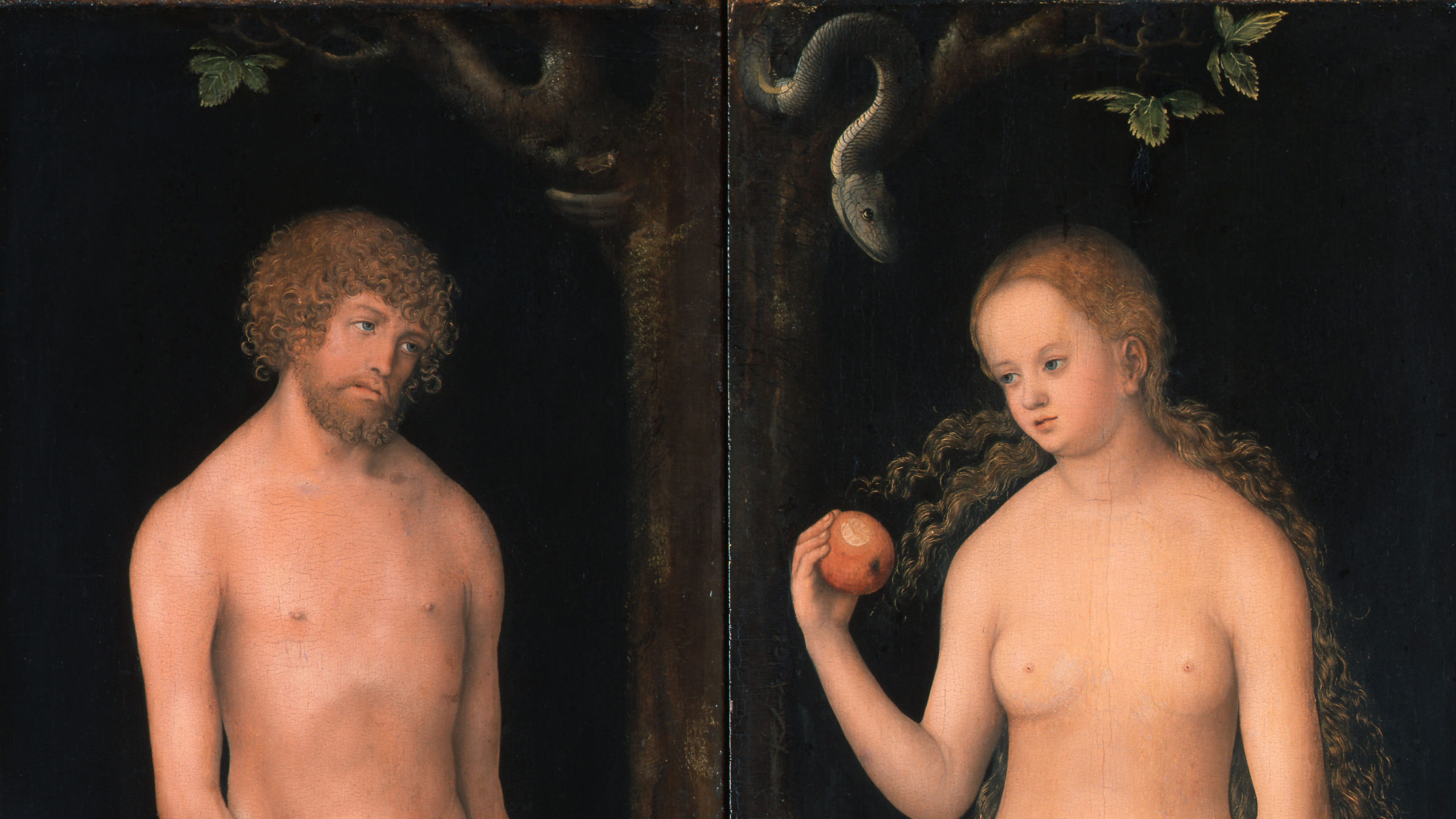
Image Credit: Adam and Eve (1518), Lucas Cranach the Elder (Oct 1472 – 16 Oct 1553). Source: Wikipedia
First Sunday in Lent, Year A
22 February 2026
Genesis 2:15-17; 3:1-7
Psalm 32
Romans 5:12-19
Matthew 4:1-11
I used to think that the Bible had two creation stories. You know, the first one is the one with the six days of creation, and the second one is the one in the garden when God creates our first ancestor, androgynous Adam, for Adam does not have a gender until the end of Genesis two when we read, Then the man said,
‘This at last is bone of my bones
and flesh of my flesh;
this one shall be called Woman,
for out of Man this one was taken.’
There is much in both stories. I have long understood the first story to be about our beginning and the world’s beginning to be in God, about the world belonging to God, and there being an order to the universe against our experience of present chaos. Now the first story ends with the Sabbath command and it has been suggested that this is the climax of that story: Don’t trust in your own strength but rest on the seventh day and in such rest you will remember that it is God who provides, not you.
The second story shows an intimacy between God and God’s creation as God walks and talks in the garden where the first people are. And so I have long understood the second story as having been written to describe our experience of separation from God, and of suffering, answering the question that if God is perfect and God created the world, why do we experience the world as imperfect. Both stories and all of Genesis 1 to 11 were written during the Babylonian Exile, in the sixth century B.C.
Today’s reading from the Old Testament is that second story. And even though the Eastern Orthodox tradition does not know the story of the Fall in the way the Western Catholic tradition does, the Orthodox theologian Alexander Schmeemann writes, “Adam, when he left the Garden where life was to have been eucharistic – an offering of the world in thanksgiving to God – Adam led the whole world, as it were, into darkness. In one of the beautiful pieces of Byzantine hymnology Adam is pictured sitting outside, facing Paradise, weeping. It is the figure of man himself.”1 Of humanity itself.
The story explains that patriarchy is not God-given but the result of human sin, that pain and death in child birth and subsistence living are equally not God’s plan or intention but the result of human sin.
While the second story certainly talks about creation, although everything except humans have been created as the story begins, it is a story that continues. The story of the Garden sets up the story of the Fall, and from the expulsion from the Garden it goes to the story of Cain and Abel, to the story of Noah and the Flood, and to the building of the Tower of Babel.
The place in which today’s reading ends suggests a personal reading of the story, with perhaps its primary message being the counsel that you and I should obey God, which includes not to misrepresent what God has said as the woman did in her answer to the snake. But this can be very personal without implications for the life of the Christian community. And if that were it, the sermon would now be done.
But there is another theme that is developed as the story of the Fall leads into the story of Cain and Abel in Genesis 4. Perhaps you remember that Abel was a keeper of sheep, and Cain a tiller of the ground. They both sacrificed to the Lord but the Lord had regard only for Abel and his sacrifice. This leads to jealousy and resentment on the part of Cain. The Lord sees Cain’s resentment and says to Cain, sin is lurking at the door; its desire is for you, but you must master it. (Gen 4:7)
It is a peculiar passage because it is unclear why God has regard for the sacrifice of one and not the other. While God declares that Cain will be a wanderer and a fugitive, although under the sign of God’s protection, Cain goes away from the presence of the Lord (4:16) and builds a city. (4:17) A few verses later we learn that Cain becomes the ancestor of the first forger of metal (4:22) and of Lamech, the first man who responds to violence with escalating violence (4:23-24).
We now have a contrast between a garden, the Garden of Eden, and a city. Remember that these texts were written when Israel was in Babylon, the capital city of its oppressor.
Now think back to Cain as a tiller of the ground and Abel as a keeper of sheep. What does agriculture have to do with this? Hunters and gatherers were not able to store surplus. Hunters and gatherers could store surplus only in their bodies. When people began to settle, to grow crops, to irrigate fields, surplus yield required storage and the social mechanisms that made this possible.
These changes meant a shift from an egalitarian social structure of a multifamily unit to a ranked structure with a “big man” or a “chief” at the top.2 This social shift required ideological, economic, military, and political power, exactly what Israel saw in Babylon. And so cities represent empires, like the ones that enslaved God’s people twice: In Egypt and in Babylon.
We may also see the connection here to 1 Samuel when Israel demands a king in order to be like other nations. Samuel warns the people that kingship means exploitation, The king will take your sons and appoint them to his chariots and to be his horsemen, and to run before his chariots; 12and he will appoint for himself commanders of thousands and commanders of fifties, and some to plough his ground and to reap his harvest, and to make his implements of war and the equipment of his chariots. 13He will take your daughters to be perfumers and cooks and bakers. 14He will take the best of your fields and vineyards and olive orchards and give them to his courtiers. 15He will take one-tenth of your grain and of your vineyards and give it to his officers and his courtiers. 16He will take your male and female slaves, and the best of your cattle and donkeys, and put them to his work. 17He will take one-tenth of your flocks, and you shall be his slaves. 18And in that day you will cry out because of your king, whom you have chosen for yourselves; but the Lord will not answer you in that day. (1 Samuel 8)
Now, returning to the loss of paradise as the consequence of Adam and Eve’s disobedience: It is clear that we cannot simply return, and the critique these chapters of Genesis offer is more than nostalgia.
The story of Noah comes next and Noah’s unique qualification to become the ancestor of a new beginning after the flood is that he walked with God. (Genesis 6:9) Noah’s walking with God stands in contrast to Cain who walked away from God’s presence. (4:16) We remember that Cain’s fratricide is the root of the spiral of human violence which leads God to regret the creation of humankind (6:6)
Noah is the alternative to the social structures enforced by violence, to social structures that stratify and share God’s bounty unevenly, even enslave. Walking with God is Noah’s distinction and is opposite of Cain who “went away from God’s presence. In Cain and in Noah, we see two different ways of life: One builds a city on one’s own initiative and names it after oneself. The other builds an “ark” at God’s command to shelter and preserve God’s creation.”3
This stands in contrast to the politics of division we see in many places, including in our own land. It stands in contrast to the singling out of minority groups in our society some seek to exclude not only from the sharing of the wealth that God has given us but in effect also from the community.
At a town hall meeting, James Talarico, the clean cut Presbyterian seminarian running for the US Senate, was asked whether he was pushing class warfare with his frequent criticisms of billionaires. Perhaps you saw the clip. He answered, “It’s the billionaires waging war against the rest of us, and right now the billionaires are winning. They’ve been winning for 50 years. Trickle-down economics is not a theory, it is theft.”4
And so the story of the Fall does not only lament our exodus from the garden, does not only urge us to live in private obedience to God, but the story as it unfolds shows us the social, economic, and political implications of sin.
The life Israel had experienced in Babylon was not unlike the life they had lived in captivity in Egypt. Throughout the Old Testament the prophets warn God’s people not to become Egypt, not to create systemic injustice, but to care for the poor, the widow, the orphan, the stranger, and to know that the earth and all that is in it is the Lord’s, and that we live not by our own labour but by God’s gracious providing.
This is a fundamentally different narrative than the narrative of ideological, economic, military, and political power on display in the life of the descendants of Adam and Eve.
While the story of the Fall is a story that describes our present condition, it also points beyond it, and in explaining what is wrong with the world, and knowing that God has not abandoned us, for though Cain went away from the face of YHWH, we know with the Psalmist that we cannot flee from God.5 In telling us about Noah the story shows us a different way, not one that will take us back into the garden but one that is characterized by walking with God, sheltering and preserving God’s creation, and a world where no one is left out, for we all are descendants of Noah, which means that we all are one family.6 This is true even outside of the Garden.
Amen.
1 See That inner world and its joy. Unfortunately quoted without source attribution, but found elsewhere as well.
2 See Wes Howard-Brook, “Come Out, My People!” God’s Call out of Empire in the Bible and Beyond, Maryknoll, NY: 2010 Orbis Books.
3 Ibid. page 44
4 ‘Billionaires Are Waging War Against the Rest of Us’: James Talarico Responds to Class Warfare Accusations
5 Psalm 139
6 This sermon is indebted to the theological work of Wes Howard-Brook, “Come Out, My People!” God’s Call out of Empire in the Bible and Beyond, Maryknoll, NY: 2010 Orbis Books and to a lesser extent to the work of James L. Kugel’s How to Read the Bible – A guide to Scripture Then and Now, New York, NY: 2007 Free Press.