

click to access archived live stream
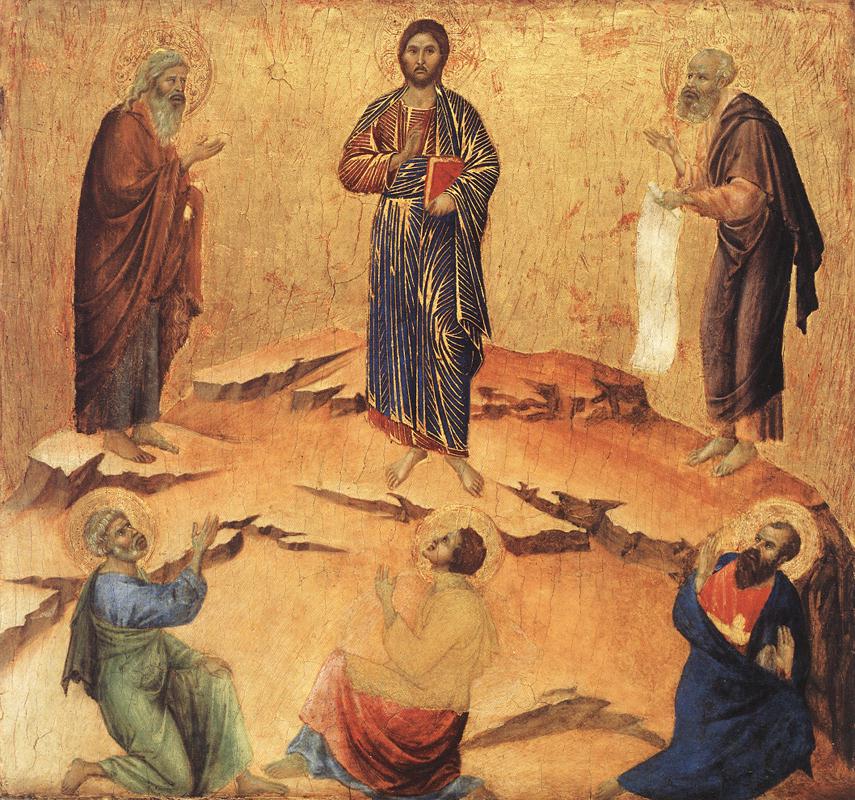
Image Credit: Transfiguration by Duccio (di Buoninsegna), c. 1255/1260 – c. 1318/1319)
Panel from the Maesta altarpiece of Siena 1308-1311. Source: Wikipedia
The Transfiguration of Our Lord, Year A
15 February 2026
Exodus 24:12-18
Psalm 2 or Psalm 99
2 Peter 1:16-21
Matthew 17:1-9
This has been a hard week for our family, it always is this time in February. Tuesday six years ago was the day our son Elias died.
Of course, there is joy as well, for there would be no grief was there not also love and joy.
The unspeakable tragedy in Tumbler Ridge hit us like it hit all of us, though, I think, as people who have lost a child we felt particularly close to the pain. You will not be surprised to learn that I will not be on this afternoon’s Zoom call with our church across this land.
Grief can become all consuming, so much so that we become blind to the love and joy we were given by those we mourn, and blind to everything else. And at first, this is normal, once the shock is gone, the shock in which the death of our loved one seemed unreal to us, thus enabling us to go on and function and do the things that needed to be done. Once the shock is gone, there is initially just the depth of our loss. But while the loss will remain, as time goes on it must not make us blind to everything else, to the outpouring of love and sympathy, to the kind words spoken, to compassion where we may not have expected it, not to how a tragedy can be hijacked for political gain. I am grateful that all federal political leaders attended the vigil in Tumbler Ridge.
This may be an odd beginning to a sermon on the Transfiguration of Our Lord, for the Transfiguration seems all about glory, about Jesus being the window to the glory of God, and the communion with not just Moses and Elijah, but the people of God, with the Old Testament. And so we maybe inclined to not want to mention tragedy and pain, and perhaps we have come to church to escape it, though turning off our TV or computer may be the best remedy for that. But of course, there is no escape, for the Lord we worship did not escape human sin and suffering but entered into it. And when all was done, Jesus came down from the mountain.
The transfiguration seems a strange story, after all it is the story of the encounter with God. The disciples are overcome by fear, as in all biblical encounters with God. In Hebrews we learn that [i]t is a fearful thing to fall into the hands of the living God. (10:31) The scholar Rudolf Otto described the encounter with the Holy as tremendum et fascinosum (mysterium tremendum et fascinans), as that to which we are innately drawn but that which also frightens us, as in all biblical vocation stories those who are called initially resist, as Peter does in the story of the great catch, ‘Go away from me, Lord, for I am a sinful man!’ (Luke 5:8)
This is the experience of Peter, James, and John on the mountain, even if disguised by Peter seeking to freeze the moment. Yet Moses and Elijah disappear, instead the voice from heaven that had already appeared at Jesus’s baptism says, This is my Son, the Beloved; with him I am well pleased; listen to him! And so this is not about a mystical experience, though it may be that, but it is about the affirmation of Jesus by the Father and the command to listen to Jesus, that is to be obedient to Jesus, and only to him.
Such obedience includes the Sermon on the Mount and the call to take up our cross, just spoken to the disciples a few verses before, ‘If any want to become my followers, let them deny themselves and take up their cross and follow me. 25For those who want to save their life will lose it, and those who lose their life for my sake will find it. 26For what will it profit them if they gain the whole world but forfeit their life? Or what will they give in return for their life? (chapter 16)
And so we see that the story of the transfiguration is not about some esoteric experience removed from the world and from our lives, but it is the affirmation of Jesus’s ministry as he turns toward the cross, and it is the call to the Church to follow him.
The scholar Frederick Dale Bruner sums it up in this way, “On the mountaintop we learn who has supreme power in the church; on the walk down we learn that suffering is the form this power takes; and at the foot of the mountain we learn how disciples put Jesus’ power to work in the world.”1
There are no simple answers to why there is suffering in the world, though we know that the world we live in is fallen. There will be answers coming forward as we try to understand what happened in Tumbler Ridge and what may have prevented it, but none of these answers will be enough, for they will not bring back any loved ones, nor will they erase the trauma of the survivors.
What speaks to us most clearly at this time, is that Jesus did not remain on the mountain but came down with his disciples and to his disciples to take up his cross. What matters is that the cross is the shape that God’s power and love take in the world, and that those who listen to Jesus follow in the way of the cross, that is, they stand with those who suffer, they do not grandstand, but help carry the burdens of others.
There is a beautiful scene in our passage we may have missed for all the glory. It is when [the disciples] (…) fell to the ground and were overcome by fear in response to the voice from heaven. Matthew tells us that Jesus came and touched them, saying, “Get up and do not be afraid.”
The word from heaven combined with the touch of Jesus prefigures Christian worship, for in our worship we hear the Word, the voice of Jesus, and we receive the touch of Jesus in the sacrament of the altar. And the way we interact with each other can be expression of God’s touch. It is meaningful to me that all our federal leaders held hands at the vigil.
Frederick Dale Bruner says that “the entire gospel is present in this verse, that Jesus came and touched them, saying, “Get up and do not be afraid.” The whole gospel is present for the church believes that in the coming of the person and ministry of Jesus God himself ‘came upon us, gripped us, and told us to get up on our feet and not be afraid anymore’ (…) “for Jesus shines not just to shine, not just to impress, not even in the final analysis (…) to make us obedient and trembling, but especially to help us up, to put us on our feet, to enable us to breathe again so that we can be obedient to his Word, can ‘Listen to him.’”2
And helping others up onto their feet and enabling them to breathe again, is essential to the ministry of the church, for it is resurrection, the resurrection the transfiguration hints at, even at the threshold of the way to the cross.
Amen.
1 Frederick Dale Bruner, Matthew – A Commentary, Volume 2: The Church Book, Matthew 13-28, Eerdmans: 2004 Grand Rapids, MI, page 164
2 Ibid. 179